

Space Exploration News – Latest Headlines
 Subscribe to our Space Exploration News feed
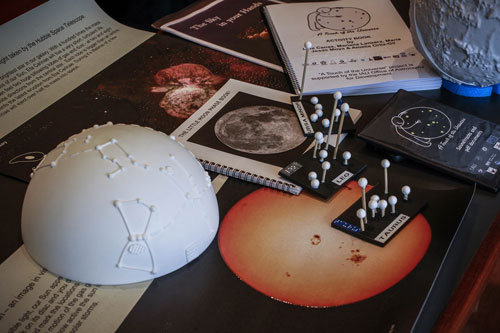
A touch of the Universe
The Astronomic Observatory of the University of Valencia has undertaken this year the project 'A touch of the Universe', a non-profit mission that aims to create thirty kits with tactile astronomical activities for children with visual difficulties.
December 12, 2013 Read more
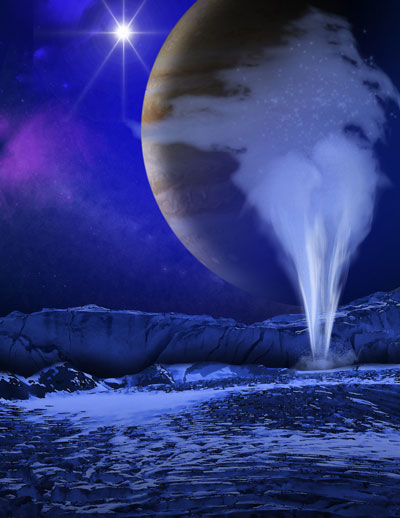
Hubble Space Telescope sees evidence of water vapor venting off Jovian moon
NASA's Hubble Space Telescope has observed water vapor above the frigid south polar region of Jupiter's moon Europa, providing the first strong evidence of water plumes erupting off the moon's surface.
December 12, 2013 Read more
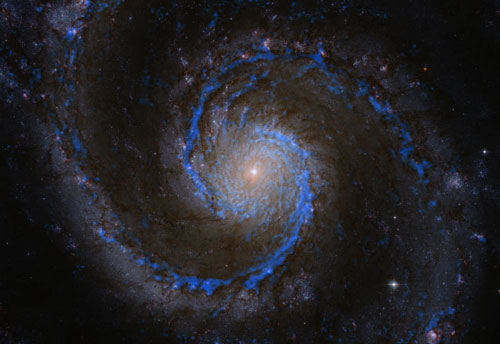
In the stellar delivery room
Molecular clouds in the whirlpool galaxy appear to be embedded in fog, whose pressure is crucial in determining the birth of suns.
December 11, 2013 Read more
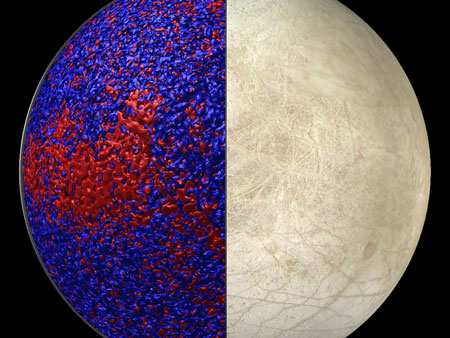
The heat pump in Europa's ocean
Researchers model currents beneath the frozen surface of Jupiter's moon.
December 10, 2013 Read more
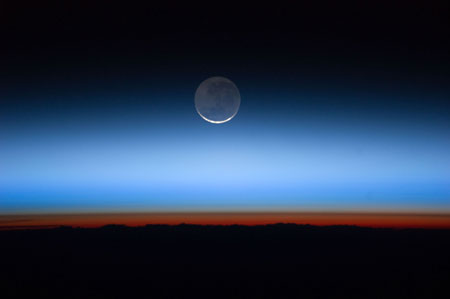
Astronomers solve temperature mystery of planetary atmospheres
An atmospheric peculiarity the Earth shares with Jupiter, Saturn, Uranus and Neptune is likely common to billions of planets, University of Washington astronomers have found, and knowing that may help in the search for potentially habitable worlds.
December 10, 2013 Read more
Early Universe less dusty than thought
Dust may be more rare than expected in galaxies of the early Universe, according to an international research team, led by Swinburne University of Technology astrophysicist Dr David Fisher.
December 10, 2013 Read more
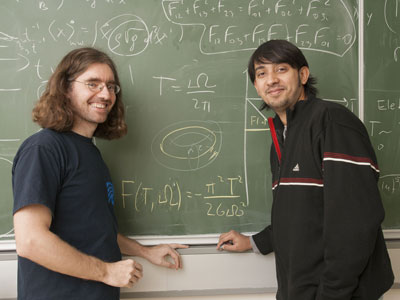
Recipe for a Universe
Apply heat and stir; an expanding universe can emerge in a remarkably simple way, say scientists.
December 10, 2013 Read more
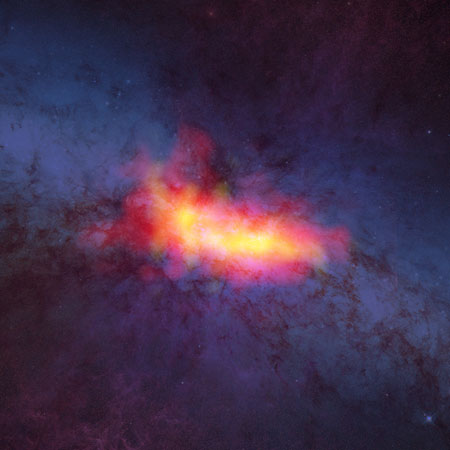
Hidden details revealed in nearby starburst galaxy
Using the new, high-frequency capabilities of the National Science Foundation's Robert C. Byrd Green Bank Telescope, astronomers have captured never-before-seen details of the nearby starburst galaxy M82. These new data highlight streamers of material fleeing the disk of the galaxy as well as concentrations of dense molecular gas surrounding pockets of intense star formation.
December 9, 2013 Read more
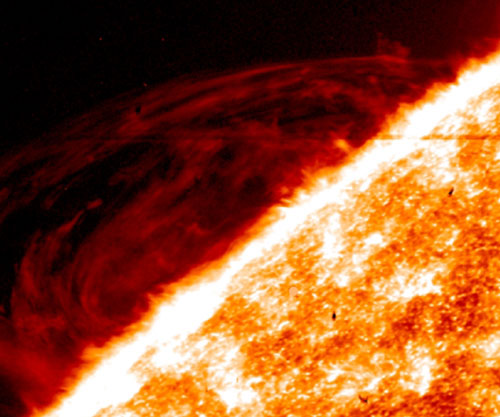
IRIS provides unprecedented images of Sun
The region located between the surface of the sun and its atmosphere has been revealed as a more violent place than previously understood, according to images and data from NASA's newest solar observatory, the Interface Region Imaging Spectrograph, or IRIS.
December 9, 2013 Read more
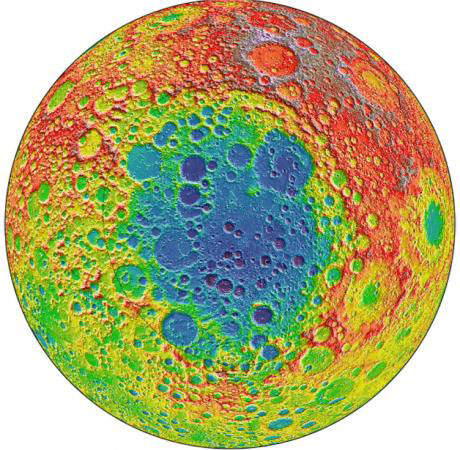
Ancient crater may be clue to Moon's mantle
A massive impact on the Moon about 4 billion years ago left a 2,500-mile crater, among the largest known craters in the solar system. Smaller subsequent impacts left craters within that crater. Comparing the spectra of light reflected from the peaks of those craters may yield clues to the composition of the Moon's lower crust and mantle - and would have implications for models of how the Moon formed.
December 9, 2013 Read more
Unique model simulates electron environment in space at 36000 km above the Earth
A spacecraft at near-Earth orbit is continuously bombarded by charged particles. Finnish Meteorological Institute has developed a unique model that simulates electron environment in the near-Earth space.
December 9, 2013 Read more

Goddard planetary instruments score a hat trick
Planetary instruments from NASA's Goddard Space Flight Center in Greenbelt, Md., hit the trifecta on Dec. 4, running three experiments of the same kind at different places in space.
December 6, 2013 Read more
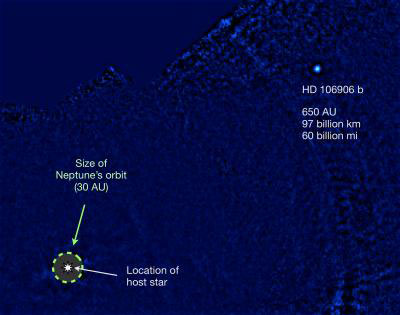
Astronomers discover planet that shouldn't be there
An international team of astronomers, led by a University of Arizona graduate student, has discovered the most distantly orbiting planet found to date around a single, sun-like star. Weighing in at 11 times Jupiter's mass and orbiting its star at 650 times the average Earth-Sun distance, planet HD 106906 b is unlike anything in our own Solar System and defies current planet formation theories.
December 5, 2013 Read more
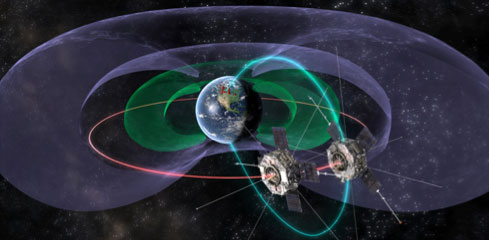
CERN, eat your heart out? Researchers identify an interstellar particle accelerator
By analyzing data from NASA's Van Allen probes, U of A physicist Ian Mann and colleagues at NASA and other institutes, have been able to measure and identify the 'smoking gun' of a planetary scale process that accelerates particles to speeds close to the speed of light within the Van Allen radiation belt.
December 5, 2013 Read more
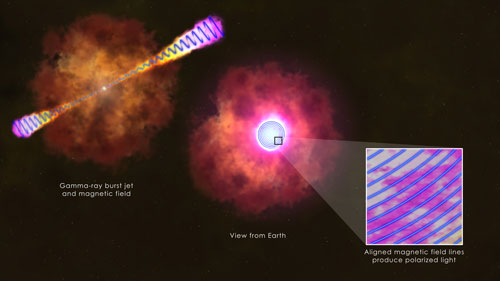
Glimpsing the infrastructure of a gamma-ray burst jet
A new study using observations from a novel instrument provides the best look to date at magnetic fields at the heart of gamma-ray bursts, the most energetic explosions in the universe. An international team of astronomers from Britain, Slovenia and Italy has glimpsed the infrastructure of a burst's high-speed jet.
December 4, 2013 Read more
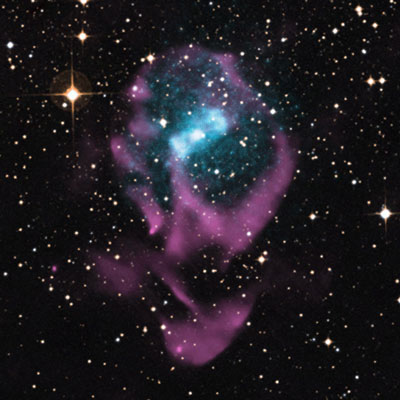
A blast from its past dates the youngest neutron-star binary
X-rays streaming toward Earth from the region near a neutron star that is cannibalizing its companion star have revealed the pair to be the youngest "X-ray binary" yet known. The discovery, by a team that includes a Penn State astronomer, also solves a long-unsolved mystery about this record-breaking object, named Circinus X-1.
December 4, 2013 Read more
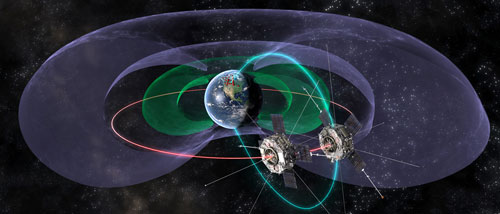
Mysteries of Earth's radiation belts uncovered by NASA twin spacecraft
Just over a year since launch, NASA's Van Allen Probes mission continues to unravel longstanding mysteries of Earth's high-energy radiation belts that encircle our planet and pose hazards to orbiting satellites and astronauts.
December 4, 2013 Read more
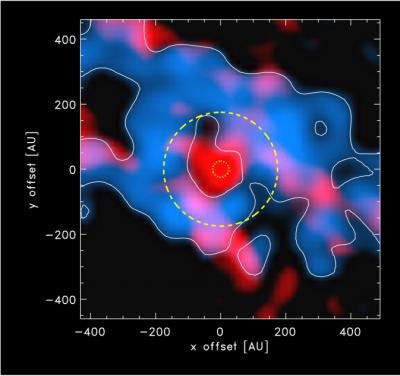
Explosive growth of young star
A star is formed when a large cloud of gas and dust condenses and eventually becomes so dense that it collapses into a ball of gas, where the pressure heats the matter, creating a glowing gas ball - a star is born. New research from the Niels Bohr Institute, among others, shows that a young, newly formed star in the Milky Way had such an explosive growth, that it was initially about 100 times brighter than it is now.
December 4, 2013 Read more