

Space Exploration News – Latest Headlines
 Subscribe to our Space Exploration News feed
The day NASA's Fermi dodged a 1.5-ton bullet (w/ video)
While Fermi is in fine shape today, continuing its mission to map the highest-energy light in the universe, the story of how it sidestepped a potential disaster offers a glimpse at an underappreciated aspect of managing a space mission: orbital traffic control.
May 1, 2013 Read more
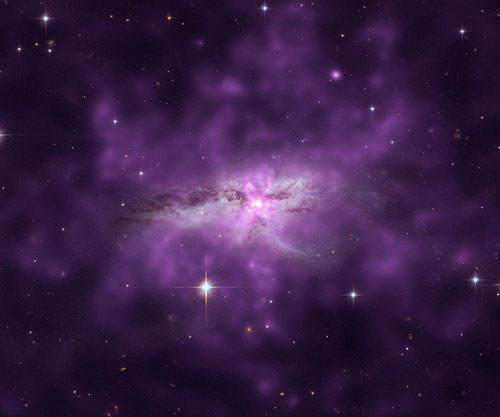
Colossal hot cloud envelopes colliding galaxies
Scientists have used Chandra to make a detailed study of an enormous cloud of hot gas enveloping two large, colliding galaxies. This unusually large reservoir of gas contains as much mass as 10 billion Suns, spans about 300,000 light years, and radiates at a temperature of more than 7 million degrees.
April 30, 2013 Read more
Saturn's youthful appearance explained
As planets age they become darker and cooler. Saturn however is much brighter than expected for a planet of its age - a question that has puzzled scientists since the late 1960s. New research has revealed how Saturn keeps itself looking young and hot.
April 30, 2013 Read more
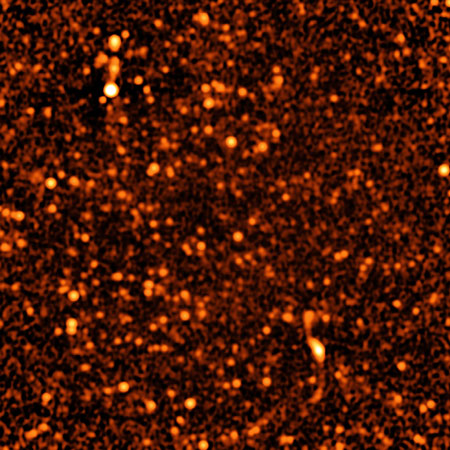
VLA gives deep, detailed image of distant universe
Staring at a small patch of sky for more than 50 hours with the ultra-sensitive Karl G. Jansky Very Large Array (VLA), astronomers have for the first time identified discrete sources that account for nearly all the radio waves coming from distant galaxies.
April 30, 2013 Read more
NASA and its partners solicit creative materials manufacturing solutions
NASA, the U.S. Agency for International Development (USAID), the U.S. State Department and Nike have issued a challenge to identify 10 game-changing innovations that could enable fabric systems to enhance global economic growth, drive human prosperity and replenish the planet's resources.
April 29, 2013 Read more
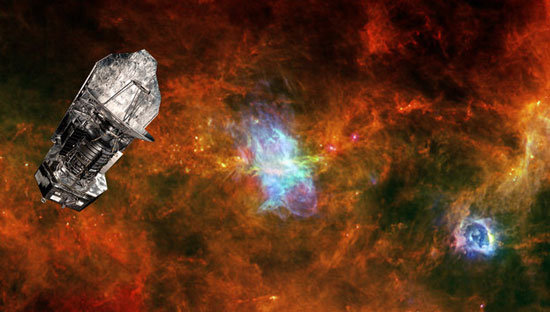
Herschel closes its eyes on the universe
ESA's Herschel space observatory has exhausted its supply of liquid helium coolant, ending more than three years of pioneering observations of the cool Universe.
April 29, 2013 Read more
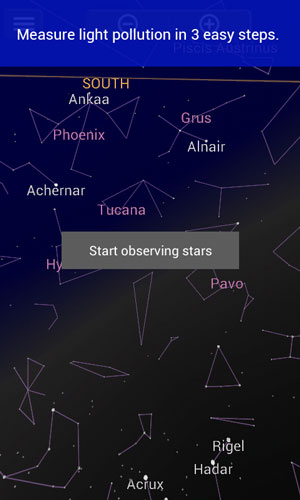
Twinkle, twinkle little star! New app measures sky brightness
Researchers from the German 'Loss of the Night' project have developed an app for Android smart phones, which counts the number of visible stars in the sky. The data from the app will be used by scientists to understand light pollution on a world wide scale.
April 29, 2013 Read more
Astronomer studies far-off worlds through 'characterization by proxy'
A University of Washington astronomer is using Earth's interstellar neighbors to learn the nature of certain stars too far away to be directly measured or observed, and the planets they may host.
April 26, 2013 Read more
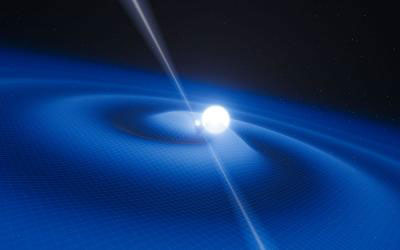
Bizarre binary star system pushes study of relativity to new limits
An international team of astronomers and an exotic pair of binary stars have proved that Albert Einstein's theory of relativity is still right, even in the most extreme conditions tested yet.
April 26, 2013 Read more
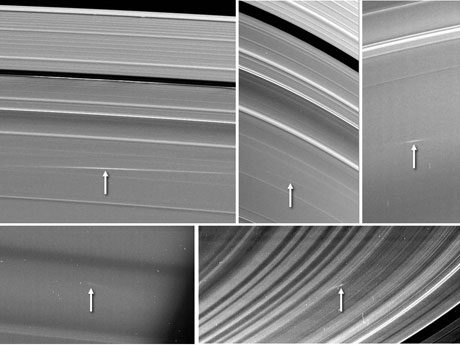
Small meteors punch through Saturn's rings
Scientists have been searching for years to find proof of small meteors that they believe have been smashing into Saturn's rings. Cornell researchers and their colleagues announced today that they now have evidence of these collisions, thanks to images of Saturn's rings taken by NASA's Cassini spacecraft.
April 25, 2013 Read more
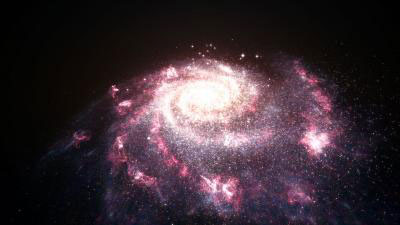
Entire galaxies feel the heat from newborn stars
When galaxies form new stars, they sometimes do so in frantic episodes of activity known as starbursts. During these bursts, hundreds of millions of stars are born, and their combined effect can drive a powerful wind that travels out of the galaxy. These winds were known to affect their host galaxy - but this new research now shows that they have a significantly greater effect than previously thought.
April 25, 2013 Read more
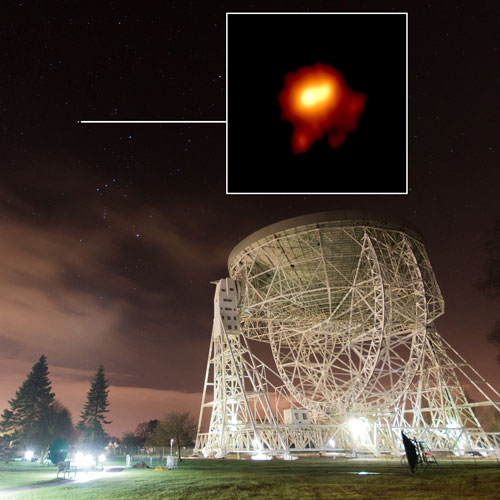
Mysterious hot spots observed in a cool red supergiant
Astronomers have released a new image of the outer atmosphere of Betelgeuse - one of the nearest red supergiants to Earth - revealing the detailed structure of the matter being thrown off the star.
April 25, 2013 Read more
Looking for life by the light of dying stars
Because it has no source of energy, a dead star - known as a white dwarf - will eventually cool down and fade away. But circumstantial evidence suggests that white dwarfs can still support habitable planets.
April 25, 2013 Read more
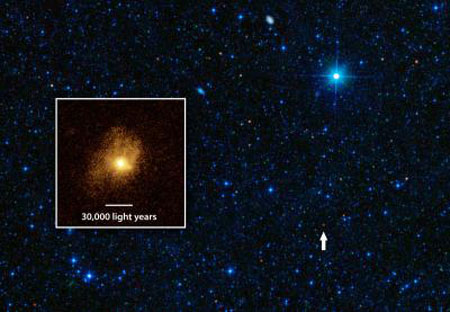
Rare galaxy found furiously burning fuel for stars
Astronomers have found a galaxy turning gas into stars with almost 100 percent efficiency, a rare phase of galaxy evolution that is the most extreme yet observed. The findings come from the IRAM Plateau de Bure interferometer in the French Alps, NASA's Wide-field Infrared Survey Explorer and NASA's Hubble Space Telescope.
April 23, 2013 Read more
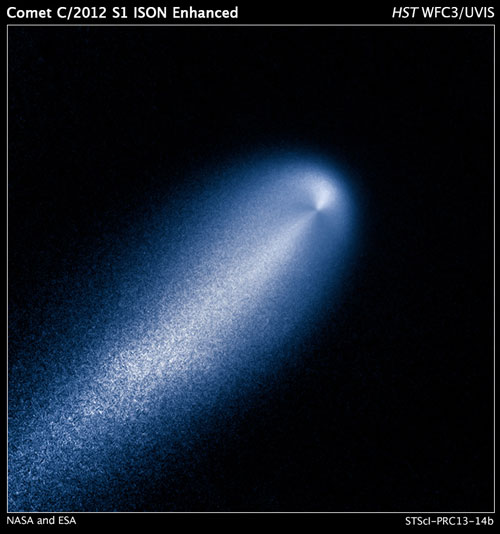
Hubble captures comet ISON
Hubble photographed a jet blasting dust particles off the sunward-facing side of the comet's nucleus. Preliminary measurements suggest that ISON's nucleus is no larger than three or four miles across.
April 23, 2013 Read more
Space scientists find way to monitor elusive collisions in space
Many collisions occur between asteroids and other objects in our solar system, but scientists are not always able to detect or track these impacts from Earth. The 'rogue debris' created by such collisions can sometimes catch us by surprise. UCLA space scientists have now devised a way to monitor these types of collisions in interplanetary space by using a new method to determine the mass of magnetic clouds that result from the impacts.
April 23, 2013 Read more
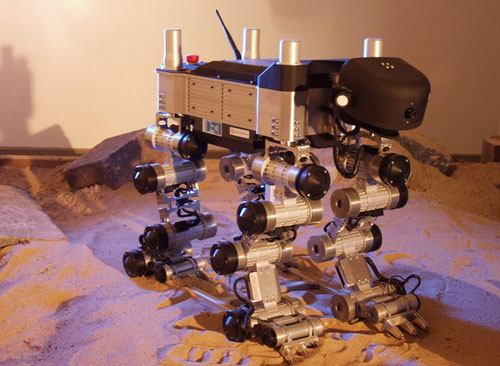
Hi-tech magnetic sensors help rovers roam around Mars
Without hi-tech magnetic sensors, rovers wouldn't be able to roam around Mars. These same sensors will soon boost terrestrial travel by improving the machinery that moulds parts for cars and aircraft here on Earth.
April 23, 2013 Read more
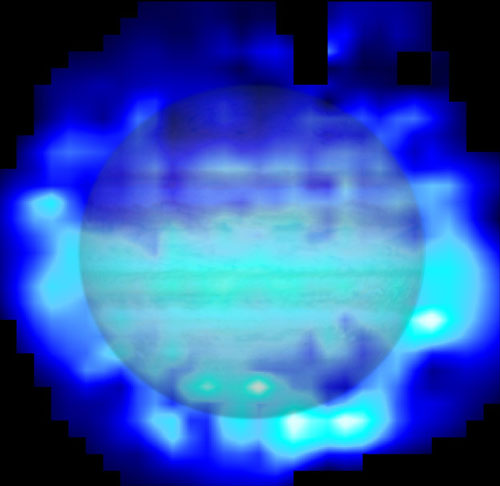
Herschel links Jupiter's water to comet impact
ESA's Herschel space observatory has solved a long-standing mystery as to the origin of water in the upper atmosphere of Jupiter, finding conclusive evidence that it was delivered by the dramatic impact of comet Shoemaker-Levy 9 in July 1994.
April 23, 2013 Read more