

Space Exploration News – Latest Headlines
 Subscribe to our Space Exploration News feed
What if extraterrestrial observers called, but nobody heard?
Researchers say the best chance for finding a signal from beyond Earth is to presume extraterrestrial observers are using the same methods to search for us that we are using to search for life beyond Earth.
March 1, 2016 Read more
Object located around a black hole 5 billion light-years from Earth has been measured
A team of researchers has accurately detected a structure in the innermost region of a quasar (small, very far objects that emit huge amounts of energy, comparable to that emitted by a whole galaxy) at a distance of more than five billion light-years from Earth.
February 25, 2016 Read more
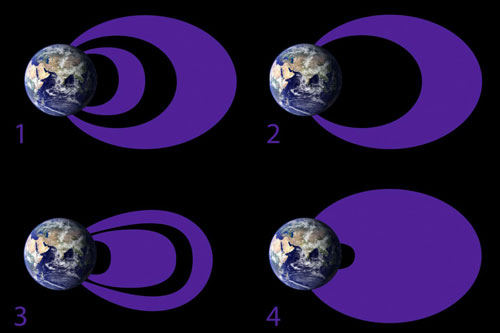
Study finds surprising variability in shape of Van Allen Belts
The shape of the two electron swarms 600 miles to more than 25,000 miles from the Earth's surface, known as the Van Allen Belts, could be quite different than has been believed for decades, according to a new study of data from NASA's Van Allen Probes.
February 24, 2016 Read more
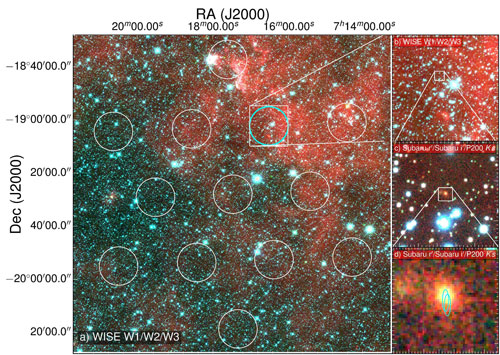
Putting the universe on the scales
Researchers used a combination of radio and optical telescopes to identify the precise location of a fast radio burst in a distant galaxy, allowing them to conduct a unique census of the Universe's matter content.
February 24, 2016 Read more
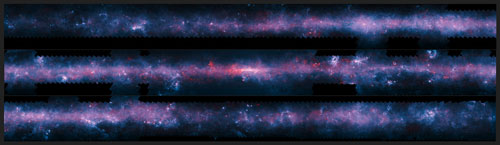
ATLASGAL survey of Milky Way completed
A spectacular image of the Milky Way has been released to mark the completion of the APEX Telescope Large Area Survey of the Galaxy (ATLASGAL). The APEX telescope has mapped the full area of the Galactic Plane visible from the southern hemisphere for the first time at submillimeter wavelengths and in finer detail than space-based surveys.
February 24, 2016 Read more
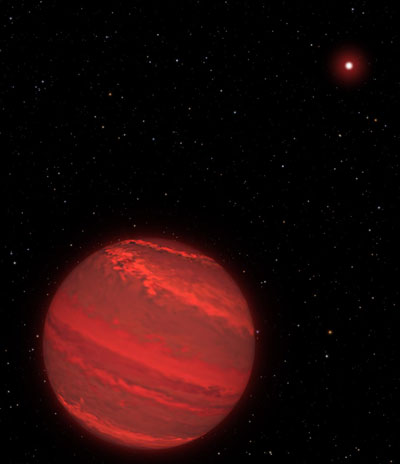
Hubble directly measures rotation of cloudy 'super-Jupiter'
Astronomers using NASA's Hubble Space Telescope have measured the rotation rate of an extreme exoplanet by observing the varied brightness in its atmosphere. This is the first measurement of the rotation of a massive exoplanet using direct imaging.
February 18, 2016 Read more
Five-dimensional black hole could 'break' general relativity
Researchers have shown how a bizarrely shaped black hole could cause Einstein's general theory of relativity, a foundation of modern physics, to break down. However, such an object could only exist in a universe with five or more dimensions.
February 18, 2016 Read more
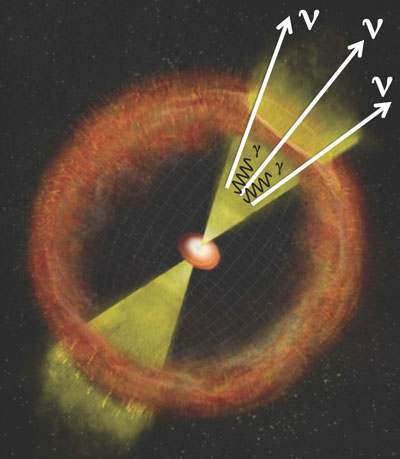
New clues in the hunt for the sources of cosmic neutrinos
The sources of the high-energy cosmic neutrinos that are detected by the IceCube Neutrino Observatory buried in the Antarctic ice may be hidden from observations of high-energy gamma rays, new research reveals. These high-energy cosmic neutrinos, which are likely to come from beyond our Milky Way Galaxy, may originate in incredibly dense and powerful objects in space that prevent the escape of the high-energy gamma rays that accompany the production of neutrinos.
February 18, 2016 Read more
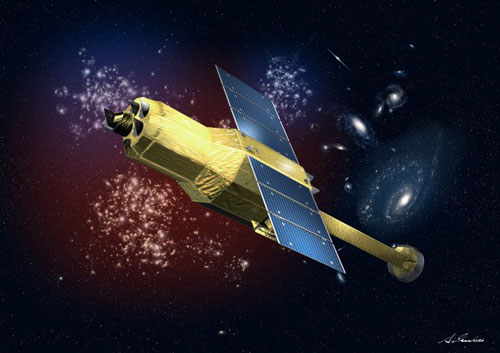
Space mission to unveil mysteries of the hot universe
The ASTRO-H X-ray space telescope mission is being launched in Japan this week.
February 12, 2016 Read more
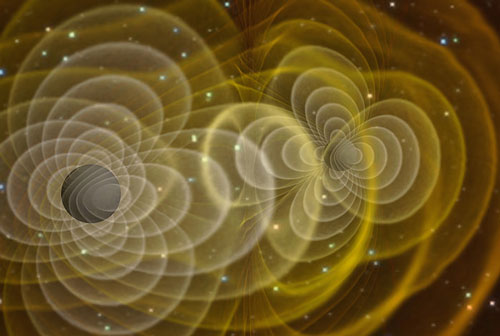
Gravitational waves found, black-hole models led the way
Gravitational waves were predicted by Einstein's theory of general relativity in 1916, and now, almost exactly 100 years later, the faint ripples across space-time have been found. The advanced Laser Interferometric Gravitational-wave Observatory (aLIGO) has achieved the first direct measurement.
February 11, 2016 Read more
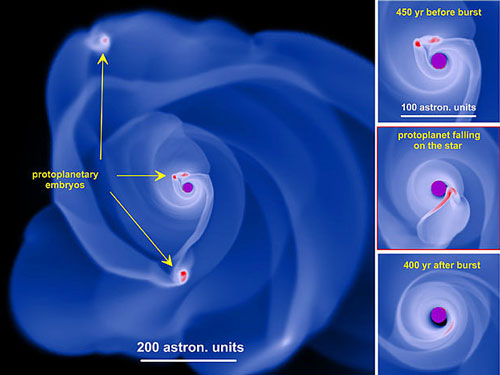
'Cannibalism' between stars
Astronomers discovered stars may not accumulate their final mass steadily, as was previously thought, but in a series of violent events manifesting themselves as sharp stellar brightening. The young FU Orionis star in the constellation of Orion is the prototype example, which showed an increase in brightness by a factor of 250 over a time period of just one year, staying in this high-luminosity state now for almost a century.
February 8, 2016 Read more
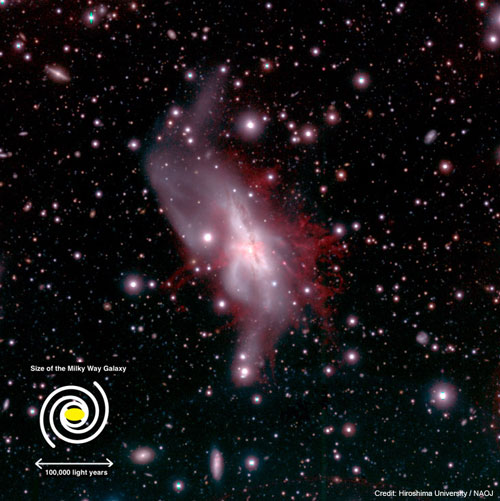
A violent wind blown from the heart of a galaxy tells the tale of a merger
Researchers have succeeded in revealing the detailed structure of a massive ionized gas outflow streaming from the starburst galaxy NGC 6240.
February 4, 2016 Read more
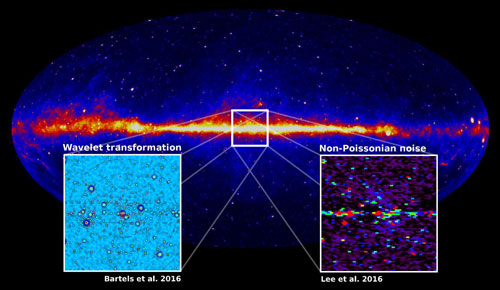
Galactic center's gamma rays unlikely to originate from dark matter, evidence shows
Bursts of gamma rays from the center of our galaxy are not likely to be signals of dark matter but rather other astrophysical phenomena such as fast-rotating stars called millisecond pulsars, according to two new studies.
February 3, 2016 Read more
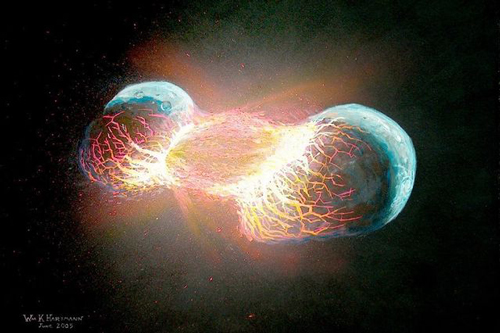
Moon was produced by a head-on collision between Earth and a forming planet
The moon was formed by a violent, head-on collision between the early Earth and a 'planetary embryo' called Theia approximately 100 million years after the Earth formed, geochemists and colleagues report.
January 29, 2016 Read more
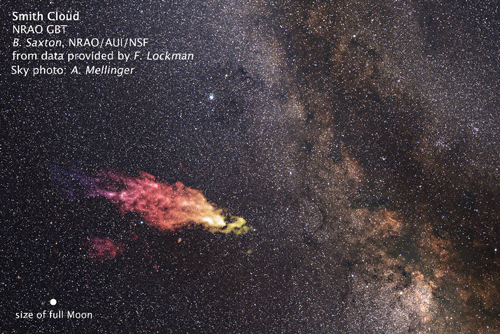
Hubble sees monstrous cloud boomerang back to our galaxy
Hubble Space Telescope astronomers are finding that the old adage 'what goes up must come down' even applies to an immense cloud of hydrogen gas outside our Milky Way galaxy. The invisible cloud is plummeting toward our galaxy at nearly 700,000 miles per hour.
January 29, 2016 Read more
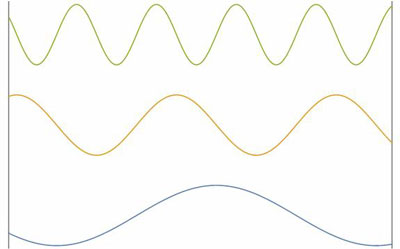
Scientists discovered ways to clock the beginning of the Universe
A new paper points out and studies a generic type of signals existing in the primordial universe models, which can be used to model-independently distinguish the inflation scenario from alternatives.
January 26, 2016 Read more
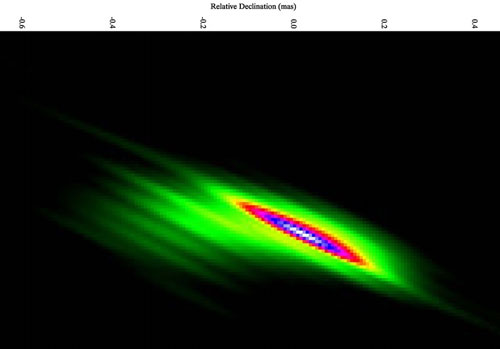
Peering into the hottest cosmic hearth
Radio astronomers gaze deep into the heart of an active galaxy.
January 26, 2016 Read more
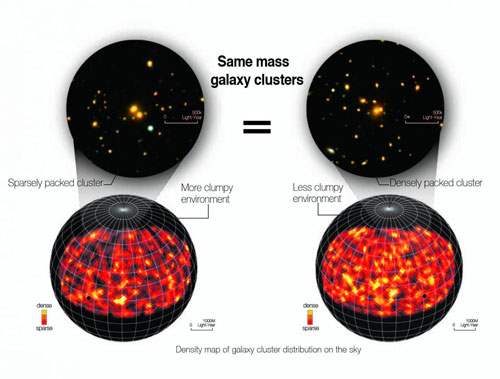
Galaxy cluster environment not dictated by its mass alone
An international team of researchers has found for the first time that the connection between a galaxy cluster and surrounding dark matter is not characterized solely by the mass of clusters, but also by their formation history.
January 25, 2016 Read more