

Space Exploration News – Latest Headlines
 Subscribe to our Space Exploration News feed
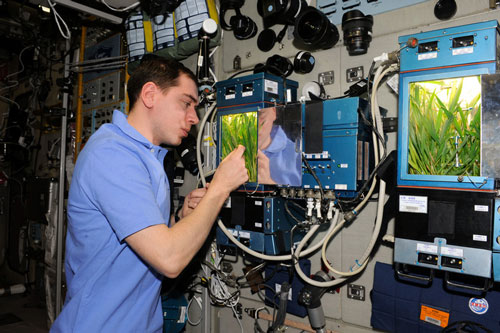
Interstellar greenhouses: how a single molecule could be key to growing plants in microgravity
A single molecule that also plays a big role in making sure plants grow on Earth, could be key to understanding how to make interstellar greenhouses successful.
June 27, 2016 Read more
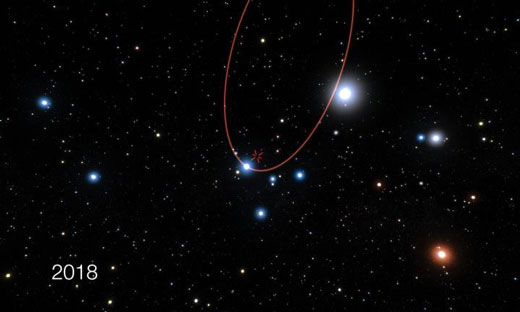
Successful first observations of galactic center
The GRAVITY instrument is now operating with the four 8.2-metre Unit Telescopes of ESO's Very Large Telescope, and even from early test results it is already clear that it will soon be producing world-class science.
June 23, 2016 Read more
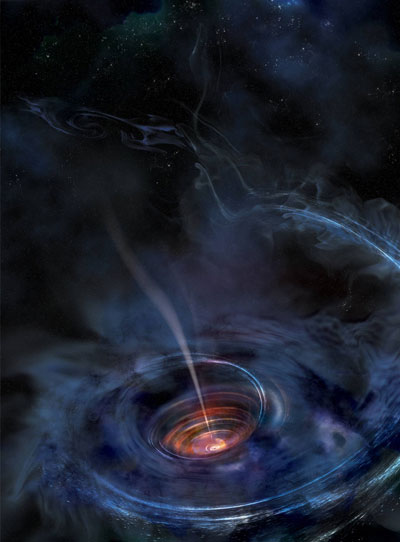
X-ray echoes of a shredded star provide close-up of 'killer' black hole (w/video)
Some 3.9 billion years ago in the heart of a distant galaxy, the intense tidal pull of a monster black hole shredded a star that passed too close. When X-rays produced in this event first reached Earth, they were detected by NASA's Swift satellite.
June 23, 2016 Read more
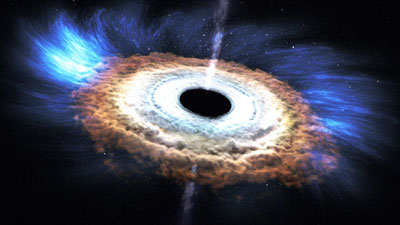
New study predicts a universe crowded with black holes
A new study presents one of the most complete models of matter in the universe and predicts hundreds of massive black hole mergers each year observable with the second generation of gravitational wave detectors.
June 23, 2016 Read more
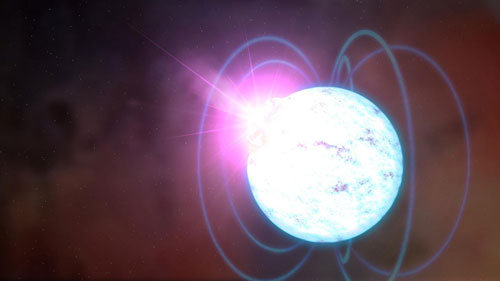
Astronomers find the first 'wind nebula' around a magnetar
Astronomers have discovered a vast cloud of high-energy particles called a wind nebula around a rare ultra-magnetic neutron star, or magnetar, for the first time. The find offers a unique window into the properties, environment and outburst history of magnetars, which are the strongest magnets in the universe.
June 21, 2016 Read more
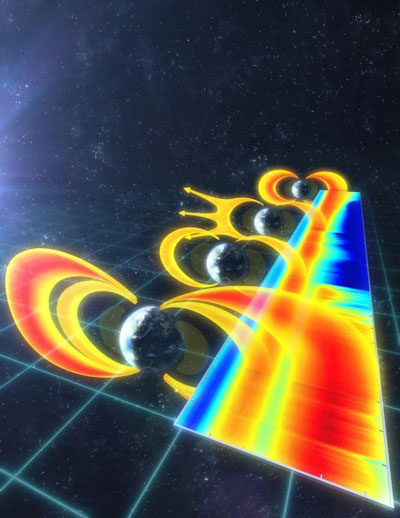
'Space tsunami' causes the third Van Allen belt
New research findings will help mitigate effects of extreme space weather.
June 20, 2016 Read more
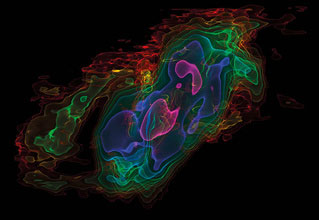
How black hole jets break out of their galaxies (w/video)
A simulation of the powerful jets generated by supermassive black holes at the centres of the largest galaxies explains why some burst forth as bright beacons visible across the universe, while others fall apart and never pierce the halo of the galaxy.
June 18, 2016 Read more

Relax, it'll be 1,500 years before aliens contact us
Deconstructing the Fermi paradox and pairing it with the mediocrity principle into a fresh equation, Cornell astronomers say extraterrestrials likely won't phone home - or Earth - for 1,500 years.
June 16, 2016 Read more
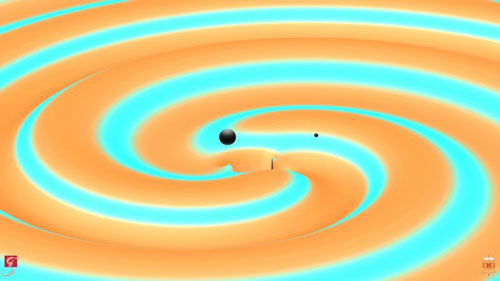
Gravitational waves 2.0
Researchers observe a signal originating from two merging black holes of about 14 and 8 solar masses.
June 15, 2016 Read more
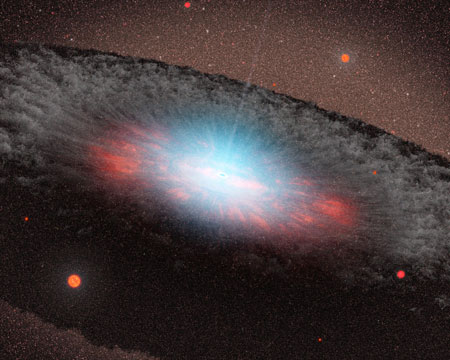
Black holes and the prospects for measuring gravitational waves
The supermassive black holes found at the centre of every galaxy, including our own Milky Way, may, on average, be smaller than we thought, according to new work.
June 15, 2016 Read more
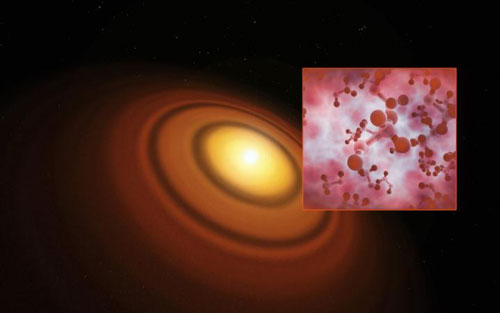
First detection of methyl alcohol in a planet-forming disc
The organic molecule methyl alcohol (methanol) has been found by the Atacama Large Millimeter/Submillimeter Array (ALMA) in the TW Hydrae protoplanetary disc. This is the first such detection of the compound in a young planet-forming disc.
June 15, 2016 Read more
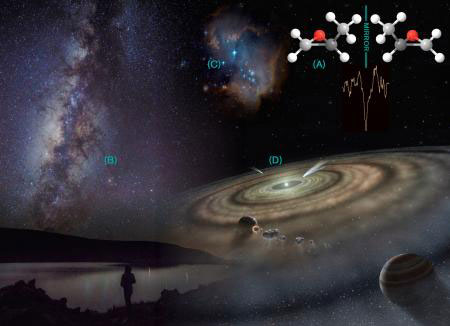
Prebiotic molecule detected in interstellar cloud
Researchers have detected, for the first time, a chiral molecule outside of our solar system, bringing them one step closer to understanding one of the most puzzling mysteries of the early origins of life.
June 14, 2016 Read more
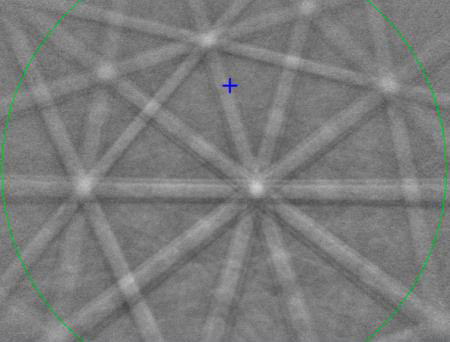
Natural quasicrystals may be the result of collisions between objects in the asteroid belt
Naturally formed quasicrystals - crystal-like solids with supposedly impossible symmetries - are among the rarest structures on Earth. Only two have ever been found.
June 14, 2016 Read more
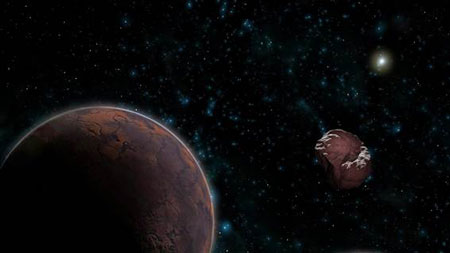
Extreme trans-Neptunian objects lead the way to Planet Nine
Astronomers have confirmed, with new calculations, that the orbits of the six extreme trans-Neptunian objects that served as a reference to announce the existence of Planet Nine are not as stable as it was thought.
June 13, 2016 Read more
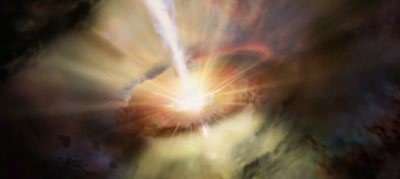
Black hole fed by cold intergalactic deluge
An international team of astronomers has witnessed a cosmic weather event that has never been seen before.
June 9, 2016 Read more
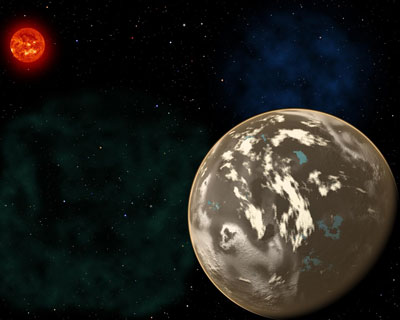
Universe's first life might have been born on carbon planets
New research suggests that planet formation in the early universe might have created carbon planets consisting of graphite, carbides, and diamond. Astronomers might find these diamond worlds by searching a rare class of stars.
June 7, 2016 Read more
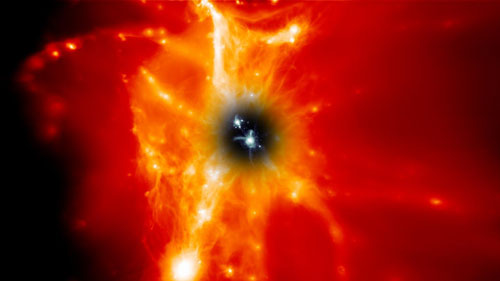
'Wasteful' galaxies launch heavy elements into surrounding halos and deep space
Galaxies 'waste' large amounts of heavy elements generated by star formation by ejecting them up to a million light years away into their surrounding halos and deep space, according to a new study.
June 6, 2016 Read more
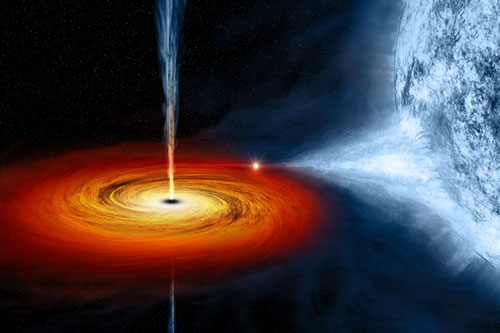
A method to image black holes (w/video)
New algorithm could stitch together astronomical measurements made across the globe.
June 6, 2016 Read more