

Space Exploration News – Latest Headlines
 Subscribe to our Space Exploration News feed
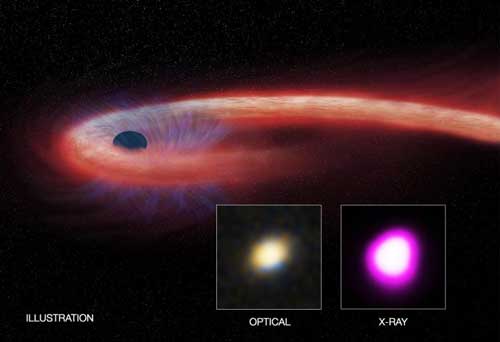
A black hole feeding frenzy that breaks records
A giant black hole ripped apart a nearby star and then continued to feed off its remains for close to a decade, according to new research. This black hole meal is more than 10 times longer than any other previous episode of a star's death.
February 7, 2017 Read more
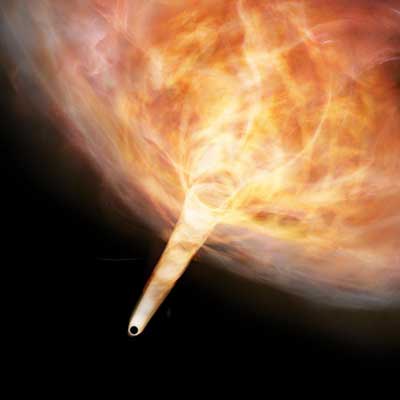
Tail of stray black hole hiding in the Milky Way
By analyzing the gas motion of an extraordinarily fast-moving cosmic cloud in a corner of the Milky Way, astronomers found hints of a wandering black hole hidden in the cloud. This result marks the beginning of the search for quiet black holes; millions of such objects are expected to be floating in the Milky Way although only dozens have been found to date.
February 2, 2017 Read more
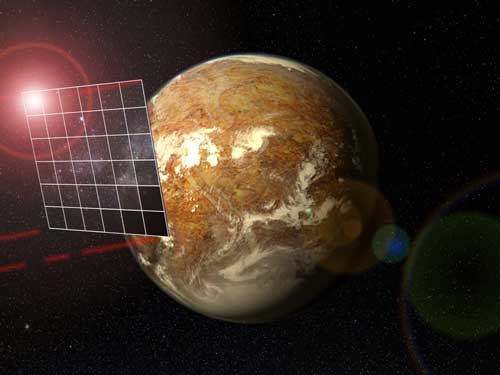
Full braking at Alpha Centauri (w/video)
Space travel visionaries solve the problem of interstellar slowdown at our stellar neighbour.
February 1, 2017 Read more
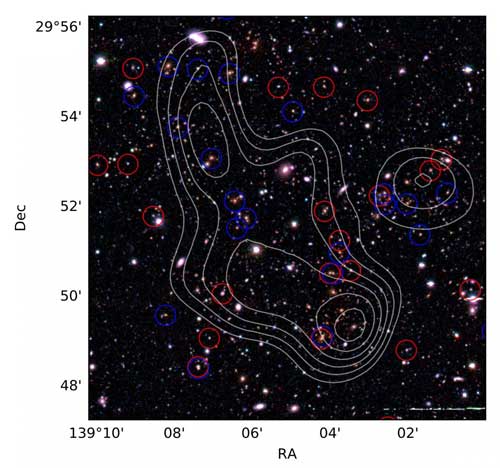
Tracing the cosmic web with star-forming galaxies in the distant universe
A research group has revealed a picture of the increasing fraction of massive star-forming galaxies in the distant universe. Massive star-forming galaxies in the distant universe, about 5 billion years ago, trace large-scale structure in the universe. In the nearby universe, about 3 billion years ago, massive star-forming galaxies are not apparent.
January 31, 2017 Read more
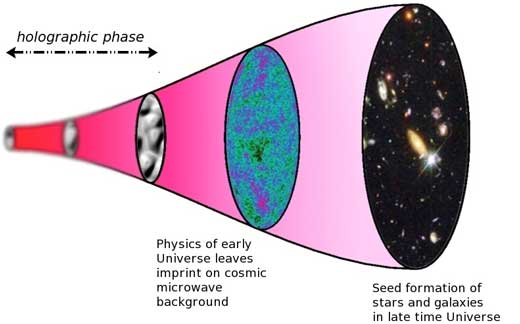
Study reveals substantial evidence of holographic universe
A new study has provided what researchers believe is the first observational evidence that our universe could be a vast and complex hologram.
January 30, 2017 Read more
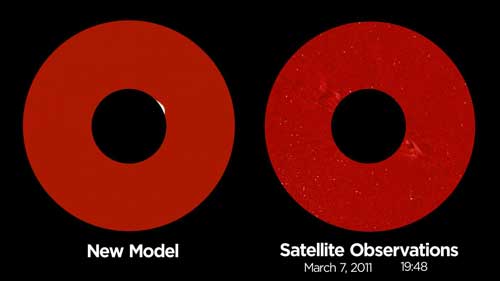
New space weather model helps simulate magnetic structure of solar storms
A new tool called EEGGL - short for the Eruptive Event Generator (Gibson and Low) and pronounced 'eagle' - helps map out the paths of these magnetically structured clouds, called coronal mass ejections or CMEs, before they reach Earth.
January 26, 2017 Read more
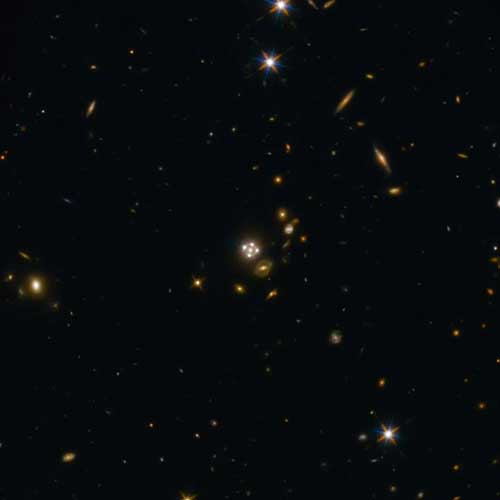
Cosmic lenses support findings on accelerated universe expansion
A group of astronomers used the NASA/ESA Hubble Space Telescope and other telescopes in space and on the ground to observe five galaxies in order to arrive at an independent measurement of the Hubble constant.
January 25, 2017 Read more
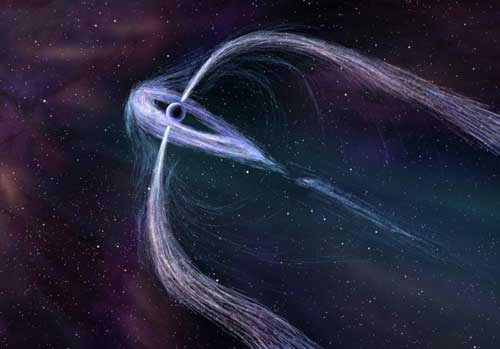
A tale of two pulsars' tails: Plumes offer geometry lessons to astronomers
Two new studies may help shine a light on the distinctive emission signatures of pulsars, as well as their often perplexing geometry.
January 17, 2017 Read more
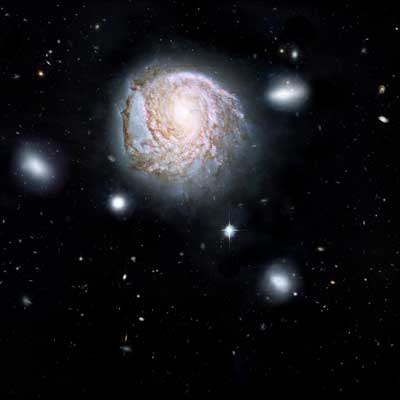
Galaxy murder mystery
It's the big astrophysical whodunnit. Across the Universe, galaxies are being killed and the question scientists want answered is, what's killing them?
January 17, 2017 Read more
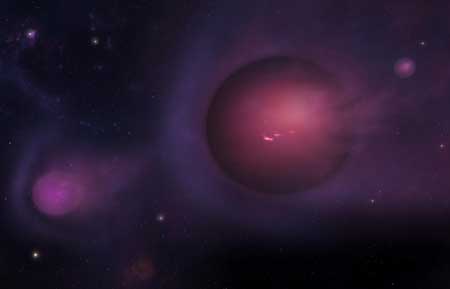
Our galaxy's black hole is spewing out planet-size 'spitballs'
If a star wanders too close to the black hole at the center of the Milky Way, the black hole's powerful gravity rips the star apart, sending a long streamer of gas whipping outward. New research shows that not only can the gas gather itself into planet-size objects, but those objects then are flung throughout the galaxy in a game of cosmic 'spitball'.
January 11, 2017 Read more
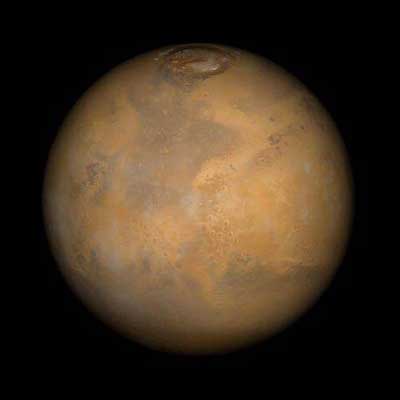
Looking for life in all the right places - with the right tool
Scientists have developed a new tool that can look for signs of life with 10,000 times more sensitivity than instruments carried on previous spaceflight missions.
January 11, 2017 Read more
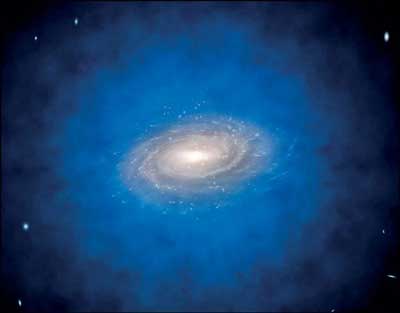
Struggle to escape distant galaxies creates giant halos of scattered photons
Astronomers have discovered giant halos around early Milky Way type galaxies, made of photons that have struggled to escape them.
January 11, 2017 Read more
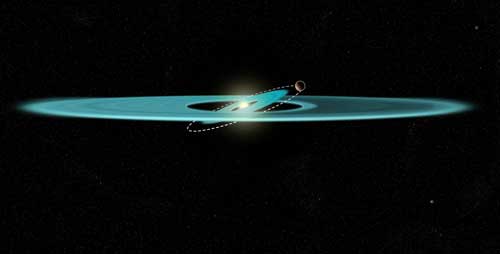
Hubble captures 'shadow play' caused by possible planet
Searching for planets around other stars is a tricky business. They're so small and faint that it's hard to spot them. But a possible planet in a nearby stellar system may be betraying its presence in a unique way: by a shadow that is sweeping across the face of a vast pancake-shaped gas-and-dust disk surrounding a young star.
January 10, 2017 Read more
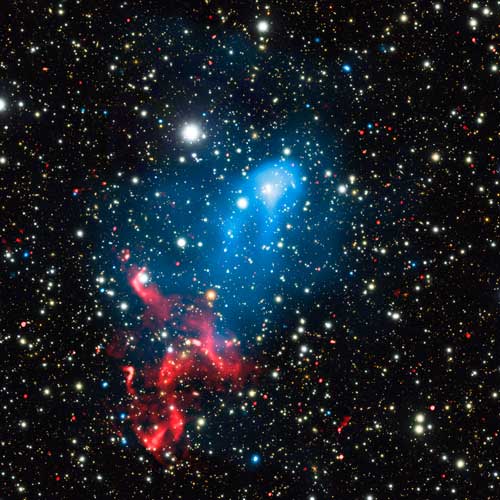
Astronomers discover cosmic double whammy
Two of the most powerful phenomena in the Universe - a supermassive black hole and the collision of giant galaxy clusters - have combined to create a stupendous cosmic particle accelerator.
January 6, 2017 Read more
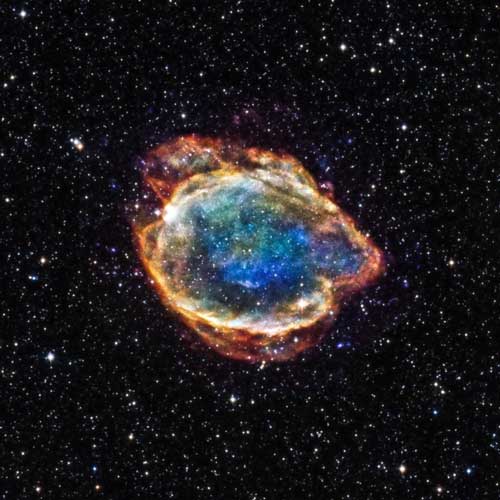
Research reinforces role of supernovae in clocking the universe
New research by cosmologists confirms the accuracy of Type Ia supernovae in measuring the pace at which the universe expands. The findings support a widely held theory that the expansion of the universe is accelerating and such acceleration is attributable to a mysterious force known as dark energy.
January 4, 2017 Read more
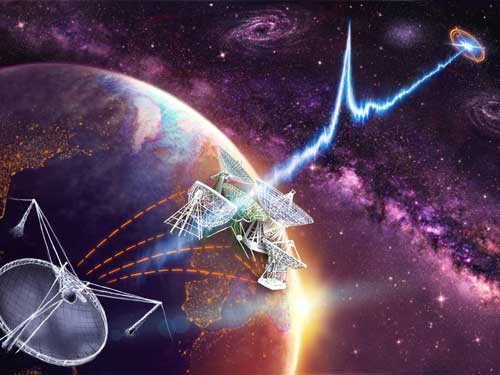
Home galaxy of a fast radio burst identified
Astronomers pinpoint radio flashes originating in a far away galaxy.
January 4, 2017 Read more
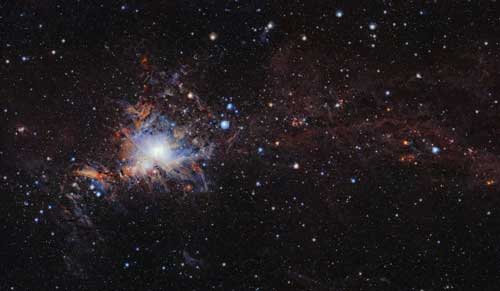
Hidden secrets of Orion's clouds
VISTA survey gives most detailed view of Orion A molecular cloud in the near-infrared.
January 4, 2017 Read more
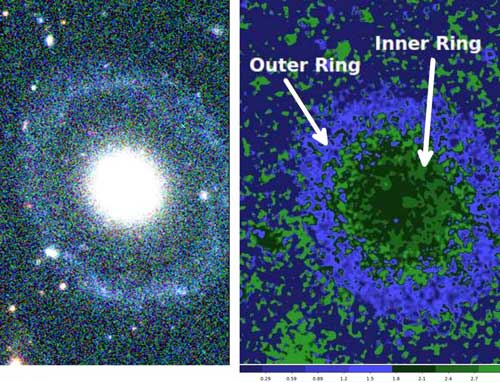
Researchers get first look at new, extremely rare galaxy
Approximately 359 million light-years away from Earth, there is a galaxy with an innocuous name (PGC 1000714) that doesn't look quite like anything astronomers have observed before. New research provides a first description of a well-defined elliptical-like core surrounded by two circular rings - a galaxy that appears to belong to a class of rarely observed, Hoag-type galaxies.
January 4, 2017 Read more