

Space Exploration News – Latest Headlines
 Subscribe to our Space Exploration News feed
Celestial flybys set to thrill
Astronomers are gearing up for thrills this year when Earth gets buzzed by two rogue asteroids and two comets, including a wanderer last seen by the forerunners of mankind.
January 6, 2013 Read more
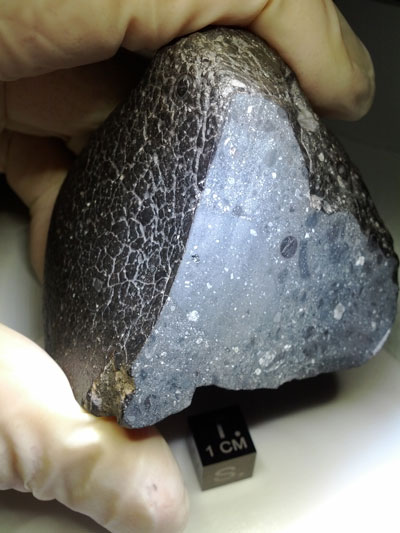
Researchers identify water rich meteorite linked to Mars crust
NASA-funded researchers analyzing a small meteorite that may be the first discovered from the Martian surface or crust have found it contains 10 times more water than other Martian meteorites from unknown origins.
January 4, 2013 Read more
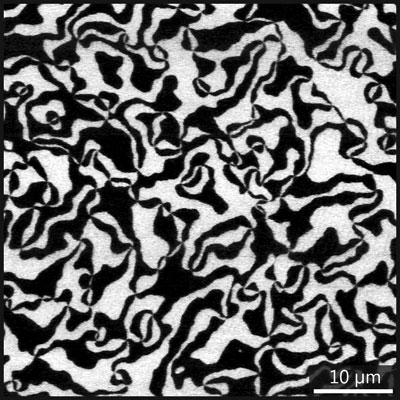
Big Bang under the microscope
Scientists have replaced the telescope by the microscope: Using the similarities between the structure of a crystal and the state of the cosmos in the early universe, they have explored a yet unconfirmed phenomenon, the formation of cosmic strings. These so-called "topological defects" are believed to have formed as the universe expanded shortly after the Big Bang.
January 4, 2013 Read more
Astronomers estimate that at least 100 billion planets populate the galaxy
Look up at the night sky and you'll see stars, sure. But you're also seeing planets - billions and billions of them. At least. That's the conclusion of a new study by astronomers at Caltech that provides yet more evidence that planetary systems are the cosmic norm.
January 3, 2013 Read more
Astrophysicists make stellar discovery about galaxies far, far away
A new study observes 13 smaller satellite galaxies orbiting around the immense Andromeda galaxy in a way similar to how the planets in our solar system orbit around the sun. The galaxies are orbiting on a thin, pancake-like plane at a scale 900 million times larger than our own solar system.
January 3, 2013 Read more
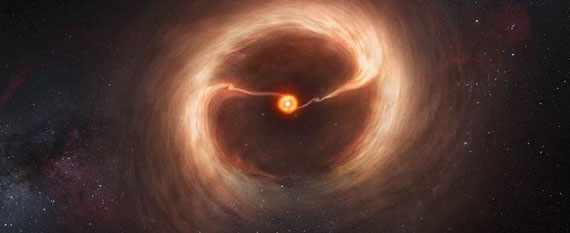
ALMA sheds light on planet-forming gas streams
Tantalizing signs of flows feeding gas-guzzling giant planets.
January 2, 2013 Read more
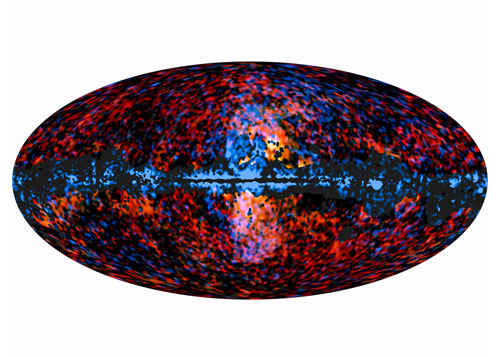
Galactic geysers fuelled by star stuff
Enormous outflows of charged particles from the centre of our Galaxy, stretching more than halfway across the sky and moving at supersonic speeds, have been detected and mapped with CSIRO's 64-m Parkes radio telescope.
January 2, 2013 Read more
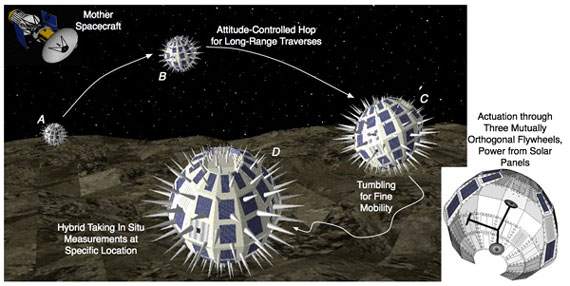
Robotic platform that could take space exploration to new heights
An autonomous system for exploring the solar system's smaller members, such as moons and asteroids, could bring us closer to a human mission to Mars.
January 2, 2013 Read more
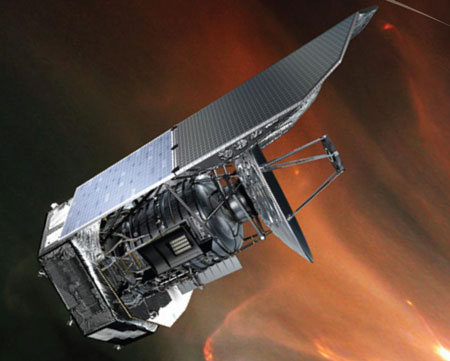
A eulogy to Herschel
With its 2160 litres of liquid helium about to run out, the Herschel Space Observatory will, by the end of March, become just another piece of space junk.
January 2, 2013 Read more
Study shows space travel is harmful to the brain
As if space travel was not already filled with enough dangers, a new study shows that cosmic radiation - which would bombard astronauts on deep space missions to places like Mars - could accelerate the onset of Alzheimer's disease.
January 2, 2013 Read more
Magnetic fields created before the first stars: Physicist calculates field strengths in the early universe
Researchers describe a new mechanism for the magnetisation of the universe even before the emergence of the first stars.
January 2, 2013 Read more
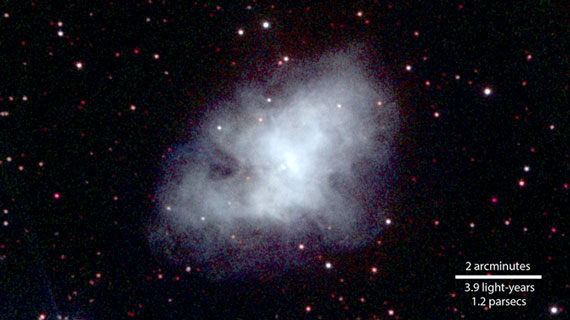
An image gallery gift from NASA's Swift satellite
Of the three telescopes carried by NASA's Swift satellite, only one captures cosmic light at energies similar to those seen by the human eye. Although small by the standards of ground-based observatories, Swift's Ultraviolet/Optical Telescope (UVOT) plays a critical role in rapidly pinpointing the locations of gamma-ray bursts (GRBs), the brightest explosions in the cosmos.
December 29, 2012 Read more
NASA encourages public to explore its curiosity with new rover-themed badge on Foursquare
NASA and the mobile application Foursquare have teamed up to help the public unlock its scientific curiosity with a new rover-themed Curiosity Explorer badge.
December 28, 2012 Read more
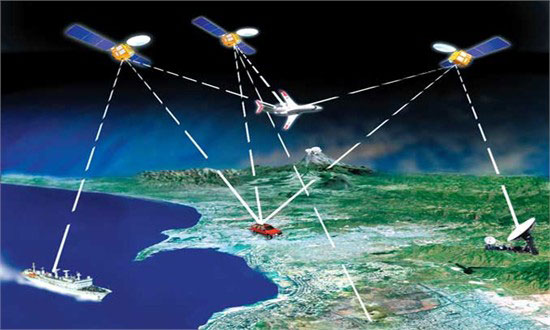
China launches rival GPS satellite system
China has launched commercial and public services across the Asia-Pacific region on its domestic satellite navigation network built to rival the US global positioning system.
December 28, 2012 Read more
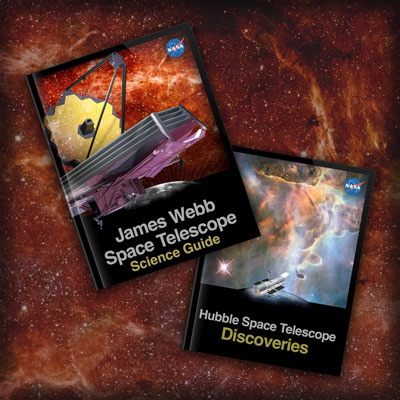
New free e-books available about two famous NASA space telescopes
NASA's Hubble Space Telescope has been providing astounding images of the universe since April 1990 and has led to remarkable discoveries. NASA's James Webb Space Telescope is the next-generation telescope that will peer even deeper into space and unveil even more mysteries. Both of these extraordinary telescopes are now the topics of two free e-books available from the Apple iBookstore.
December 22, 2012 Read more
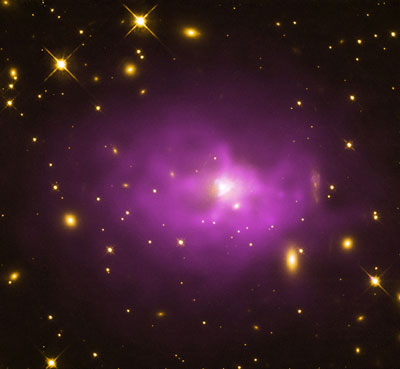
From super to ultra: Just how big can black holes get?
Some of the biggest black holes in the Universe may actually be even bigger than previously thought, according to a study using data from NASA's Chandra X-ray Observatory.
December 21, 2012 Read more
Clays on Mars: More plentiful than expected
A new study indicates that clay minerals, rocks that usually form when water is present for long periods of time, cover a larger portion of Mars than previously thought.
December 21, 2012 Read more
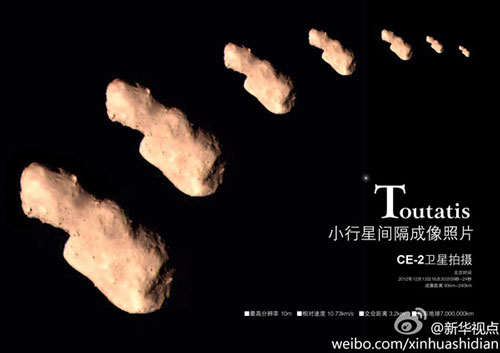
Chinese space probe flies by asteroid Toutatis
China's space probe Chang'e-2 has successfully conducted a maneuver in which it flew by the asteroid Toutatis, about seven million km away from the Earth.
December 21, 2012 Read more