

Space Exploration News – Latest Headlines
 Subscribe to our Space Exploration News feed
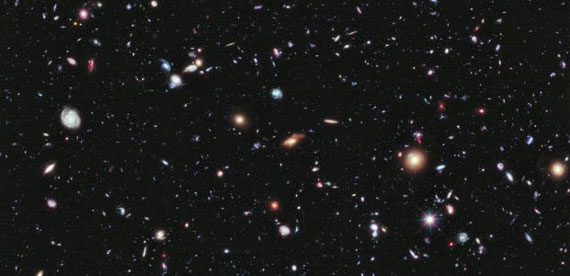
Dark energy alternatives to Einstein are running out of room
Research by University of Arizona astronomy professor Rodger Thompson finds that a popular alternative to Albert Einstein's theory for the acceleration of the expansion of the universe does not fit newly obtained data on a fundamental constant, the proton to electron mass ratio.
January 9, 2013 Read more
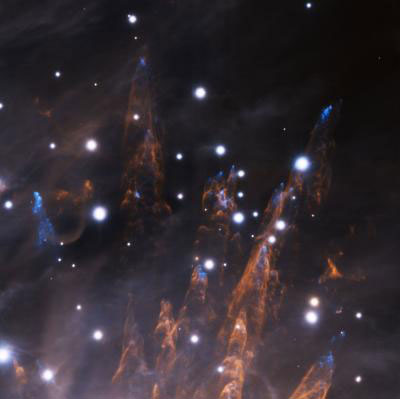
Next-generation adaptive optics brings remarkable details to light in stellar nursery
A new image released today reveals how Gemini Observatory's most advanced adaptive optics (AO) system will help astronomers study the universe with an unprecedented level of clarity and detail by removing distortions due to the Earth's atmosphere. The photo, featuring an area on the outskirts of the famous Orion Nebula, illustrates the instrument's significant advancements over previous-generation AO systems.
January 9, 2013 Read more
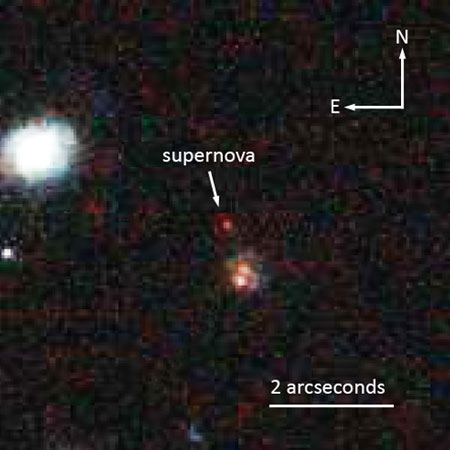
The farthest supernova yet for measuring cosmic history
Berkeley Lab-based Supernova Cosmology Project uses Hubble Space Telescope data to discover the most distant well-measured Type Ia supernova ever found.
January 9, 2013 Read more
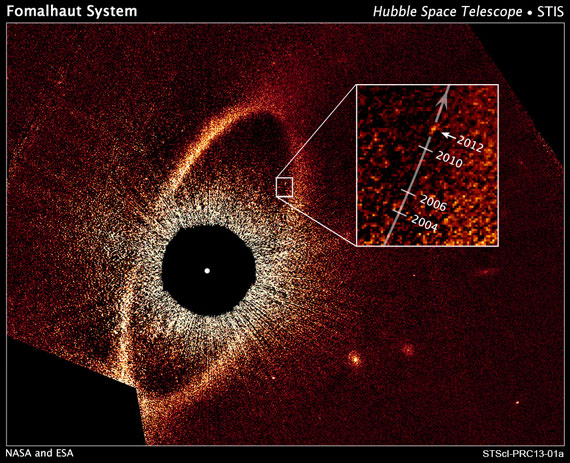
Hubble reveals rogue planetary orbit for Fomalhaut b
Newly released Hubble Space Telescope images of a vast debris disk encircling the nearby star Fomalhaut, and of a mysterious planet circling it, may provide forensic evidence of a titanic planetary disruption in the system.
January 9, 2013 Read more
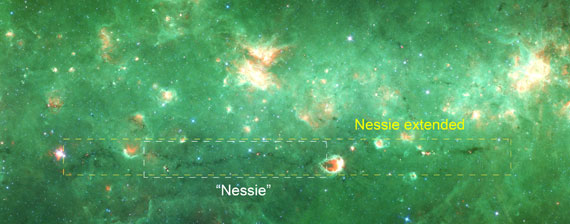
First 'bone' of the Milky Way identified
Astronomers have identified a new structure in the Milky Way: a long tendril of dust and gas that they are calling a "bone".
January 9, 2013 Read more
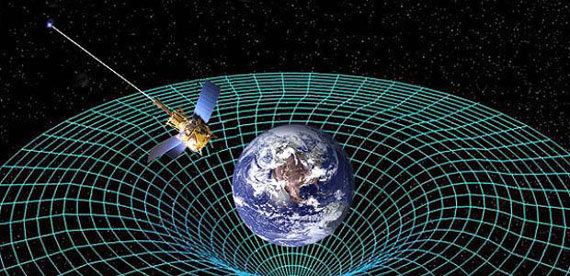
Testing Einstein's E=mc2 in outer space
UA physicist Andrei Lebed has stirred the physics community with an intriguing idea yet to be tested experimentally: The world's most iconic equation, Albert Einstein's E=mc2, may be correct or not depending on where you are in space.
January 9, 2013 Read more
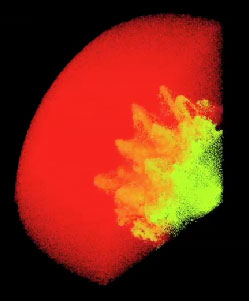
Researchers try new approach for simulating supernovas
Two University of Texas at Arlington researchers want to bridge the gap between what is known about exploding stars and the remnants left behind thousands of years later. So they're trying something new - using SNSPH, a complex computer code developed at Los Alamos National Laboratory.
January 9, 2013 Read more
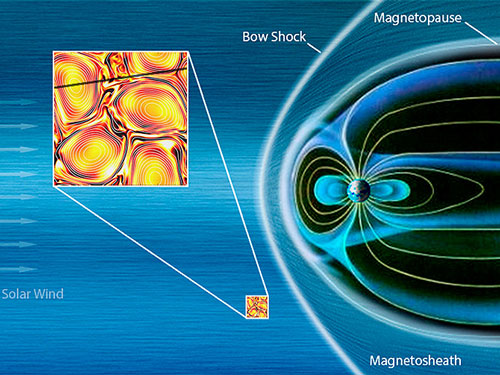
Cluster mission indicates turbulent eddies may warm the solar wind
The sun ejects a continuous flow of electrically charged particles and magnetic fields in the form of the solar wind -- and this wind is hotter than it should be. A new study of data obtained by European Space Agency's Cluster spacecraft may help explain the mystery.
January 9, 2013 Read more
New telescopes to give researchers glimpse of the beginning of time
Where do we come from? What is the universe made of? Will the universe exist only for a finite time or will it last forever? These are just some of the questions that University of California, San Diego physicists are working to answer in the high desert of northern Chile.
January 8, 2013 Read more
Simulated Mars mission reveals body's sodium rhythms
Researchers report that - in contrast to the prevailing dogma - sodium levels fluctuate rhythmically with 7-day and monthly cycles. The findings, which demonstrate that sodium is stored in the body, have implications for blood pressure control, hypertension and salt-associated cardiovascular risk.
January 8, 2013 Read more
Space sailing soon: Researchers produce one-kilometre-long electric sail tether
Using ultrasonic welding, the Electronics Research Laboratory at the University of Helsinki successfully produced a 1 km long ESAIL tether.
January 8, 2013 Read more
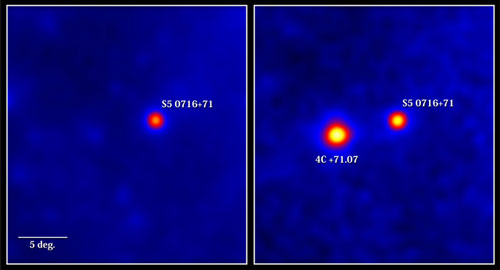
Galaxy's gamma-ray flares erupted far from its black hole
In 2011, a months-long blast of energy launched by an enormous black hole almost 11 billion years ago swept past Earth. Using a combination of data from NASA's Fermi Gamma-ray Space Telescope and the National Science Foundation's Very Long Baseline Array (VLBA), the world's largest radio telescope, astronomers have zeroed in on the source of this ancient outburst.
January 8, 2013 Read more
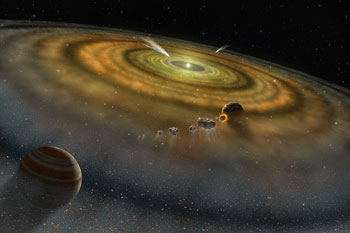
Exocomets may be as common as exoplanets
The discovery by astronomers of six likely comets around distant stars suggests that comets - dubbed "exocomets" - are just as common in other stellar systems with planets.
January 7, 2013 Read more
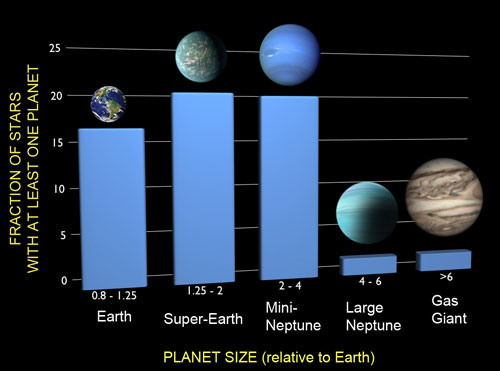
At least one in six stars has an Earth-sized planet
A new analysis of Kepler data shows that about 17 percent of stars have an Earth-sized planet in an orbit closer than Mercury. Since the Milky Way has about 100 billion stars, there are at least 17 billion Earth-sized worlds out there.
January 7, 2013 Read more
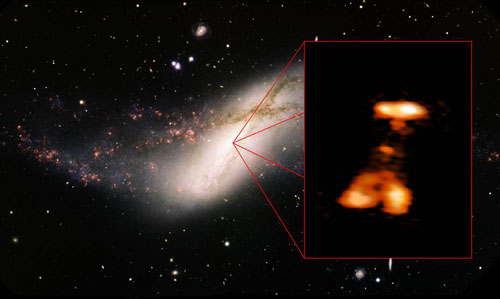
Massive outburst in neighbor galaxy surprises astronomers
Serendipitous discovery reveals probable belch by a gorging black hole.
January 7, 2013 Read more
15 new planets hint at 'traffic jam' of moons in habitable zone
Volunteers from the Planethunters.org website, part of the Oxford University-led Zooniverse project, have discovered 15 new planet candidates orbiting in the habitable zones of other stars.
January 7, 2013 Read more
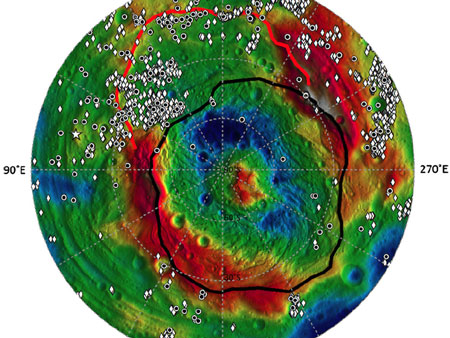
Carbon in Vesta's craters
Large impacts of asteroids may have transferred carbonaceous material to the protoplanet and inner solar system.
January 7, 2013 Read more
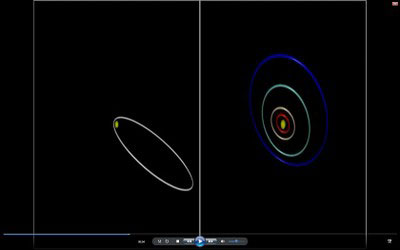
Astrophysicists find wide binary stars wreak havoc in planetary systems
An international team of astrophysicists has shown that planetary systems with very distant binary stars are particularly susceptible to violent disruptions, more so than if they had stellar companions with tighter orbits around them.
January 6, 2013 Read more