

Space Exploration News – Latest Headlines
 Subscribe to our Space Exploration News feed
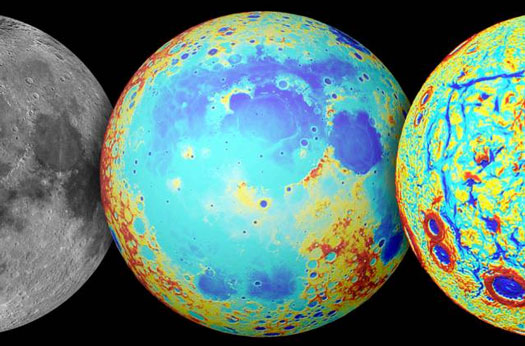
Solving the mystery of the 'man in the moon'
Researchers find that a volcanic plume, not an asteroid, likely created the moon's largest basin.
October 2, 2014 Read more
Space debris expert warns of increasing small satellite collision risk
The increasing number of small CubeSat satellites being launched combined with a relaxed attitude to debris mitigation could lead to hazards for all space users unless preventative measures are taken, warns a leading space debris expert.
September 30, 2014 Read more

Nitrogen fingerprint in biomolecules could be from early sun
Chemical fingerprints of the element nitrogen vary by extremes in materials from the molecules of life to the solar wind to interstellar dust. Ideas for how this great variety came about have included alien molecules shuttled in by icy comets from beyond our solar system and complex chemical scenarios. New experiments using a powerful source of ultraviolet light have shown that no extra-solar explanation is needed and the chemistry is straight forward.
September 30, 2014 Read more
Astronomers find 'cousin' planets around twin stars
Astronomers have found two new Jupiter-sized extra-solar planets, each orbiting one star of a binary-star system.
September 30, 2014 Read more
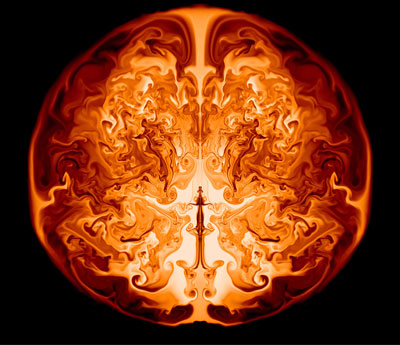
Simulations reveal an unusual death for ancient stars
Certain primordial stars - those 55,000 and 56,000 times the mass of our sun, or solar masses - may have died unusually. In death, these objects would have exploded as supernovae and burned completely, leaving no remnant black hole behind.
September 29, 2014 Read more
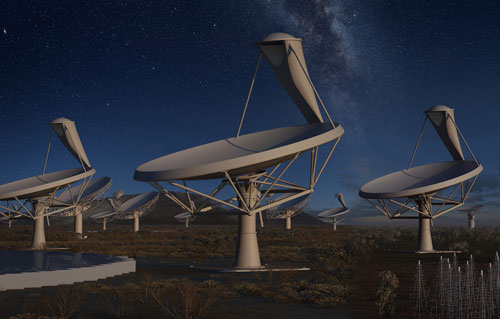
Turning the Moon into a cosmic ray detector
Scientists are to turn the Moon into a giant particle detector to help understand the origin of Ultra-High-Energy (UHE) cosmic rays - the most energetic particles in the Universe.
September 26, 2014 Read more
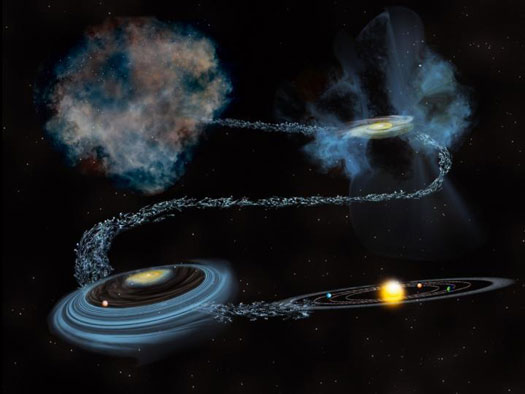
Earth's water is older than the sun
Water was crucial to the rise of life on Earth and is also important to evaluating the possibility of life on other planets. Identifying the original source of Earth's water is key to understanding how life-fostering environments come into being and how likely they are to be found elsewhere. New work found that much of our solar system's water likely originated as ices that formed in interstellar space.
September 25, 2014 Read more
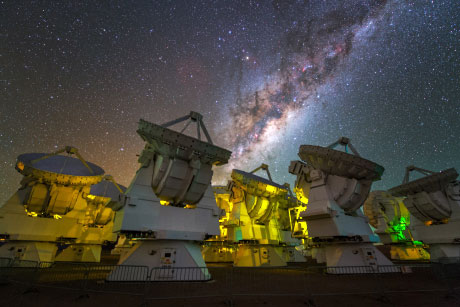
New molecule found in space connotes life origins
Hunting from a distance of 27,000 light years, astronomers have discovered an unusual carbon-based molecule contained within a giant gas cloud in interstellar space. The discovery suggests that the complex molecules needed for life may have their origins in interstellar space.
September 25, 2014 Read more
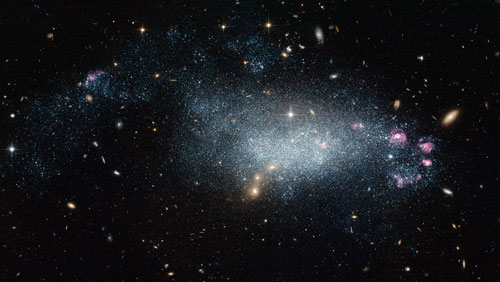
A galaxy of deception
Astronomers usually have to peer very far into the distance to see back in time, and view the Universe as it was when it was young. This new NASA/ESA Hubble Space Telescope image of galaxy DDO 68, otherwise known as UGC 5340, was thought to offer an exception. This ragged collection of stars and gas clouds looks at first glance like a recently-formed galaxy in our own cosmic neighborhood. But, is it really as young as it looks?
September 25, 2014 Read more
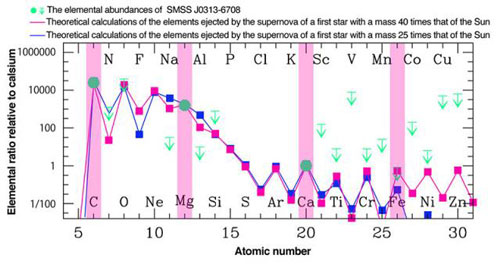
Most metal-poor star hints at universe's first supernovae
In a new study, researchers point out that the elemental abundance of the most iron-poor star can be explained by elements ejected from supernova explosions of the universe's first stars. This reveals that massive stars, which are several tens of times more immense than the Sun, were present among the first stars.
September 24, 2014 Read more
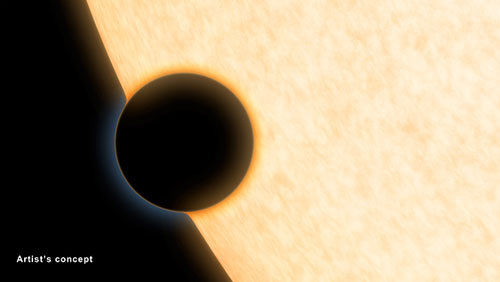
Astronomers find clear skies and water vapor on exoplanet
Astronomers using data from three space telescopes - Hubble, Spitzer and Kepler - have discovered clear skies and steamy water vapor on a gaseous planet outside our solar system. The planet is about the size of Neptune, making it the smallest planet from which molecules of any kind have been detected.
September 24, 2014 Read more
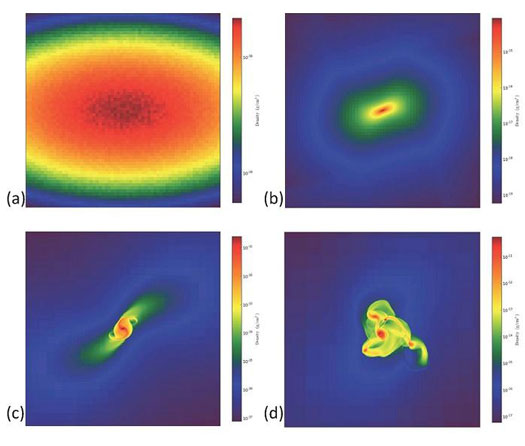
Most stars are born in clusters, some leave 'home'
New modeling studies demonstrate that most of the stars we see were formed when unstable clusters of newly formed protostars broke up. These protostars are born out of rotating clouds of dust and gas, which act as nurseries for star formation. Rare clusters of multiple protostars remain stable and mature into multi-star systems. The unstable ones will eject stars until they achieve stability and end up as single or binary stars.
September 24, 2014 Read more
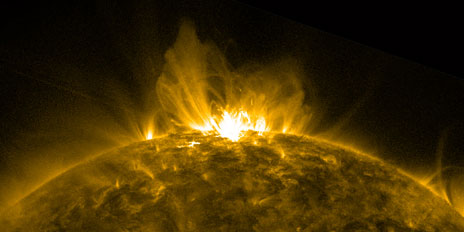
Solar explosions inside a computer
Strong solar flares can bring down communications and power grids on Earth. By demonstrating how these gigantic eruptions are caused, physicists are laying the foundations for future predictions.
September 24, 2014 Read more
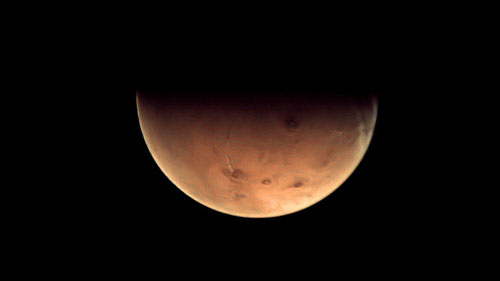
Explainer: why are countries vying for a piece of Mars?
The red planet is about to welcome a new visitor: India's Mars Orbiter Mission (MOM) is hoping to start orbiting Mars on September 24. MOM is not the only new kid in town. There are currently five operational spacecraft orbiting Mars and two rovers on its surface. China, Japan, Russia, the US and joint European countries have all tried to send missions to Mars before India. What is it about our rocky neighbour that makes it such a focus of interest?
September 23, 2014 Read more
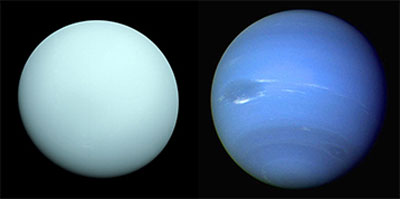
The origin of Uranus and Neptune elucidated?
Researchers have proposed a solution to the problematic chemical composition of Uranus and Neptune, thus providing clues for understanding their formation. The researchers focused on the positioning of these two outermost planets of the Solar System, and propose a new model explaining how and where they formed.
September 23, 2014 Read more
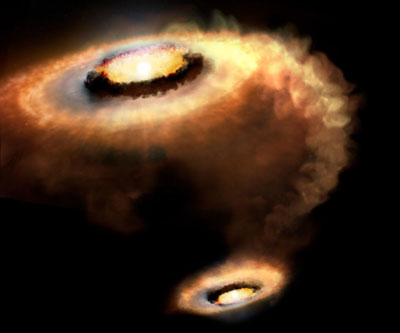
Infant solar system shows signs of windy weather
Astronomers using the Atacama Large Millimeter/submillimeter Array have observed what may be the first-ever signs of windy weather around a T Tauri star, an infant analog of our own Sun. This may help explain why some T Tauri stars have disks that glow weirdly in infrared light while others shine in a more expected fashion.
September 22, 2014 Read more
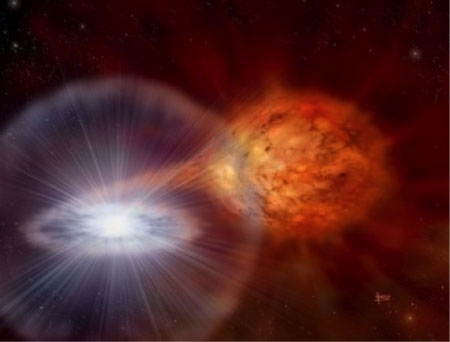
Thermonuclear X-ray bursts on neutron stars set speed record
A new study of thermonuclear X-ray bursts on neutron stars reveals that shells can be expelled at speeds up to 30% of the speed of light.
September 22, 2014 Read more
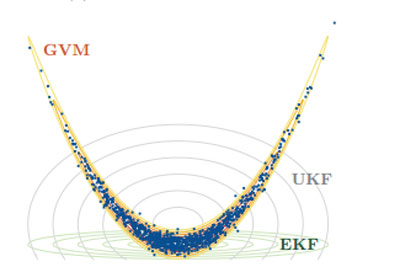
Where is that spacecraft?
Space surveillance is inherently challenging when compared to other tracking environments due to various reasons, not least of which is the long time gap between surveillance updates. Scientists propose a more statistically rigorous treatment of uncertainty in the near-Earth space environment than currently available.
September 22, 2014 Read more