

Space Exploration News – Latest Headlines
 Subscribe to our Space Exploration News feed
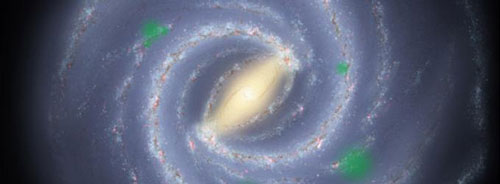
Interstellar seeds could create oases of life
New research by astrophysicists shows that if life can travel between the stars (a process called panspermia), it would spread in a characteristic pattern that we could potentially identify.
August 27, 2015 Read more
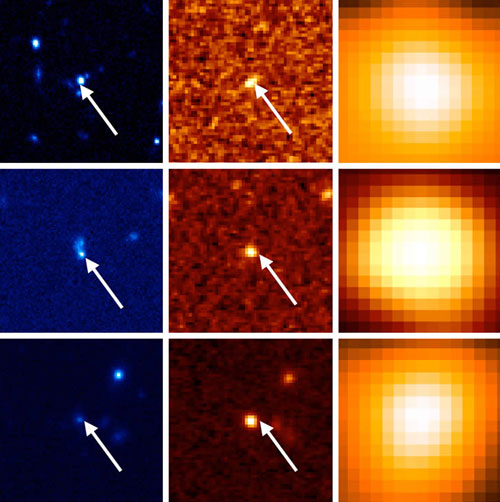
Discovering dust-obscured active galaxies as they grow
Astronomers performed an extensive search for Dust Obscured Galaxies (DOGs) using data obtained from the Subaru Strategic Program with Hyper Suprime-Cam (HSC). The research group discovered 48 DOGs, and has measured how common they are. Since DOGs are thought to harbor a rapidly growing black hole in their centers, these results give us clues for understanding the evolution of galaxies and supermassive black holes.
August 27, 2015 Read more
Astronomers unravel the history of galaxies for the first time
A team of international scientists has shown for the first time that galaxies can change their structure over the course of their lifetime.
August 27, 2015 Read more
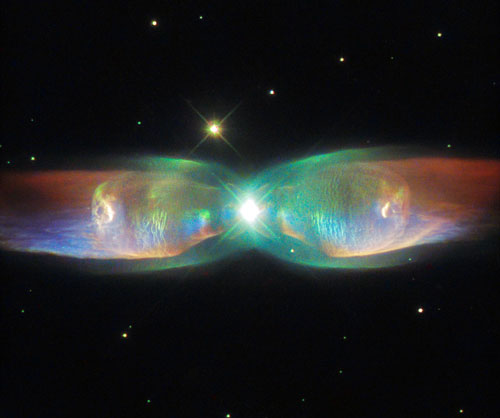
The wings of the butterfly - New Hubble image of the Twin Jet Nebula
The shimmering colours visible in this NASA/ESA Hubble Space Telescope image show off the remarkable complexity of the Twin Jet Nebula. The new image highlights the nebula's shells and its knots of expanding gas in striking detail.
August 26, 2015 Read more
Dying star suffers 'irregular heartbeats'
The research confirms rapid brightening events in otherwise normal pulsating white dwarfs, which are stars in the final stage of their life cycles.
August 26, 2015 Read more
Self-healing material could plug life-threatening holes in spacecraft (w/video)
Researchers report on a new material that heals itself within seconds and could prevent structural penetration from being catastrophic.
August 26, 2015 Read more
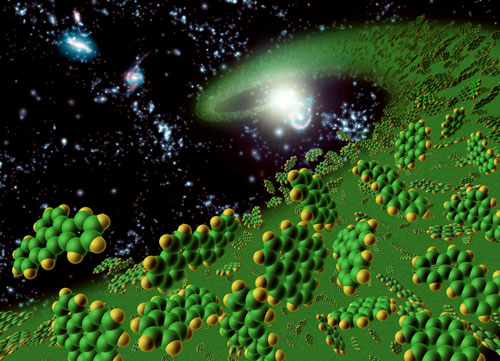
A new approach towards solving mysteries of the interstellar medium
It is one of the most intriguing questions in astrochemistry: the mystery of the diffuse interstellar bands (DIBs), a collection of about 400 absorption bands that show up in spectra of light that reaches the earth after having traversed the interstellar medium. Despite intense research efforts over the last few decades, an assignment of the DIBs has remained elusive, although indications exist that they may arise from the presence of large hydrocarbon molecules in interstellar space. Recent experiments lend novel credibility to this hypothesis.
August 21, 2015 Read more
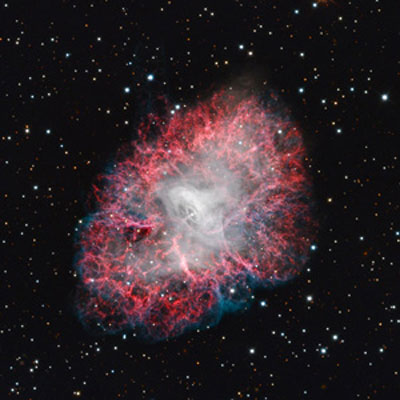
Riding the pulsar wind
The particle wind generated by spinning neutron stars is driven by exotic electromagnetic waves that push the particles to relativistic speeds.
August 21, 2015 Read more
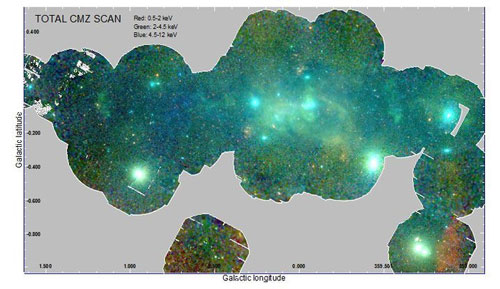
The turbulent heart of the Milky Way
Using the X-ray satellite XMM-Newton, astronomers observe the events around the black hole at the centre of our galaxy.
August 20, 2015 Read more
Mystery of exploding stars yields to astrophysicists
Four researchers explain why nailing down the causes of stellar explosions known as Type Ia supernovae may help unravel the dynamics of stars, galaxies and even the Universe on its grandest scales.
August 19, 2015 Read more
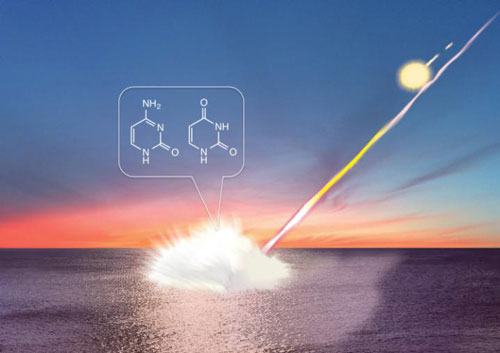
Meteorite impacts can create DNA building blocks
A new study shown that meteorite impacts on ancient oceans may have created nucleobases and amino acids. Researchers discovered this after conducting impact experiments simulating a meteorite hitting an ancient ocean.
August 19, 2015 Read more
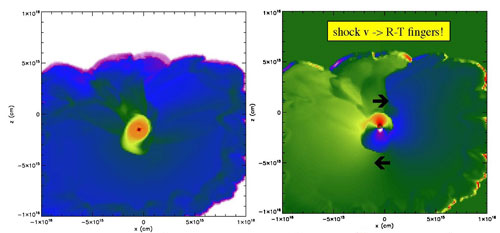
Solar System formation don't mean a thing without that spin
New work provides surprising new details about the trigger that may have started the earliest phases of planet formation in our solar system.
August 19, 2015 Read more
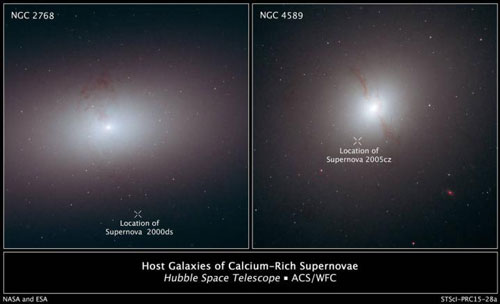
Hubble finds supernovae in 'wrong place at wrong time'
Scientists have been fascinated by a series of unusual exploding stars - outcasts beyond the typical cozy confines of their galaxies. A new analysis of 13 supernovae is helping astronomers explain how some young stars exploded sooner than expected, hurling them to a lonely place far from their host galaxies.
August 13, 2015 Read more
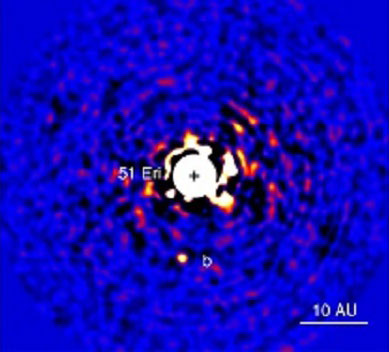
Astronomers discover 'young Jupiter' exoplanet
Student's work with recycled planetary dust brings context to the international scientific team's finding.
August 13, 2015 Read more
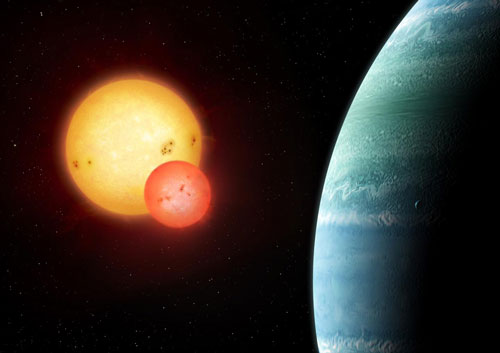
Astronomers discover new planet orbiting two stars
A team of astronomers has discovered a new planet orbiting a pair of stars, the 10th 'circumbinary' planet discovered by NASA's Kepler Mission and a milestone for the 6-year-old spacecraft.
August 10, 2015 Read more
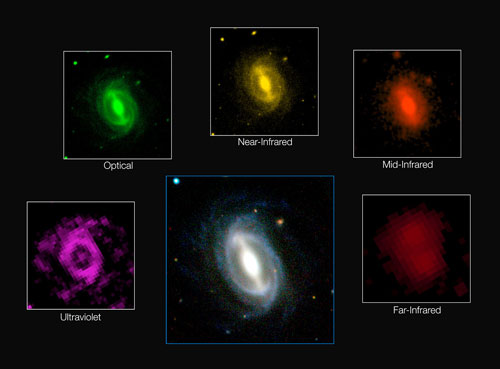
Charting the slow death of the Universe
Astronomers studying over 200,000 galaxies have measured the energy generated within a large portion of space more precisely than ever. This represents the most comprehensive assessment of the energy output of the nearby Universe. They confirm that the energy produced in a section of the Universe today is only about half what it was two billion years ago and is occurring from the ultraviolet to the far infrared.
August 10, 2015 Read more
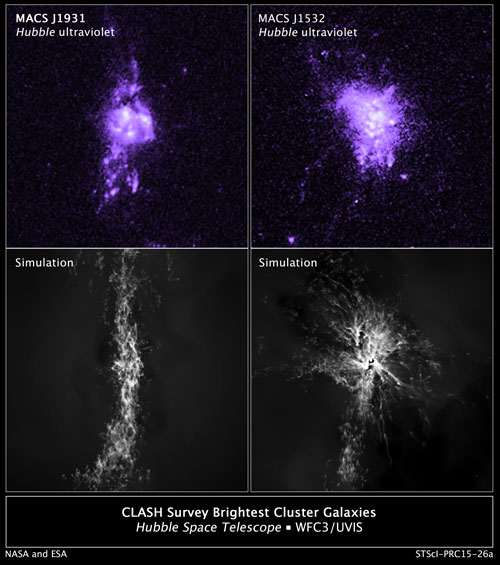
Hubble finds evidence of galaxy star birth regulated by black-hole fountain
Astronomers have uncovered a unique process for how the universe's largest elliptical galaxies continue making stars long after their peak years of star birth. NASA's Hubble Space Telescope's exquisite high resolution and ultraviolet-light sensitivity allowed the astronomers to see brilliant knots of hot, blue stars forming along the jets of active black holes found in the centers of giant elliptical galaxies.
August 6, 2015 Read more
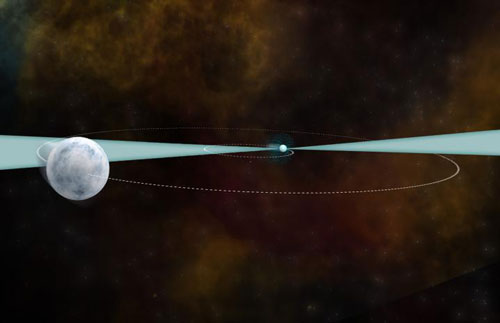
Gravitational constant appears universally constant, pulsar study suggests
Gravity, one of the four fundamental forces of nature, appears reassuringly constant across the Universe, according to a decades-long study of a distant pulsar. This research helps to answer a long-standing question in cosmology: Is the force of gravity the same everywhere and at all times? The answer, so far, appears to be yes.
August 6, 2015 Read more