

Nanotechnology News – Latest Headlines
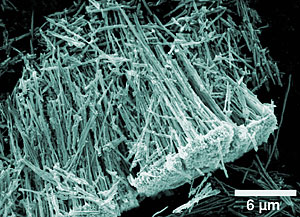
Super sensitive gas detector goes down the nanotubes
Researchers at NIST describe a new method for creating gas detectors so sensitive that some day they may be able to register these tiny emissions from a single cell, providing a new way to determine if drugs or nanoparticles harm cells or to study how cells communicate with one another.
January 13, 2009 Read more

'Two-faced' bioacids put a new face on carbon nanotube self-assembly
A new study from the National Institute of Standards and Technology (NIST) and Rice University offers an inexpensive process that gets nanotubes to obediently line themselves up - that is, self-assemble - in neat rows, more like ducks.
January 13, 2009 Read more
New tool gives researchers a glimpse of biomolecules in motion
Using a new technique based on terahertz (THz) spectroscopy, scientists at the National Institute of Standards and Technology (NIST) have recently taken the first step toward revealing the hidden machinations of biomolecules in water.
January 13, 2009 Read more

Lack of thermoelectric effect is cool feature in carbon nanotubes
Recent experiments have shown the absence of the thermoelectric effect in metallic carbon nanotubes. Building upon earlier theoretical work, researchers at the University of Illinois say they can explain this peculiar behavior, and put it to good use.
January 13, 2009 Read more
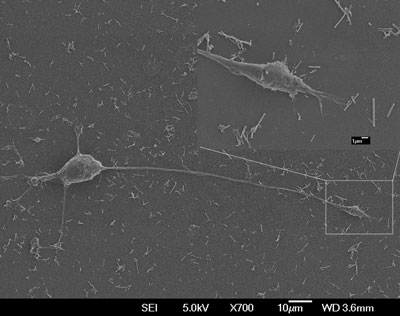
Magnetic nanotubes could lead to treatment for neurodegenerative disorders
Electrical engineering researchers at the University of Arkansas have demonstrated that magnetic nanotubes combined with nerve growth factor can enable specific cells to differentiate into neurons.
January 13, 2009 Read more

Curved photodetectors with nanomembranes sharpen images
Researchers have developed a flexible light-sensitive material that could revolutionize photography and other imaging technologies.
January 13, 2009 Read more
LLNL and Chevron to develop the next generation of fuel catalysts
Lawrence Livermore National Laboratory has signed a research agreement with Chevron to develop the next generation of catalysts for production of clean, more efficient fuels from crude oil.
January 13, 2009 Read more
EPA's voluntary approach captures only a thin slice of nanomaterials in the U.S.
The U.S. Environmental Protection Agency (EPA) has acknowledged that its voluntary approach to reporting has yielded only limited information on a small fraction of the hundreds of potentially toxic nanomaterials already in commercial use or in development in the United States, according to Environmental Defense Fund (EDF).
January 13, 2009 Read more
New application of photoacoustic tomography (PAT) is worth its weight in (nano)gold
Information obtained from a new application of photoacoustic tomography (PAT) is worth its weight in gold to breast cancer patients.
January 13, 2009 Read more
U.S. Department of Energy kicks off 19th National Science Bowl
Thousands of high school and middle school students begin a journey this month that they hope will take them to the finals of the U.S. Department of Energy?s (DOE) annual National Science Bowl, America?s largest and most prestigious science competition for middle and high school students.
January 13, 2009 Read more
Photonic crystals enable precise control of terahertz cascade lasers
Researchers have used photonic crystals to control a terahertz cascade laser beam and considerably restrict its divergence.
January 13, 2009 Read more
Seven innovative Canadian biosensor projects receive $2.65 million in funding
NanoQuebec, the Canadian Space Agency and the Canadian Institute for Photonic Innovations announce the projects selected for support from the Support Program for Integrative Biosensor Research.
January 13, 2009 Read more
First annual photonics innovation awards will be presented at Photonics West 2009
SPIE, the international society for optics and photonics, and Laurin Publishing, publisher of Photonics Media, have announced the 67 finalist companies for the 2008 Prism Awards for Photonics Innovation, the premier competition for the photonics industry worldwide.
January 13, 2009 Read more
EPA releases nanotechnology NMSP interim report
On January 12, 2009, the Environmental Protection Agency (EPA) in the U.S. released its interim report on the Nanoscale Materials Stewardship Program (NMSP). The document is available as a download from the EPA site.
January 13, 2009 Read more
IBM extends 3D MRI to nanoscale with 100 million times finer resolution
IBM Research scientists, in collaboration with the Center for Probing the Nanoscale at Stanford University, have demonstrated magnetic resonance imaging (MRI) with volume resolution 100 million times finer than conventional MRI.
January 13, 2009 Read more
Stanford launches $100 million research institute to tackle energy issues
Recognizing that energy is at the heart of many of the world's tribulations - economic, environmental and political - Stanford is establishing a $100 million research institute to focus intently on energy issues, President John Hennessy announced today.
January 12, 2009 Read more
 Subscribe to our Nanotechnology News feed