

Space Exploration News – Latest Headlines
 Subscribe to our Space Exploration News feed
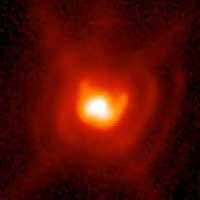
Unraveling a spiral stream of dusty embers from a massive binary stellar forge
With almost two decades of mid-infrared imaging from the largest observatories around the world, a team of astronomers was able to capture the spiral motion of newly formed dust streaming from the massive and evolved binary star system Wolf-Rayet 112.
September 16, 2020 Read more
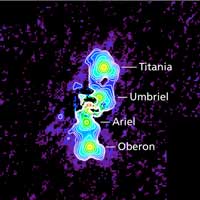
Uranian moons in new light
According to observations by the Herschel Space Observatory, the five largest satellites resemble dwarf planets.
September 15, 2020 Read more
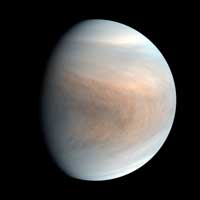
Hints of life on Venus
An international team of astronomers announced the discovery of a rare molecule - phosphine - in the clouds of Venus. On Earth, this gas is only made industrially, or by microbes that thrive in oxygen-free environments.
September 14, 2020 Read more
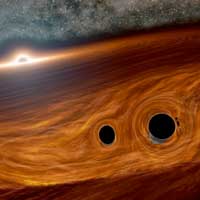
Astronomers find brand new type of black hole
The discovery of a new type of black hole challenges prior understanding of how the mysterious cosmic objects form across the universe, according to a new study.
September 11, 2020 Read more
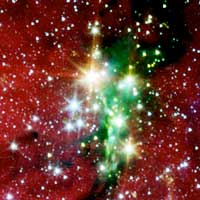
Magnetic fields in space clouds feed young stars
Magnetic fields within molecular clouds - formations made of cosmic dust and gas - help feed young, growing stars.
September 11, 2020 Read more
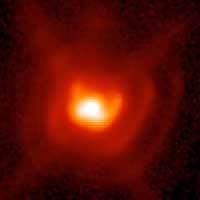
Hubble observations suggest a missing ingredient in dark matter theories (w/video)
Astronomers have uncovered a discrepancy between the theoretical models of how dark matter should be distributed in galaxy clusters, and observations of dark matter's grip on clusters.
September 11, 2020 Read more
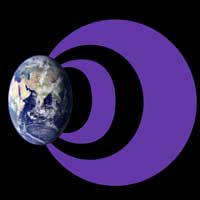
Giant particle accelerator in the sky
New study finds that electrons are locally heated to extremely high energies within the Van Allen Radiation Belts.
September 10, 2020 Read more
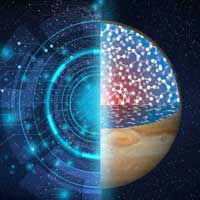
Artificial intelligence explains hydrogen's behavior on giant planets
Using computer simulations powered by machine-learning algorithms, scientists have made an important breakthrough in understanding how hydrogen behaves on Saturn and Jupiter.
September 10, 2020 Read more
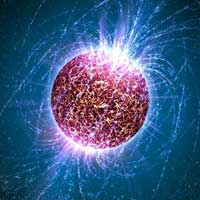
Astrophysicists detect the strongest magnetic field in the universe
The magnetic field is up to one billion Tesla, which is tens of millions of times stronger than what can be generated in Earth laboratories.
September 10, 2020 Read more
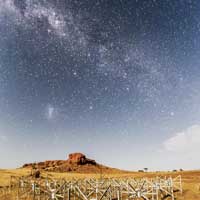
SETI survey finds no signs of alien technology in 10 million star systems
A radio telescope in outback Western Australia has completed the deepest and broadest search at low frequencies for alien technologies, scanning a patch of sky known to include at least 10 million stars.
September 9, 2020 Read more
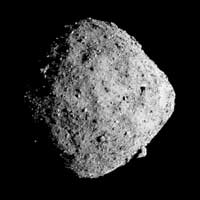
How small particles could reshape Bennu and other asteroids
NASA's OSIRIS-REx spacecraft observed tiny bits of material jumping off the surface of the asteroid Bennu. A new study tracks where those particles went.
September 9, 2020 Read more
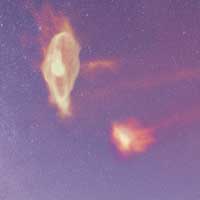
How the Milky Way stole an enormous gas halo from our dwarf neighbours
An international team of astronomers has solved a 50-year-old mystery: why is there an enormous gas halo the mass of a billion Suns persisting around the Magellanic Clouds?
September 9, 2020 Read more
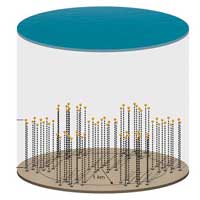
Revealing the secrets of high-energy cosmic particles
Researchers have started an international initiative to build a neutrino telescope several cubic kilometers in size in the northeastern Pacific.
September 9, 2020 Read more
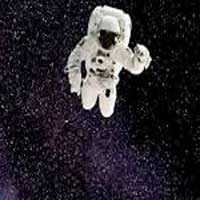
Gut microbes could allow space travelers to stay healthy on long voyages
Review highlights that treatments targeting the gut microbiome could protect space travelers against negative health effects of space travel.
September 8, 2020 Read more
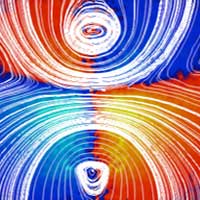
How to have a blast like a black hole
Scientists use extremely intense laser pulses to create magnetized-plasma conditions comparable to those surrounding a black hole, research that may help explain the still mysterious X-rays that can be emitted from some celestial bodies.
September 7, 2020 Read more
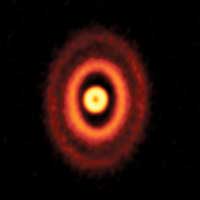
Misaligned planet-forming rings around triple young stars
An international team of astronomers found a peculiar dust ring system around the young triple star GW Orionis. The system has three large, misaligned rings with sufficient dust for planet formation. The misaligned rings might have been formed by a hidden planet between the rings, which would provide a clue to understand planet formation around a multiple star system.
September 4, 2020 Read more
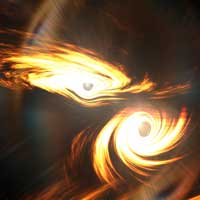
First ever detection of monster black hole collision, 150 times heavier than the Sun (w/video)
Astronomers have reported the first ever direct observation of the most massive black hole merger to date. Two monster black holes collided to form an even more massive object - an intermediate-mass black hole, about 150 times as heavy as the Sun.
September 2, 2020 Read more
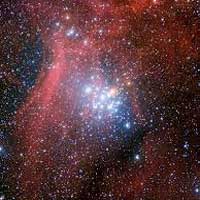
A disk of gas would explain mysterious light changes observed in Sagittarius constellation
Astronomers analyzed 18.5 years of data, to propose an answer to the enigmatic variations seen in the binary system.
September 2, 2020 Read more