

Space Exploration News – Latest Headlines
 Subscribe to our Space Exploration News feed
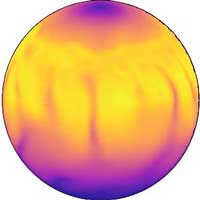
Modelling extreme magnetic fields and temperature variation on distant stars
New research is helping to explain one of the big questions that has perplexed astrophysicists for the past 30 years - what causes the changing brightness of distant stars called magnetars.
October 13, 2020 Read more
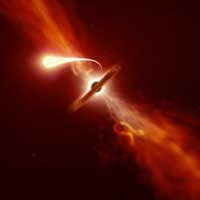
Death by spaghettification: Astronomers record last moments of star devoured by black hole
Using telescopes from around the world, astronomers have spotted a rare blast of light from a star being ripped apart by a supermassive black hole. The phenomenon, known as a tidal disruption event, is the closest such flare recorded to date at just over 215 million light-years from Earth, and has been studied in unprecedented detail.
October 12, 2020 Read more
Astronomers find x-rays lingering years after landmark neutron star collision
New, most complete start-to-finish view of neutron star merger rewrites the way scientists understand these events.
October 12, 2020 Read more
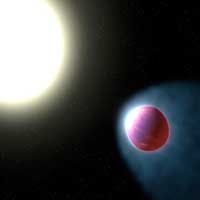
Vaporised metal in the air of an exoplanet
An international team of researchers studied the atmosphere of the ultra-hot exoplanet WASP-121b. In it, they found a number of gaseous metals. The results are a next step in the search for potentially habitable worlds.
October 8, 2020 Read more
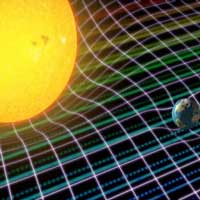
New measurements of the solar spectrum verify Einstein's theory of General Relativity
An international team of researchers has measured, with unprecedented accuracy, the gravitational redshift of the Sun, a change in frequency of the lines in the solar spectrum which is produced when the light escapes from the gravitational field of the Sun on its way to Earth.
October 8, 2020 Read more
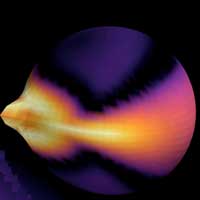
The black hole always chirps twice: Scientists find clues to decipher the shape of black holes
A team of gravitational-wave scientists reveals that when two black holes collide and merge, the remnant black hole 'chirps' not once, but multiple times, emitting gravitational waves - intense ripples in the fabric space and time - that inform us about its shape.
October 8, 2020 Read more
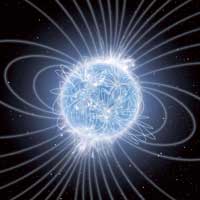
Researchers find 'missing link' between magnetars and rotation-powered pulsars
Astronomers have made observations of a new magnetar, called Swift J1818.0-1607, which challenges current knowledge about two types of extreme stars, known as magnetars and pulsars.
October 8, 2020 Read more
Astronomers turn up the heavy metal to shed light on star formation
Astronomers have developed a new way to study star formation in galaxies from the dawn of time to today.
October 7, 2020 Read more
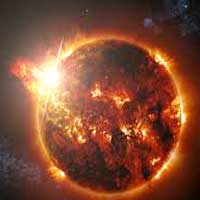
New research explores how super flares affect planets' habitability
New research will help astrobiologists understand how much radiation planets experience during super flares and whether life could exist on worlds beyond our solar system.
October 7, 2020 Read more
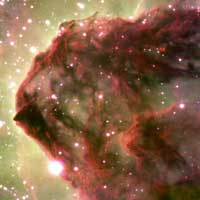
Gemini South's high-def version of 'A Star is Born'
NASA's James Webb Space Telescope is still more than a year from launching, but the Gemini South telescope in Chile has provided astronomers a glimpse of what the orbiting observatory should deliver.
October 5, 2020 Read more
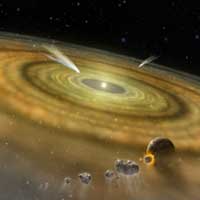
Portrait of an exoplanet
Astronomers reveal first direct image of Beta Pictoris c using the GRAVITY instrument.
October 5, 2020 Read more
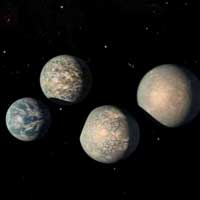
Some planets may be better for life than Earth
Earth is not necessarily the best planet in the universe. Researchers have identified two dozen planets outside our solar system that may have conditions more suitable for life than our own. Some of these orbit stars that may be better than even our sun.
October 5, 2020 Read more
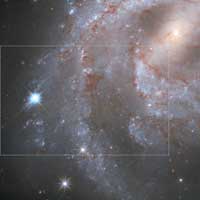
Hubble watches exploding star fade into oblivion
Now you see it, now you don't. Though stars explode at the rate of one per second in the vast universe, it's rare to get a time-lapse movie of one fading into obscurity. This disappearing act, in a galaxy 70 million light-years away, was captured by the Hubble Space Telescope as part of a program to measure the universe's expansion rate.
October 1, 2020 Read more
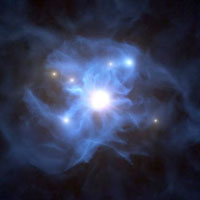
Astronomers spot galaxies trapped in the web of a supermassive black hole
With the help of ESO's Very Large Telescope (VLT), astronomers have found six galaxies lying around a supermassive black hole when the Universe was less than a billion years old.
October 1, 2020 Read more
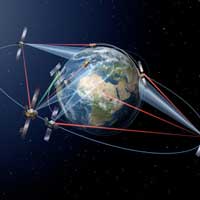
The most sensitive optical receivers yet for space communications
Communications in space demand the most sensitive receivers possible for maximum reach, while also requiring high bit-rate operations. A novel concept for laser-beam based communications uses an almost noiseless optical preamplifier in the receiver.
October 1, 2020 Read more
Astronomers find the first galaxy whose ultraviolet luminosity is comparable to that of a quasar
An international scientific team have found the galaxy BOSS-EUVLG1. This is the galaxy with star formation but almost no dust, the most luminous of its type known up to now.
September 29, 2020 Read more

Cosmic diamonds formed during gigantic planetary collisions
Geoscientists have now been able to prove that these diamonds formed in the early period of our solar system when minor planets collided together or with large asteroids. These new data disprove the theory that they originated deep inside planets.
September 29, 2020 Read more
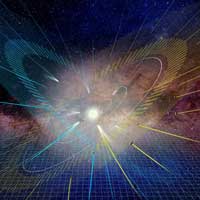
Second alignment plane of solar system discovered
A study of comet motions indicates that the Solar System has a second alignment plane. This has important implications for models of how comets originally formed in the Solar System.
September 29, 2020 Read more