

Space Exploration News – Latest Headlines
 Subscribe to our Space Exploration News feed
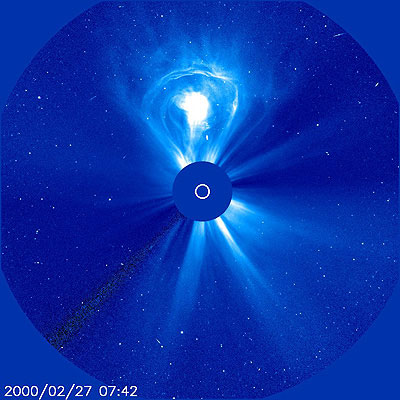
The Sun has a great idea
A light bulb-shaped eruption leaps from the Sun and blasts into space in this archival image from the ESA/NASA Solar and Heliospheric Observatory, SOHO.
July 23, 2012 Read more
NASA telescope captures sharpest images of sun's corona
A telescope launched July 11 aboard a NASA sounding rocket has captured the highest-resolution images ever taken of the sun's million-degree atmosphere called the corona. The clarity of the images can help scientists better understand the behavior of the solar atmosphere and its impacts on Earth's space environment.
July 20, 2012 Read more
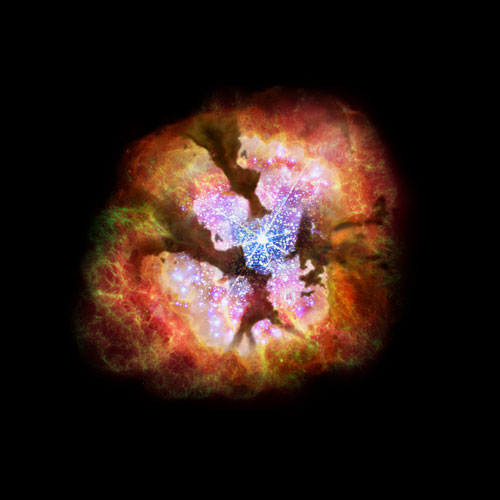
'Seeds' of massive black holes found at the center of the Milky Way
A research team observed emission lines at wavelengths of 0.87 mm, emitted from carbon monoxide molecules in an area of several degrees that includes the center of the Milky Way Galaxy.
July 20, 2012 Read more
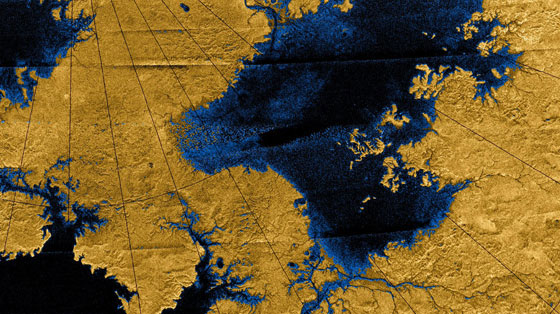
River networks on Titan point to a puzzling geologic history
Findings suggest the surface of Saturn's largest moon may have undergone a recent transformation.
July 20, 2012 Read more
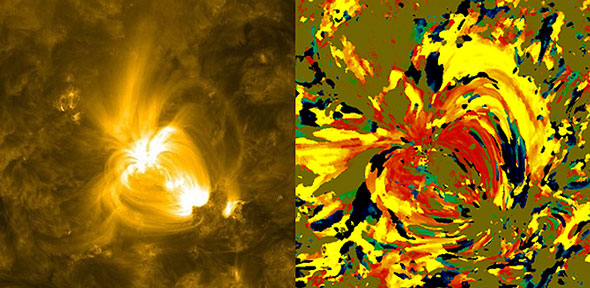
Colorful science sheds light on solar heating
Heliophysics nuggets are a collection of early science results, new research techniques, and instrument updates that further our attempt to understand the sun and the dynamic space weather system that surrounds Earth.
July 20, 2012 Read more
A wrinkle in space-time
Mathematicians at UC Davis have come up with a new way to crinkle up the fabric of space-time -- at least in theory.
July 19, 2012 Read more
Scientists discover exoplanet neighbor smaller than Earth
The University of Central Florida has detected what could be its first planet, only two-thirds the size of Earth and located right around the corner, cosmically speaking, at a mere 33light- years away.
July 18, 2012 Read more
A magnification of two million
Telescope network zooms in on the heart of a distant quasar.
July 18, 2012 Read more
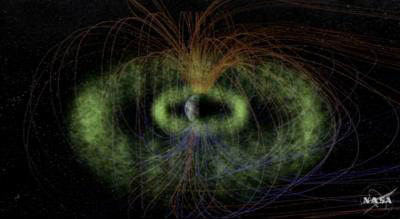
The electric atmosphere: Plasma is next NASA science target
A new NASA mission called the Radiation Belt Storm Probes (RBSP), due to launch in August 2012, will improve our understanding of what makes plasma move in and out of these electrified belts wrapped around our planet.
July 18, 2012 Read more
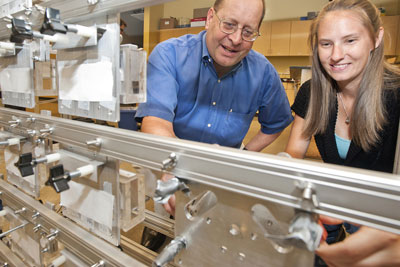
Students to design, build experiment to fly on space station
NASA has selected a team of students from Purdue and North Carolina Agricultural and Technical State universities to design and build an experiment to be operated on the International Space Station.
July 11, 2012 Read more
An extraterrestrial collision of international importance
An 18-member international team of researchers has found exciting new evidence that supports the theory of an extraterrestrial impact that occurred nearly 13 000 years ago. Their evidence lies in material found in a thin layer of sedimentary rock in Pennsylvania and South Carolina in the United States and in Syria.
July 11, 2012 Read more
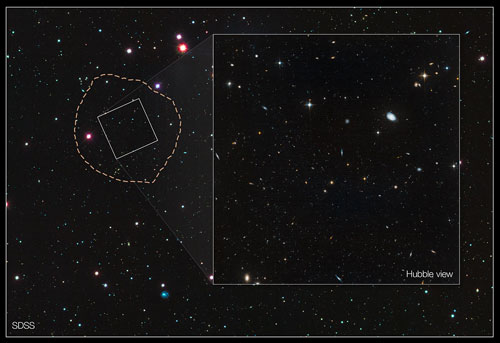
Hubble unmasks ghost galaxies
Astronomers have used the NASA/ESA Hubble Space Telescope to study some of the smallest and faintest galaxies in our cosmic neighbourhood. These galaxies are fossils of the early Universe: they have barely changed for 13 billion years.
July 10, 2012 Read more
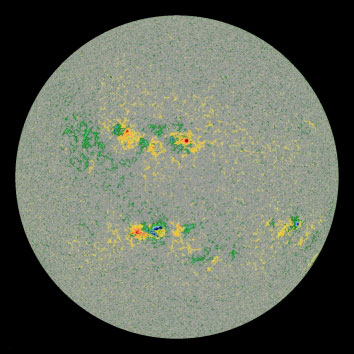
Researchers create 'MRI' of the sun's interior motions
A team of scientists has created an "MRI" of the Sun's interior plasma motions, shedding light on how it transfers heat from its deep interior to its surface.
July 9, 2012 Read more
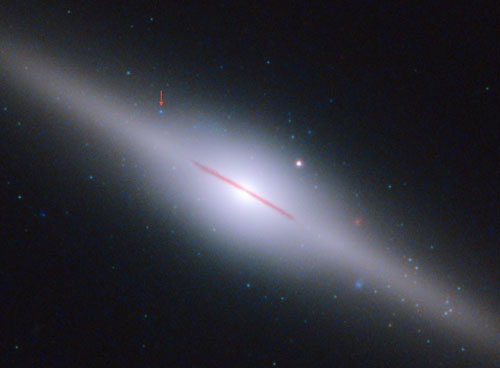
Belching black hole proves a biggie
Observations with CSIRO's Australia Telescope Compact Array have confirmed that astronomers have found the first known "middleweight" black hole.
July 9, 2012 Read more
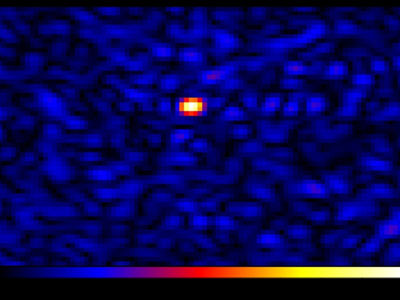
Close-up of active galactic nucleus
First interferometric signals between the Effelsberg telescope and orbital radio telescope Spektr-R.
July 6, 2012 Read more
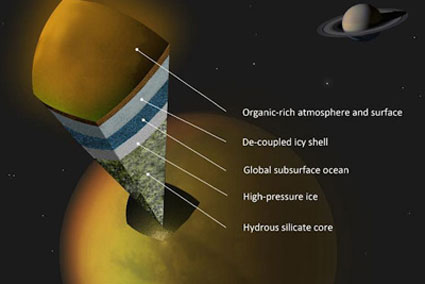
Buried ocean lends insight into Titan's dense, methane-rich atmosphere
To better understand Saturn's moon Titan, scientists must study the methane in its atmosphere, the persistence of which was likely influenced by an ocean of water recently discovered 100 kilometers below the moon's surface.
July 5, 2012 Read more
Spaceflight may extend the lifespan of microscopic worm
The effect of spaceflight on a microscopic worm - Caenorhabditis elegans (C. elegans) - could help it to live longer. The discovery was made by an international group of scientists studying the loss of bone and muscle mass experienced by astronauts after extended flights in space.
July 5, 2012 Read more
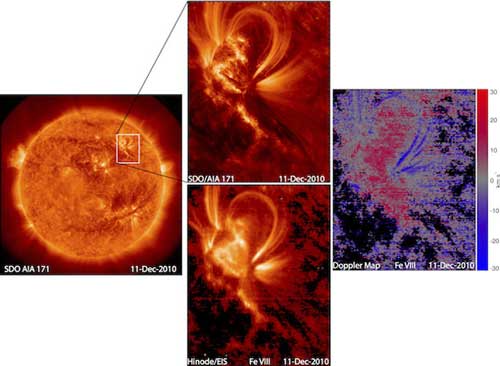
Rising plasma offers clues to sun storms
Rice researcher part of team that used Doppler shifts to ID phenomenon; may help predict space weather.
July 3, 2012 Read more