

Space Exploration News – Latest Headlines
 Subscribe to our Space Exploration News feed
NASA investigates proton radiation effects on cells
A team of researchers at NASA's Johnson Space Center in Houston and Lawrence Berkeley National Laboratory in Berkeley, Calif., has found radiation from protons could further enhance a process that occurs during tumor progression. This information may help lead to better methods to protect astronauts from the harmful effects of radiation in space, as well as help cancer researchers on Earth better understand the effects of radiation treatment on the human body.
August 4, 2012 Read more
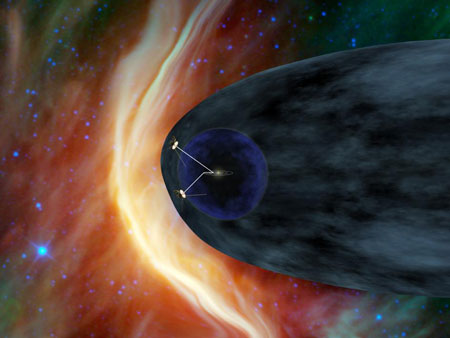
Signs changing fast for Voyager at solar system edge
Two of three key signs of changes expected to occur at the boundary of interstellar space have changed faster than at any other time in the last seven years, according to new data from NASA's Voyager 1 spacecraft.
August 3, 2012 Read more
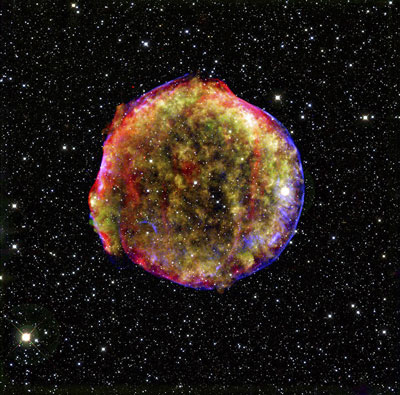
Supernova progenitor found?
New research, led by Stella Kafka of the Carnegie Institution for Science in the United States, identifies a star system, prior to explosion, which will possibly become a type Ia supernova.
August 3, 2012 Read more
2012 NASA advanced technology concepts selected for study
NASA's Space Technology Program is turning science fiction into science fact. The program has selected 28 proposals for study under the NASA Innovative Advanced Concepts (NIAC) Program.
August 1, 2012 Read more
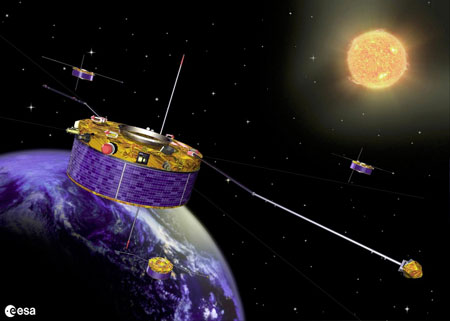
Thin current sheets in space: where the action is
Around Earth, the processes accelerating electrons which hit the atmosphere and cause beautiful auroras are often initiated in thin current sheets. Similar processes, auroras and thin current sheets are found around other planets such as Jupiter and Saturn.
August 1, 2012 Read more
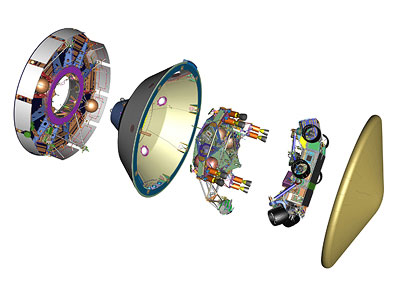
New Mars Rover digitally designed and tested
NASA scientists used software from Siemens to help create the new Mars rover Curiosity, which is currently on its way to Mars.
July 31, 2012 Read more
Taking the heat: Aeroshell to protect NASA's Mars Science Laboratory on descent through Martian atmosphere
After a journey of 245 days across 352 million miles, the moment of truth for the Mars Science Laboratory begins late in the evening of August 5 when the spacecraft roars into the Martian atmosphere, traveling at 13,200 miles an hour. The final seven minutes will determine the fate of the mission, and a perfect performance of the Lockheed Martin Space Systems aeroshell is absolutely vital to getting the Mars Curiosity Rover safely down on the sands of Mars.
July 26, 2012 Read more
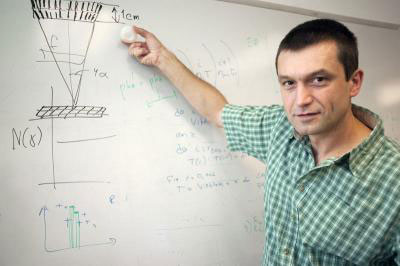
NASA X-ray concept inspired from a roll of Scotch tape
The inspiration behind NASA scientist Maxim Markevitch's quest to build a highly specialized X-ray mirror using a never-before-tried technique comes from an unusual source: a roll of Scotch tape.
July 26, 2012 Read more
New eye sweeps the gamma sky
Largest ever Cherenkov telescope sees first light.
July 26, 2012 Read more
A pulsar with a tremendous hiccup
Max Planck scientists discover a young and energetic neutron star with unusually irregular rotation.
July 26, 2012 Read more
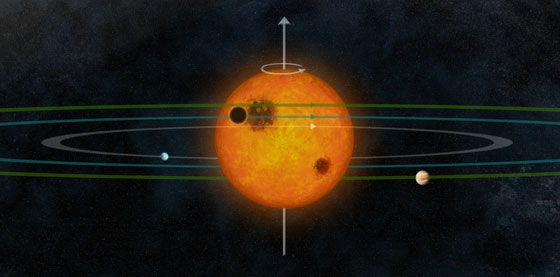
A far-off solar system
Researchers measure the orientation of a multiplanet system and find it very similar to our own solar system.
July 26, 2012 Read more
A black hole's dinner (w/video)
A giant gas cloud is on collision course with the black hole in the centre of our galaxy in 2013. This is a unique opportunity to observe how a super massive black hole sucks in material, in real time.
July 25, 2012 Read more
Two Solar System puzzles solved
Comets and asteroids preserve the building blocks of our Solar System and should help explain its origin. But there are unsolved puzzles. For example, how did icy comets obtain particles that formed at high temperatures, and how did these refractory particles acquire rims with different compositions? Carnegie's theoretical astrophysicist Alan Boss and cosmochemist Conel Alexander are the first to model the trajectories of such particles in the unstable disk of gas and dust that formed the Solar System.
July 25, 2012 Read more
After the Canadarm, the Canadeyes for the future Webb
Cutting-edge Canadian space technology directed by Université de Montreal's Rene Doyon
July 25, 2012 Read more
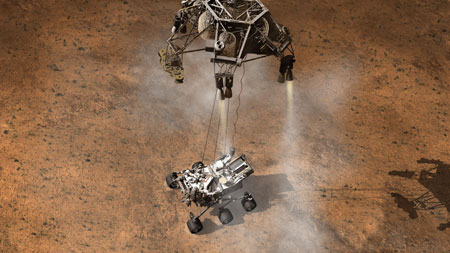
ESA's Mars Express supports dramatic landing on Mars
NASA's Mars Science Laboratory (MSL) is set to deliver the largest planetary rover ever flown onto the Red Planet?s surface early in the morning of 6 August.
July 25, 2012 Read more
Satellites see unprecedented Greenland ice sheet surface melt
For several days this month, Greenland's surface ice cover melted over a larger area than at any time in more than 30 years of satellite observations. Nearly the entire ice cover of Greenland, from its thin, low-lying coastal edges to its 2-mile-thick center, experienced some degree of melting at its surface, according to measurements from three independent satellites analyzed by NASA and university scientists.
July 24, 2012 Read more
New clues to the early Solar System from ancient meteorites
In order to understand Earth's earliest history--its formation from Solar System material into the present-day layering of metal core and mantle, and crust--scientists look to meteorites. New research from a team including Carnegie's Doug Rumble and Liping Qin focuses on one particularly old type of meteorite called diogenites.
July 23, 2012 Read more
NASA successfully tests hypersonic inflatable heat shield
A large inflatable heat shield developed by NASA's Space Technology Program has successfully survived a trip through Earth's atmosphere while travelling at hypersonic speeds up to 7,600 mph.
July 23, 2012 Read more