

Space Exploration News – Latest Headlines
 Subscribe to our Space Exploration News feed
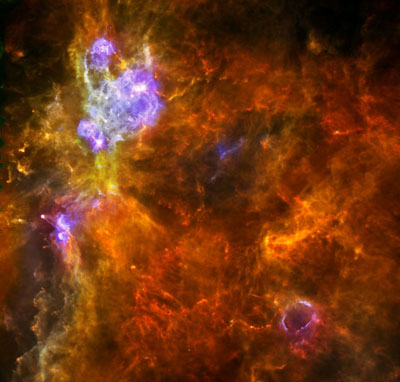
How to build a very large star
Stars ten times as massive as the Sun, or more, should not exist: as they grow, they tend to push away the gas they feed on, starving their own growth. Scientists have been struggling to figure out how some stars overcome this hurdle.
March 27, 2013 Read more
Measuring Mars: The MAVEN magnetometer (w/video)
When the Mars Atmosphere and Volatile Evolution (MAVEN) mission begins its journey to the Red Planet in 2013, it will carry a sensitive magnetic-field instrument built and tested by a team at NASA's Goddard Space Flight Center.
March 26, 2013 Read more
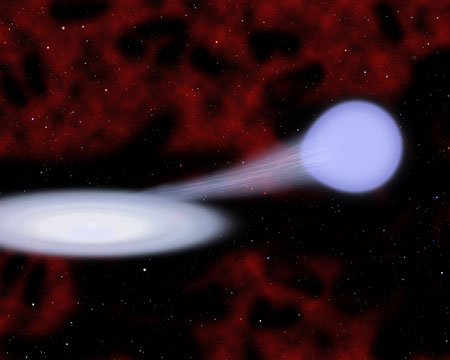
Astronomers discover new kind of supernova
Supernovae were always thought to occur in two main varieties. But a team of astronomers including Carnegie's Wendy Freedman, Mark Phillips and Eric Persson is reporting the discovery of a new type of supernova called Type Iax.
March 26, 2013 Read more
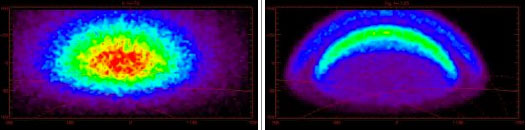
LRO's LAMP ultraviolet spectrograph observes mercury and hydrogen in GRAIL impact plumes
NASA intentionally crashed the GRAIL twins onto the Moon on Dec. 17, 2012, following successful prime and extended science missions. Both spacecraft hit a mountain near the lunar north pole, which was shrouded in shadow at the time. Developed by Southwest Research Institute, LAMP uses a novel method to peer into the darkness of the Moon's permanently shadowed regions, making it ideal for observations of the Moon's night-side and its tenuous atmospheric constituents.
March 26, 2013 Read more
Ephemeral vacuum particles induce speed-of-light fluctuations
New research shows that the speed of light may not be fixed after all, but rather fluctuates.
March 25, 2013 Read more
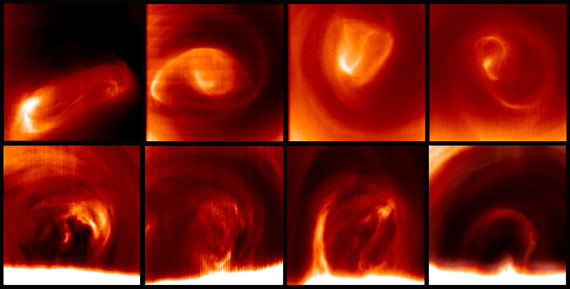
Surprises in the South polar vortex in Venus' atmosphere
The astronomers in the UPV/EHU's Planetary Science Group have published a study of the atmospheric vortex of the south pole of Venus, a huge whirlwind the size of Europe.
March 25, 2013 Read more
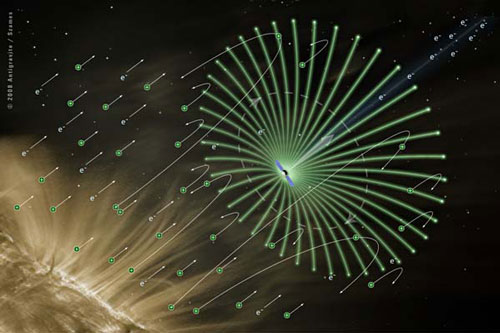
Electric solar wind sailing spacecraft an important step closer
A little more than a year ago a research team started to develop a vital part of a Finnish invention - an electric solar wind sail for interplanetary journeys. Now, a prototype has been successfully manufactured and tested.
March 25, 2013 Read more
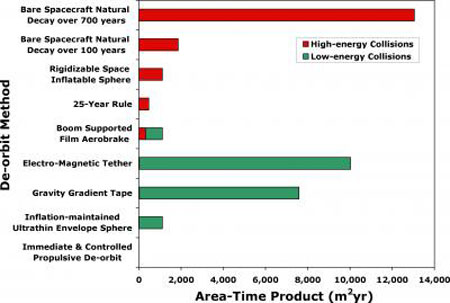
Removing orbital debris with less risk
A new article compares in-orbit debris removal options regarding their potential risk of creating new orbital debris or disabling working satellites during deorbit operation.
March 22, 2013 Read more
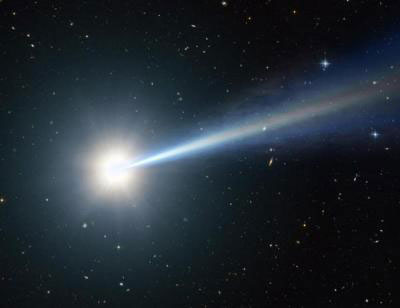
'Sideline quasars' helped to stifle early galaxy formation
University of Colorado Boulder astronomers targeting one of the brightest quasars glowing in the universe some 11 billion years ago say "sideline quasars" likely teamed up with it to heat abundant helium gas billions of years ago, preventing small galaxy formation.
March 21, 2013 Read more
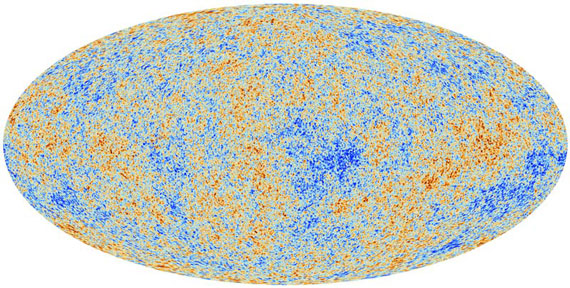
Planck reveals an almost perfect Universe
Planck measures the Universe - detailed all-sky map of the cosmic background radiation confirms standard cosmological model but also finds deviations
March 21, 2013 Read more
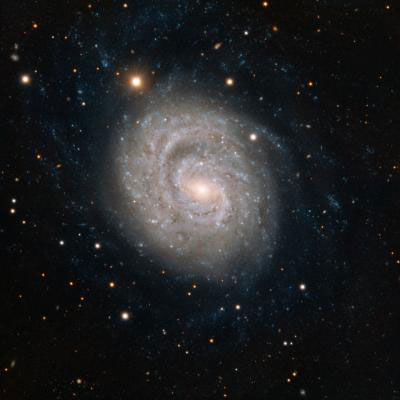
Spiral beauty graced by fading supernova
About 35 million light-years from Earth, in the constellation of Eridanus (The River), lies the spiral galaxy NGC 1637. Back in 1999 the serene appearance of this galaxy was shattered by the appearance of a very bright supernova. Astronomers studying the aftermath of this explosion with ESO's Very Large Telescope at the Paranal Observatory in Chile have provided us with a stunning view of this relatively nearby galaxy.
March 20, 2013 Read more
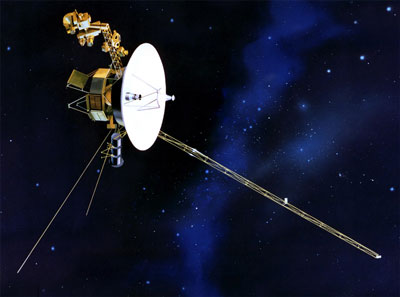
Voyager 1 has left the solar system, sudden changes in cosmic rays indicate
Thirty-five years after its launch, Voyager 1 appears to have travelled beyond the influence of the Sun and exited the heliosphere, according to a new study appearing online today.
March 20, 2013 Read more

Searching for solar systems like our own
Josh Winn's hunt for exoplanets may someday reveal habitable, Earth-like worlds.
March 20, 2013 Read more
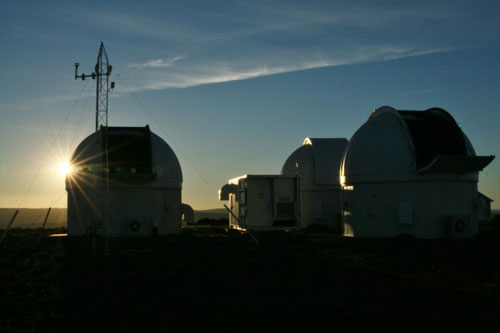
First light at SAAO for third 1-meter node of global telescope
The first truly global telescope came a significant step closer to completion this month with the installation and first light on three new 1-meter telescopes at the South Africa Astronomical Observatory (SAAO) near Sutherland, South Africa.
March 19, 2013 Read more
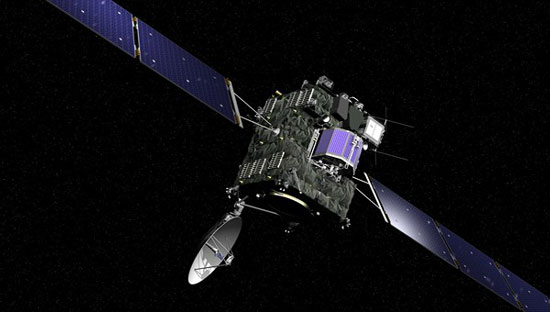
Training sessions for the Philae comet lander
The original Philae comet lander has been travelling through space since 2 March 2004. It is currently in hibernation mode, awaiting its arrival at Comet 67P/Churyumov-Gerasimenko. But the Philae models on the ground are being put through their paces: they are being tested to breaking point and examined by the German Aerospace Center.
March 18, 2013 Read more
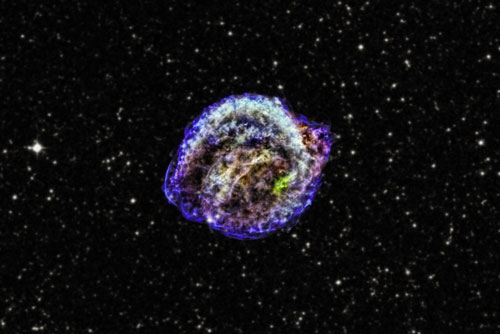
Famous supernova reveals clues about crucial cosmic distance markers
A new study using data from NASA's Chandra X-ray Observatory points to the origin of a famous supernova. This supernova, discovered in 1604 by Johannes Kepler, belongs to an important class of objects that are used to measure the rate of expansion of the Universe.
March 18, 2013 Read more
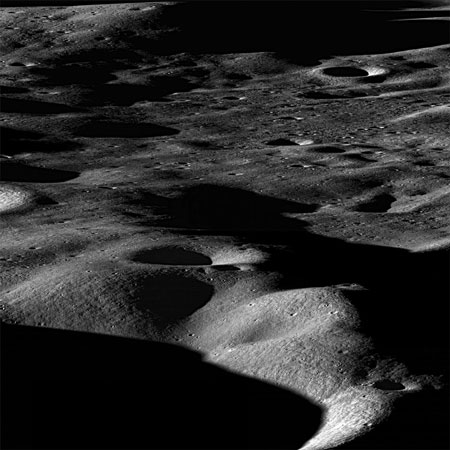
NASA sees leaping lunar dust
Electrically charged lunar dust near shadowed craters can get lofted above the surface and jump over the shadowed region, bouncing back and forth between sunlit areas on opposite sides, according to new calculations by NASA scientists.
March 18, 2013 Read more
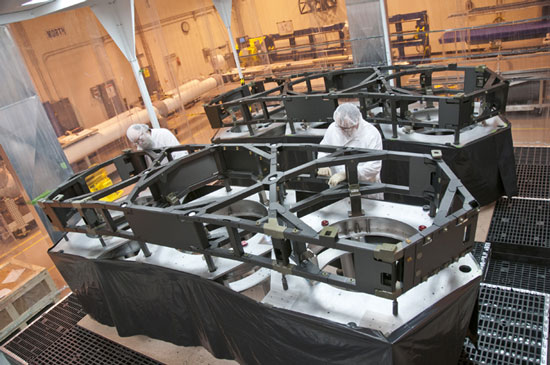
Webb Telescope gets its wings
A massive backplane that will hold the primary mirror of NASA's James Webb Space Telescope nearly motionless while it peers into space is another step closer to completion with the recent assembly of the support structure's wings.
March 17, 2013 Read more