

Space Exploration News – Latest Headlines
 Subscribe to our Space Exploration News feed
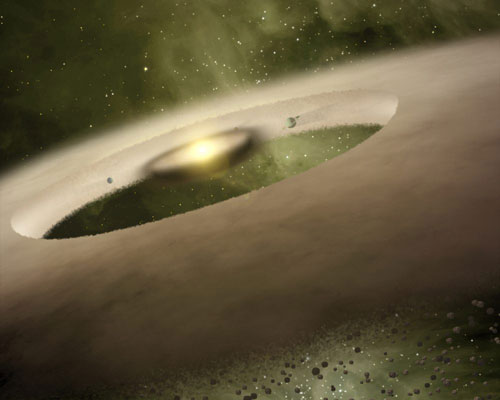
Cosmochemist discovers potential solution to meteorite mystery
Chondrules may have formed from high-pressure collisions in early solar system.
July 8, 2013 Read more
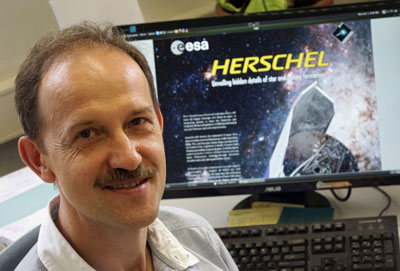
Cosmic dust belts without dust
Six newly discovered debris disks not only are extremely cold, they also are lacking the characteristic dust which is always released when the rocks collide.
July 8, 2013 Read more
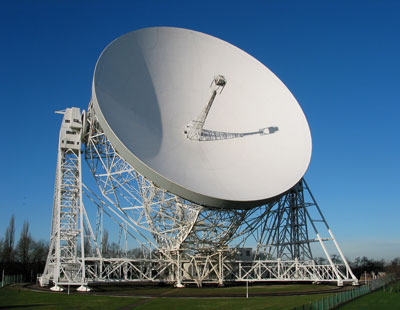
UK launches Search for ExtraTerrestrial Intelligence Research Network
A network has been launched to promote academic research in the UK relating to the Search for ExtraTerrestrial Intelligence (SETI). The UK SETI Research Network (UKSRN) brings together academics from 11 institutions across the country.
July 5, 2013 Read more
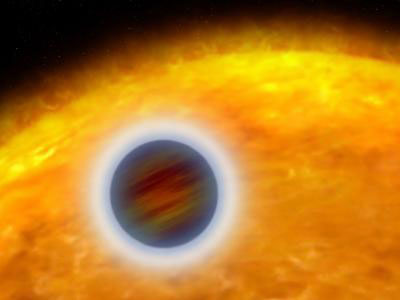
Hubble Telescope reveals variation between hot extrasolar planet atmospheres
First results from the analysis of eight 'hot Jupiter' exoplanets suggest that winds and clouds play an important role in the atmospheric make up of these exotic planets.
July 5, 2013 Read more
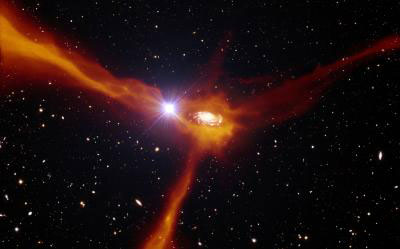
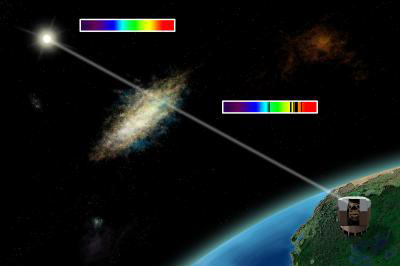
Feeding galaxy caught in distant searchlight by international research team
An international group of astronomers has spotted a distant galaxy hungrily snacking on nearby gas. The gas is seen to fall inward toward the galaxy, creating a flow that both fuels star formation and drives the galaxy's rotation. This is the best direct observational evidence so far supporting the theory that galaxies pull in and devour nearby material in order to grow and form stars.
July 5, 2013 Read more
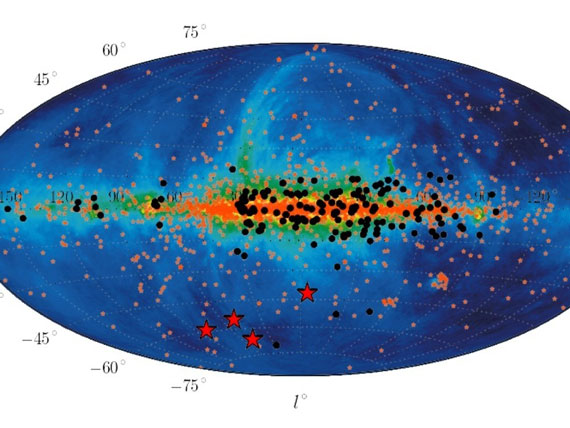
Flashes in the sky
Cosmic radio bursts point to cataclysmic origins in the distant universe.
July 4, 2013 Read more
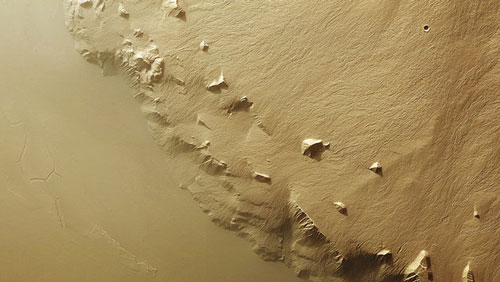
At the foot of the Red Planet's giant volcano
Hundreds of individual lava flows are seen frozen in time on the flanks of Olympus Mons, the largest volcano in the Solar System. Images taken by ESA's Mars Express focus on the southeast segment of the giant volcano, which towers some 22 km above the surrounding plains.
July 4, 2013 Read more
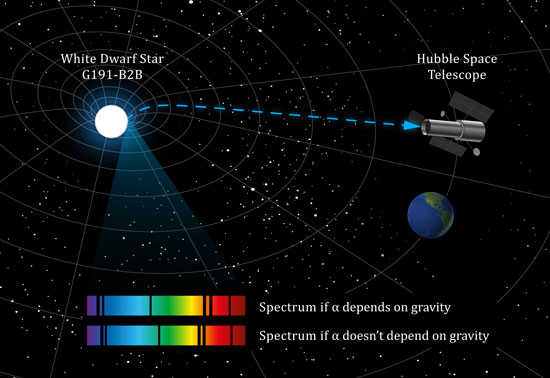
Space study opens up new opportunities to explore exotic energy
Answering the ultimate question to Life, Universe and Everything? Not quite, but an international team of scientists have conducted research that opens up new possibilities for exploring what to date have only been theories of physics.
July 4, 2013 Read more
New knowledge about early galaxies
The early galaxies of the universe were very different from today's galaxies. Using new detailed studies carried out with the ESO Very Large Telescope and the Hubble Space Telescope, researchers, including members from the Niels Bohr Institute, have studied an early galaxy in unprecedented detail and determined a number of important properties such as size, mass, content of elements and have determined how quickly the galaxy forms new stars.
July 3, 2013 Read more
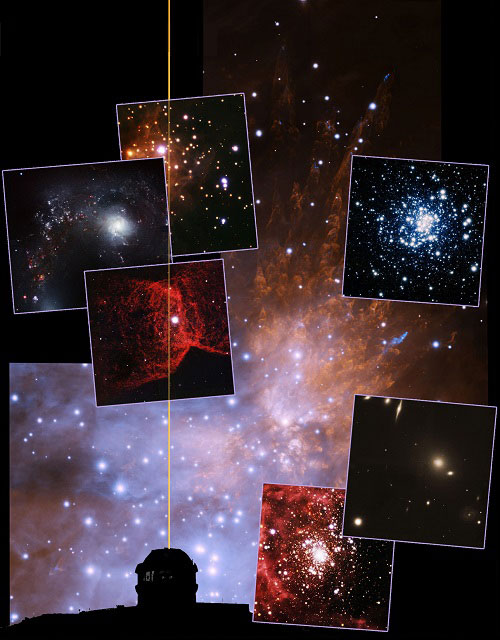
Revolutionary instrument delivers a sharper universe to astronomers
A unique new instrument at Gemini South in Chile takes the removal of atmospheric distortions (using adaptive optics technology) to a new level. Today's release of seven ultrasharp, large-field images from the instrument's first science observations demonstrate its remarkable discovery potential.
July 2, 2013 Read more
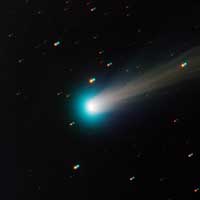
Comet ISON brings holiday fireworks (w/video)
This July 4th the solar system is showing off some fireworks of its own.
July 2, 2013 Read more
World premiere of IMAX 3D film Hidden Universe (w/video)
The film shows state-of-the-art telescopes in high-resolution time-lapse, mesmerising 3D versions of celestial structures, and a 3D simulation of the evolution of the Universe.
July 2, 2013 Read more
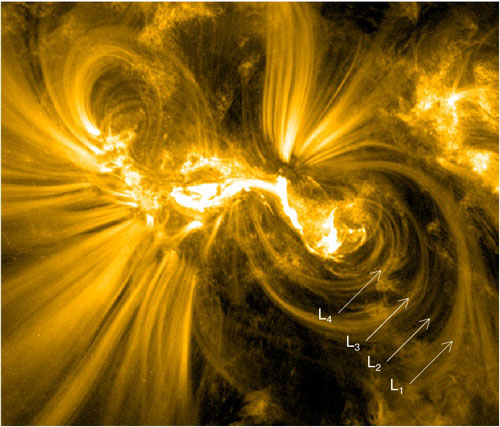
Solar dynamic loops reveal a simultaneous explosion and implosion, plus evidence for magnetic reconnection
Movies of giant loops projecting from the surface of the Sun are giving new insights into the complex mechanisms that drive solar flares and Coronal Mass Ejections (CMEs). These eruptions release vast energy and electrically charged particles that can affect the Earth through space weather.
July 2, 2013 Read more
Cluster spacecraft detects elusive space wind
A new study provides the first conclusive proof of the existence of a space wind first proposed theoretically over 20 years ago. By analysing data from the European Space Agency's Cluster spacecraft, researcher Iannis Dandouras detected this plasmaspheric wind, so-called because it contributes to the loss of material from the plasmasphere, a donut-shaped region extending above the Earth's atmosphere.
July 2, 2013 Read more
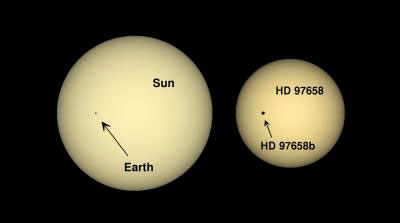
Astronomer uncovers the hidden identity of an exoplanet
Hovering about 70 light-years from Earth is a star astronomers call HD 97658, which is almost bright enough to see with the naked eye. But the real 'star' is the planet HD 97658b, not much more than twice the Earth's diameter and a little less than eight times its mass.
July 1, 2013 Read more
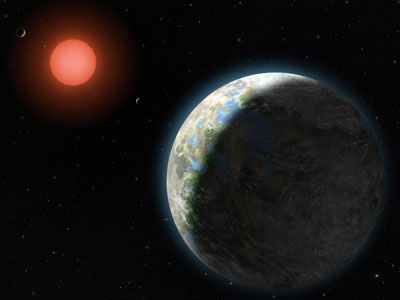
Cloud behavior expands habitable zone of alien planets
A new study that calculates the influence of cloud behavior on climate doubles the number of potentially habitable planets orbiting red dwarfs, the most common type of stars in the universe. This finding means that in the Milky Way galaxy alone, 60 billion planets may be orbiting red dwarf stars in the habitable zone.
July 1, 2013 Read more
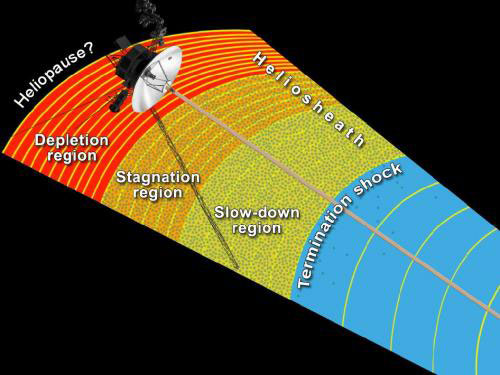
At the solar system's edge, more surprises from Voyager
Data from NASA's Voyager 1 spacecraft continues to provide new insight on the outskirts of our solar system, a frontier thought to be the last that Voyager will cross before becoming the first man-made object to reach interstellar space.
June 27, 2013 Read more
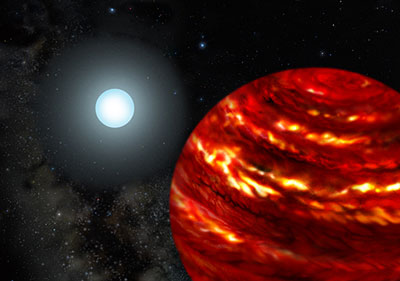
Gas-giant exoplanets cling close to their parent stars
Gemini Observatory's Planet-Finding Campaign finds that, around many types of stars, distant gas-giant planets are rare and prefer to cling close to their parent stars. The impact on theories of planetary formation could be significant.
June 27, 2013 Read more