

Space Exploration News – Latest Headlines
 Subscribe to our Space Exploration News feed
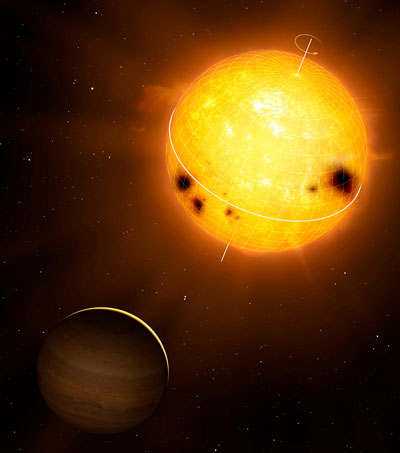
Interior rotation of a distant star revealed
With the help of asteroseismic data obtained by the CoRoT space telescope, scientists were able to determine the interior rotation of a Sun-like star - and characterise an exoplanet.
July 30, 2013 Read more
To infinity and beyond: teleporting humans into space
In the science fiction show, Star Trek, teleportation is a regular and significant feature. But how much time and power is required to send the data needed to teleport a human being? University of Leicester physics students have calculated the answer to this very question.
July 30, 2013 Read more
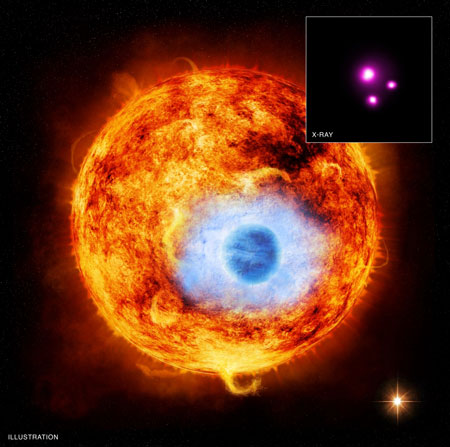
Chandra sees eclipsing planet in X-rays for first time
For the first time since exoplanets, or planets around stars other than the sun, were discovered almost 20 years ago, X-ray observations have detected an exoplanet passing in front of its parent star.
July 29, 2013 Read more
Removing complexity layers from the universe's creation
Understanding complexity in the early universe may require combining simpler models to interpret cosmological observations.
July 26, 2013 Read more
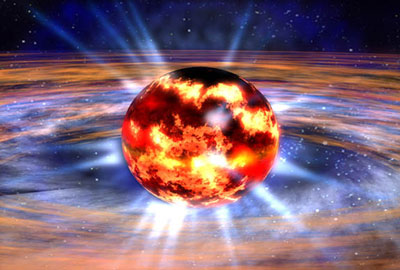
Scientists discover surprising importance of 'I Love Q' for understanding neutron stars
Scientists can learn a tremendous amount about neutron stars and quark stars without understanding their internal structure in detail, according to two Montana State University scientists.
July 26, 2013 Read more
Discoveries from Planck may mean rethinking how the universe began
This spring, humanity was shown its most detailed map of the early universe ever created. Generated by observations from the Planck spacecraft, the map revealed fluctuations in temperature in the relic radiation left over from the Big Bang - what we call the Cosmic Microwave Background (CMB). Recently, scientists on the Planck team announced finding certain large-scale features on the CMB sky that they cannot explain. One of them: a large cold spot, which corresponds to an anomalously large area of high density.
July 25, 2013 Read more
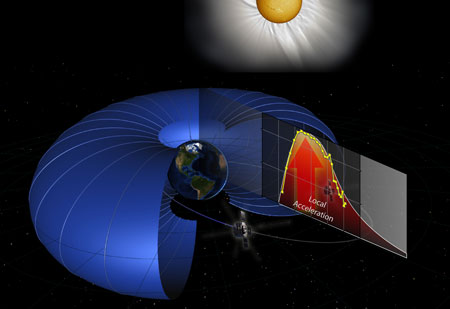
Scientists discover massive particle accelerator in heart of Van Allen radiation belts
Using data from a NASA satellite, scientists have discovered a massive particle accelerator in the heart of one of the harshest regions of near-Earth space, a region of super-energetic, charged particles surrounding the globe and known as the Van Allen radiation belts.
July 25, 2013 Read more
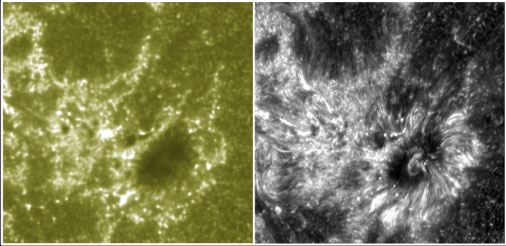
IRIS mission gets first look at Sun's mysterious interface region
NASA's Interface Region Imaging Spectrograph (IRIS) spacecraft has captured its first observations of a region of the sun that is now possible to observe in detail: the lowest layers of the sun's atmosphere.
July 25, 2013 Read more
'International beam team' solves Martian meteorite age puzzle (w/video)
By directing energy beams at tiny crystals found in a Martian meteorite, a Western University-led team of geologists has proved that the most common group of meteorites from Mars is almost four billion years younger than many scientists had believed - resolving a long-standing puzzle in Martian science and painting a much clearer picture of the Red Planet's evolution that can now be compared to that of habitable Earth.
July 24, 2013 Read more
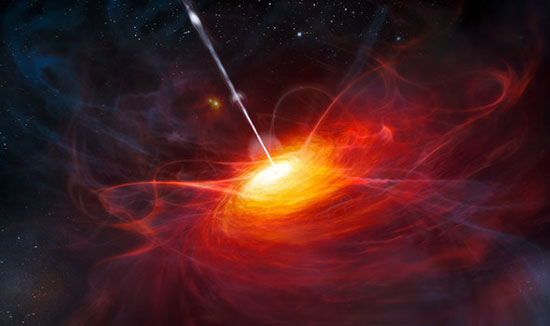
Shedding new light on the brightest objects in the universe
Astrophysicists have documented the immense power of quasar radiation, reaching out for many thousands of light years to the limits of the quasar's galaxy.
July 24, 2013 Read more
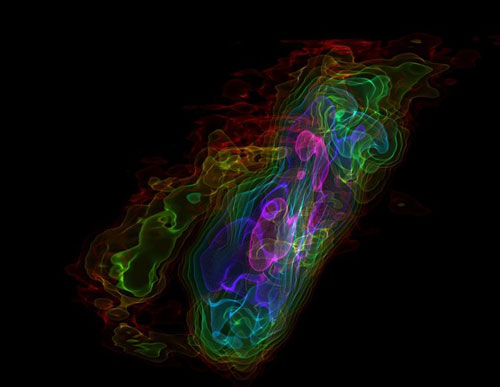
The limits to galactic growth
In the system NGC 253, astronomers observe outflows of matter curtailing the birth of stars.
July 24, 2013 Read more
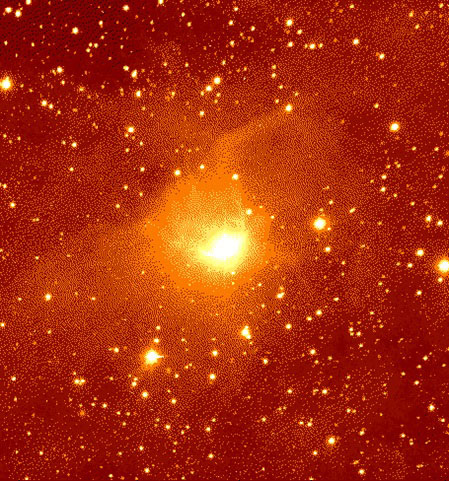
Solar system's youth gives clues to planet search
Comets and meteorites contain clues to our solar system's earliest days. But some of the findings are puzzle pieces that don't seem to fit well together. A new set of theoretical models from Carnegie's Alan Boss shows how an outburst event in the Sun's formative years could explain some of this disparate evidence. His work could have implications for the hunt for habitable planets outside of our solar system.
July 24, 2013 Read more
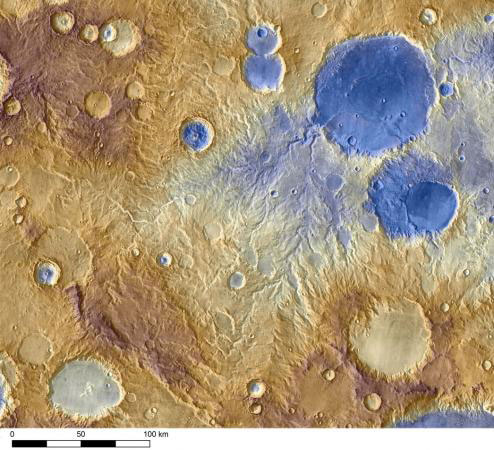
Ancient snowfall likely carved Martian valleys
Researchers at Brown University have shown that some Martian valleys appear to have been caused by runoff from orographic precipitation - moisture carried part of the way up a mountain and deposited on the slopes. The findings help to answer the question of whether water flowing on ancient Mars bubbled up from the ground or fell down from the atmosphere.
July 24, 2013 Read more
Spitzer observes gas emission from comet Ison
Astronomers using NASA's Spitzer Space Telescope have observed what most likely are strong carbon dioxide emissions from Comet ISON ahead of its anticipated pass through the inner solar system later this year.
July 23, 2013 Read more
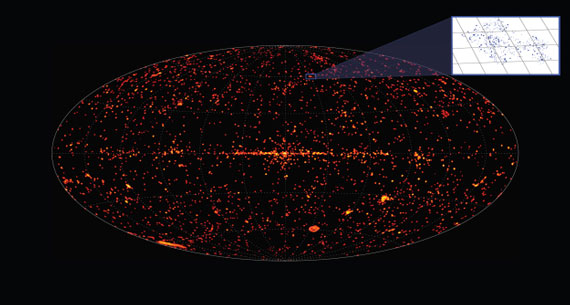
A new record for cosmic X-ray sightings
Scientists led by the University of Leicester have set a new record for cosmic X-ray sources ever sighted - creating an unprecedented cosmic X-ray catalogue that will provide a valuable resource allowing astronomers to explore the extreme Universe.
July 23, 2013 Read more
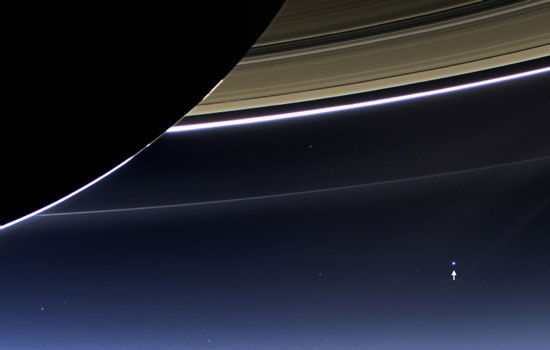
NASA releases images of Earth by distant spacecraft
Color and black-and-white images of Earth taken by two NASA interplanetary spacecraft on July 19 show our planet and its moon as bright beacons from millions of miles away in space.
July 23, 2013 Read more
A warmer planetary haven around cool stars, as ice warms rather than cools
In a bit of cosmic irony, planets orbiting cooler stars may be more likely to remain ice-free than planets around hotter stars. This is due to the interaction of a star's light with ice and snow on the planet's surface.
July 19, 2013 Read more
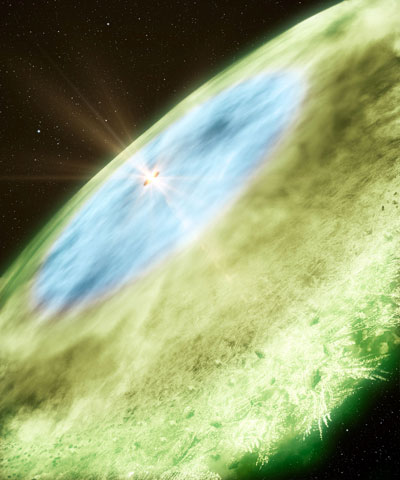
Snow in an Infant Solar System - A frosty landmark for planet and comet formation
A snow line has been imaged in a far-off infant solar system for the very first time. The snow line, located in the disc around the Sun-like star TW Hydrae, promises to tell us more about the formation of planets and comets, the factors that decide their composition, and the history of the Solar System.
July 18, 2013 Read more