

Space Exploration News – Latest Headlines
 Subscribe to our Space Exploration News feed
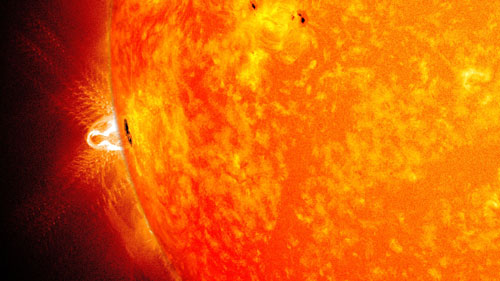
Giant sunspot makes third trip across the sun
A giant sunspot - a magnetically strong and complex region on the sun's surface - has just appeared over the sun's horizon. This is the third trip for this region across the face of the sun, which takes approximately 27 days to make a complete rotation.
February 28, 2014 Read more
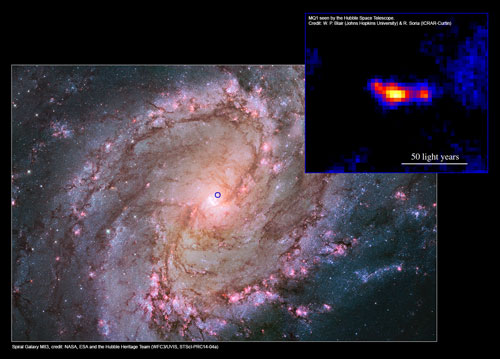
New fast and furious black hole found
A team of Australian and American astronomers have been studying nearby galaxy M83 and have found a new superpowered small black hole, named MQ1, the first object of its kind to be studied in this much detail.
February 28, 2014 Read more
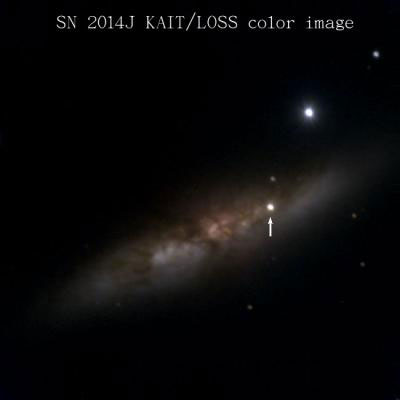
Closest, brightest supernova in decades is also a little weird
The closest and brightest supernova in decades, SN 2014J, brightens faster than expected for Type Ia supernovae, the exploding stars used to measure cosmic distances, according to University of California Berkeley astronomers.
February 27, 2014 Read more
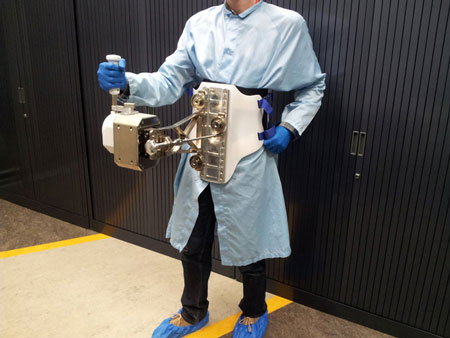
Touchy-feely joystick heading to Space Station
Stowed inside ESA's next supply ship to the International Space Station will be one of the most advanced joysticks ever built, designed to test the remote control of robots on the ground from up in orbit.
February 26, 2014 Read more
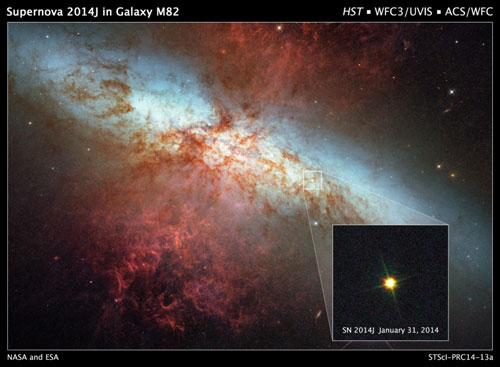
Hubble monitors supernova in nearby galaxy M82
This is a Hubble Space Telescope composite image of a supernova explosion designated SN 2014J in the galaxy M82.
February 26, 2014 Read more
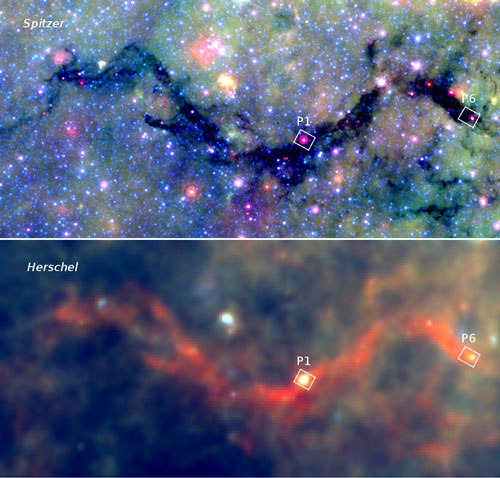
SMA unveils how small cosmic seeds grow into big stars
New images from the Smithsonian's Submillimeter Array (SMA) telescope provide the most detailed view yet of stellar nurseries within the Snake nebula. These images offer new insights into how cosmic seeds can grow into massive stars.
February 26, 2014 Read more
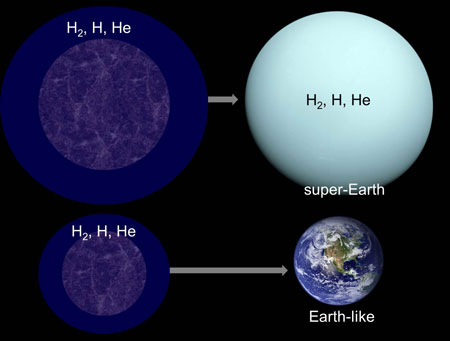
'Super-Earths' may be dead worlds
A team of scientists have looked at how these worlds form and suggest that many of them may be a lot less clement than was though. They find that planets that form from less massive cores can become benign habitats for life, whereas the larger objects instead end up as 'mini-Neptunes' with thick atmospheres and probably stay sterile.
February 26, 2014 Read more
How did the universe begin: Hot Big Bang or slow thaw?
A physicist at Heidelberg University has developed a theoretical model that complements the nearly 100-year-old conventional model of cosmic expansion. According tohis theory, the Big Bang did not occur 13.8 billion years ago - instead, the birth of the universe stretches into the infinite past.
February 25, 2014 Read more
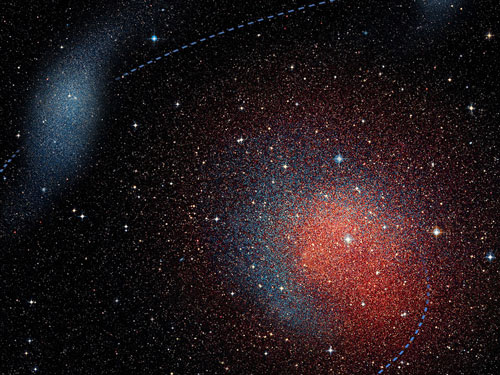
When dwarves collide
Studying Andromeda II, astronomers observe where little galaxies come from.
February 25, 2014 Read more
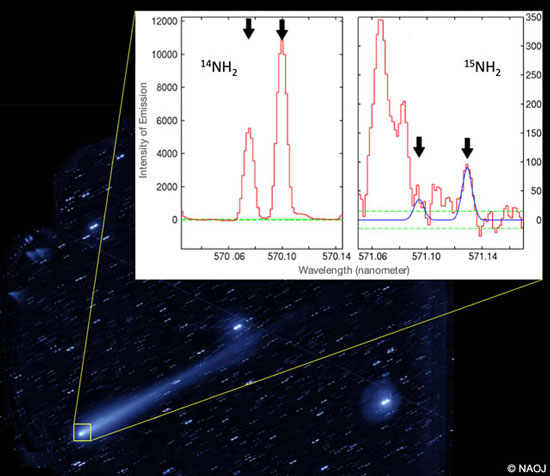
Subaru telescope detects rare form of nitrogen in comet ISON
This is the first time that astronomers have reported a clear detection of a relatively rare nitrogen isotope in a single comet and also measured the relative abundance of two different forms of nitrogen of cometary ammonia.
February 25, 2014 Read more
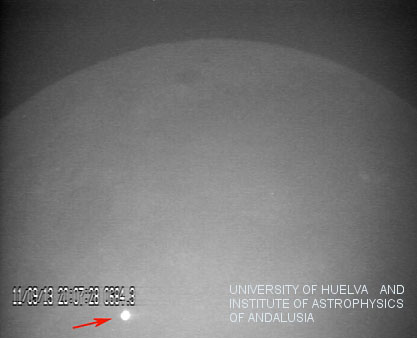
Astronomers spot record-breaking lunar impact
A meteorite with the mass of a small car crashed into the Moon last September, according to Spanish astronomers. The impact, the biggest seen to date, produced a bright flash and would have been easy to spot from the Earth.
February 24, 2014 Read more
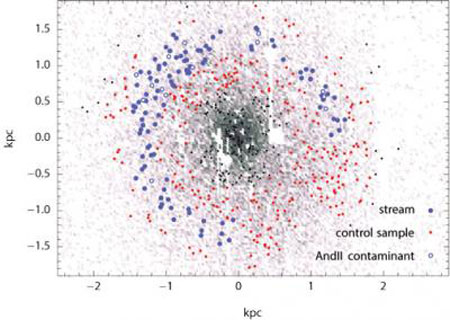
Stream of stars in Andromeda satellite galaxy shows cosmic collision
The Andromeda Galaxy is surrounded by a swarm of small satellite galaxies. Researchers from the Niels Bohr Institute, among others, have detected a stream of stars in one of the Andromeda Galaxy's outer satellite galaxies, a dwarf galaxy called Andromeda II. The movement of the stars tells us that what we are observing is the remnant of a merger between two dwarf galaxies. Mergers between galaxies of such low mass has not been observed before.
February 23, 2014 Read more
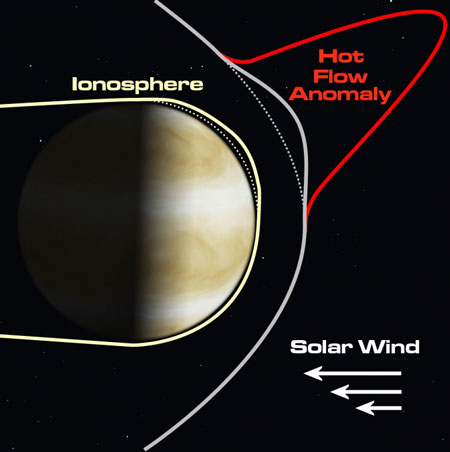
Researcher finds planet-sized space weather explosions at Venus
Researchers recently discovered that a common space weather phenomenon on the outskirts of Earth's magnetic bubble, the magnetosphere, has much larger repercussions for Venus. The giant explosions, called hot flow anomalies, can be so large at Venus that they're bigger than the entire planet and they can happen multiple times a day.
February 21, 2014 Read more
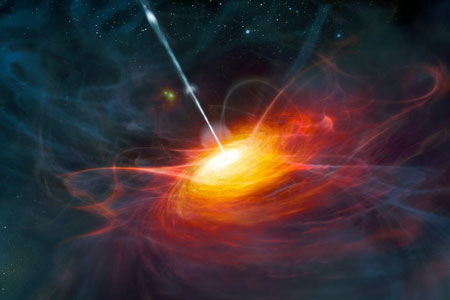
Researchers say distant quasars could close a loophole in quantum mechanics
MIT researchers propose using distant quasars to test Bell's theorem.
February 20, 2014 Read more
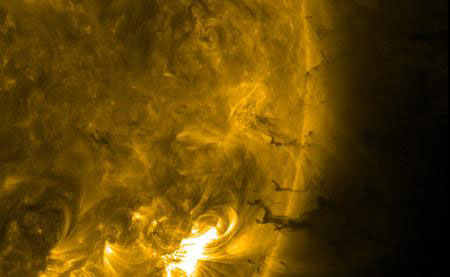
Astronomers find solar storms behave like supernovae (w/video)
Researchers have studied the behaviour of the Sun's coronal mass ejections, explaining for the first time the details of how these huge eruptions behave as they fall back onto the Sun's surface. In the process, they have discovered that coronal mass ejections have a surprising twin in the depths of space: the tendrils of gas in the Crab Nebula, which lie 6500 light-years away and are millions of times larger.
February 20, 2014 Read more
Space eye with 34 telescopes will investigate one million stars
The exploration of planets around stars other than the Sun, known as extrasolar planets or 'exoplanets', is one of the most exciting topics of 21st century science. One of the key goals of this research is to discover and learn the properties of Earth-like worlds in the Sun's neighbourhood. ESA, the European Space Agency, will do this in preparing a new space mission named PLATO.
February 20, 2014 Read more
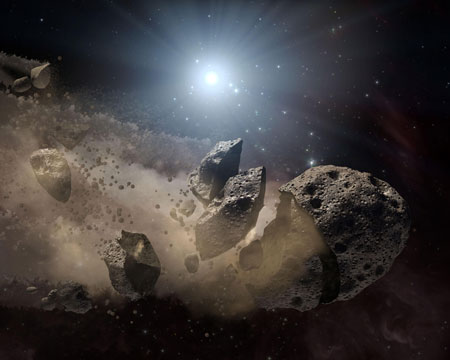
Rocks around the clock: asteroids pound tiny star
Asteroids hit the Earth, the Moon and even, it seems, distant stars.
February 19, 2014 Read more
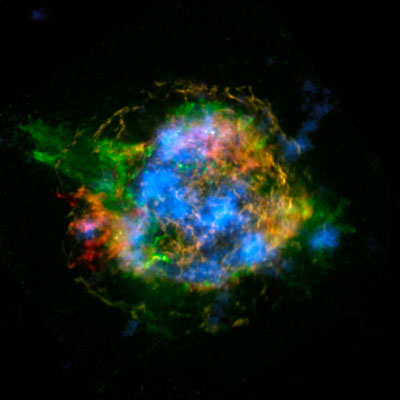
NuSTAR telescope takes first peek into core of supernova
Astronomers have peered for the first time into the heart of an exploding star in the final minutes of its existence. The feat by the high-energy X-ray satellite NuSTAR provides details of the physics of the core explosion inaccessible until now, says team member Steven Boggs of UC Berkeley. NuSTAR mapped radioactive titanium in the Cassiopeia A supernova remnant, which has expanded outward and become visible from Earth since the central star exploded in 1671.^
February 19, 2014 Read more