

Space Exploration News – Latest Headlines
 Subscribe to our Space Exploration News feed
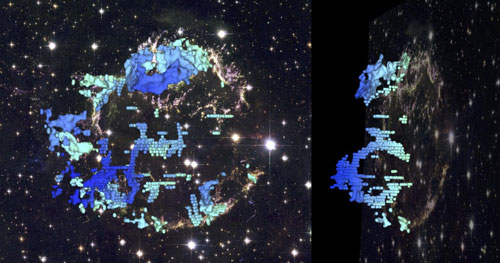
CAT scan of nearby supernova remnant reveals frothy interior
Cassiopeia A, or Cas A for short, is one of the most well studied supernova remnants in our galaxy. But it still holds major surprises. Astronomers have generated a new 3-D map of its interior using the astronomical equivalent of a CAT scan. They found that the Cas A supernova remnant is composed of a collection of about a half dozen massive cavities - or 'bubbles'.
January 29, 2015 Read more
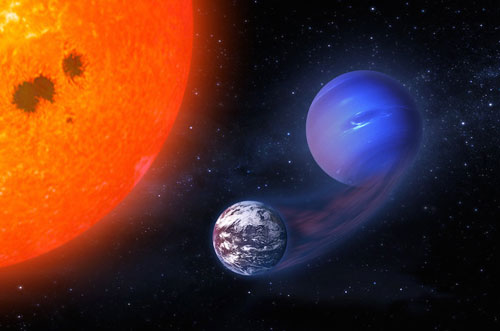
Some potentially habitable planets began as gaseous, Neptune-like worlds
Two phenomena known to inhibit the potential habitability of planets - tidal forces and vigorous stellar activity - might instead help chances for life on certain planets orbiting low-mass stars, astronomers have found.
January 28, 2015 Read more
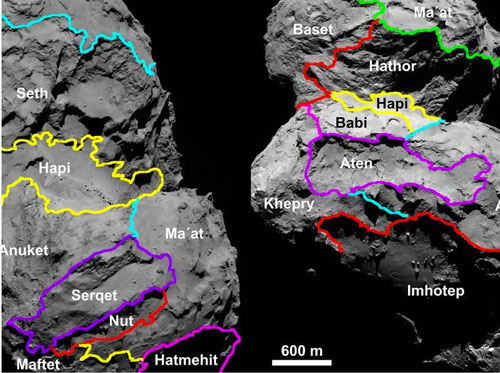
Rosetta's profile of a comet
Measurement results from ESA's space probe provide a comprehensive picture of 67P/Churyumov-Gerasimenko.
January 28, 2015 Read more
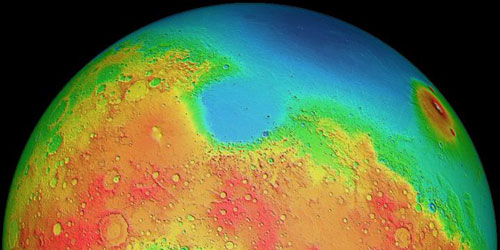
The two faces of Mars
The two hemispheres of Mars are more different from any other planet in our solar system. Non-volcanic, flat lowlands characterise the northern hemisphere, while highlands punctuated by countless volcanoes extend across the southern hemisphere. Although theories and assumptions about the origin of this so-called and often-discussed Mars dichotomy abound, there are very few definitive answers. Geophysicists are now providing a new explanation.
January 28, 2015 Read more
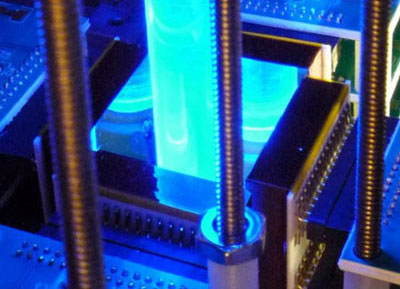
A new instrument to study the extreme universe - the X-Ray polarimeter X-Calibur
The astrophysics research group at Washington University in St.Louis built an instrument that is capable to measure the polarization properties of X-rays. This instrument, once flown in space, can be used in a novel approach to study the most extreme objects in the Universe, such as black holes and neutron stars.
January 28, 2015 Read more
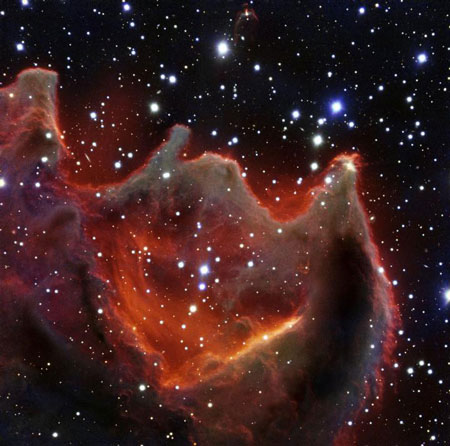
The mouth of the beast
Like the gaping mouth of a gigantic celestial creature, the cometary globule CG4 glows menacingly in this new image from ESO's Very Large Telescope. Although it appears to be big and bright in this picture, this is actually a faint nebula, which makes it very hard for amateur astronomers to spot. The exact nature of CG4 remains a mystery.
January 28, 2015 Read more
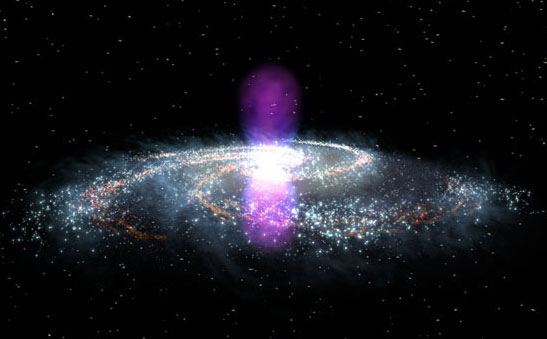
Bubbles from the galactic center: A key to understanding dark matter and our galaxy's past?
Fresh from giving the January Rossi Prize Lecture, the astrophysicists who discovered 2 enormous radiation bubbles in the center of our galaxy discuss what they may tell us about the Milky Way and how they could help in the search for dark matter.
January 27, 2015 Read more
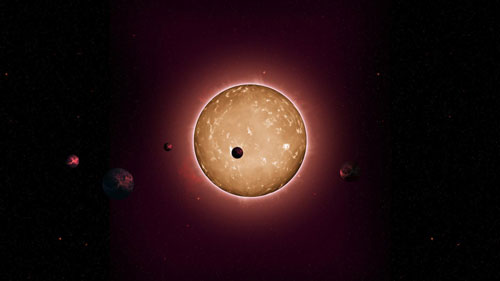
Ancient star system reveals Earth-sized planets forming near start of universe
A Sun-like star with orbiting planets, dating back to the dawn of the Galaxy, has been discovered by an international team of astronomers.
January 27, 2015 Read more
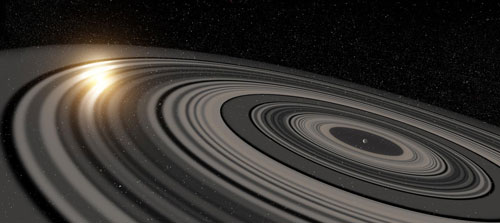
Gigantic ring system around J1407b much larger, heavier than Saturn's
Astronomers have discovered that the ring system that they see eclipse the very young Sun-like star J1407 is of enormous proportions, much larger and heavier than the ring system of Saturn. The ring system - the first of its kind to be found outside our solar system - was discovered in 2012.
January 26, 2015 Read more
Private Moon race heats up as five Google Lunar XPRIZE teams take home $5.25 million (w/video)
XPRIZE, the global leader in incentivized prize competition, today announced that five Google Lunar XPRIZE teams have been awarded a combined US$5.25 million in recognition of key technological advancements toward their quest to land a private spacecraft on the surface of the moon.
January 26, 2015 Read more
Swarm of microprobes to head for Jupiter
A swarm of tiny probes each with a different sensor could be fired into the clouds of Jupiter and grab data as they fall before burning up in the gas giant planet's atmosphere. The probes would last an estimated 15 minutes.
January 26, 2015 Read more
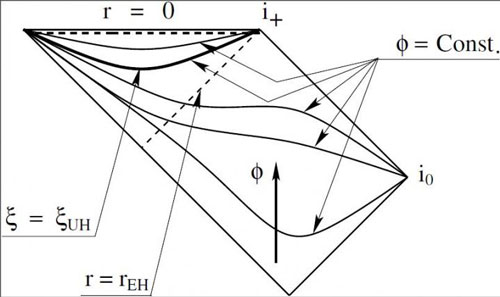
Yes, black holes exist in gravitational theories with unbounded speeds of propagation
Gravitational theories with broken Lorentz invariance have attracted a great deal of interest as they provide a test-bed of LI and offer a mechanism to improve their ultraviolet behavior, so that the theories may be renormalizable. However in such theories, particles can travel with arbitrary velocities and black holes may not exist at all. In contrast to this expectation, it has been shown that an absolute horizon exists, which traps signals despite infinitely large velocities.
January 23, 2015 Read more
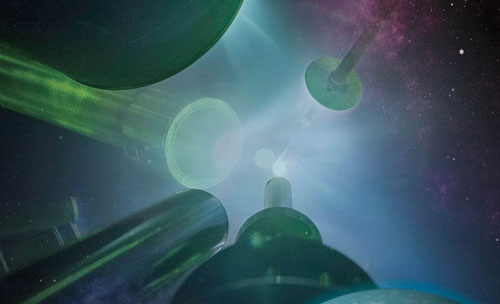
New research re-creates planet formation, super-earths and giant planets in the laboratory
New laser-driven compression experiments reproduce the conditions deep inside exotic super-Earths and giant planet cores, and the conditions during the violent birth of Earth-like planets, documenting the material properties that determined planet formation and evolution processes.
January 23, 2015 Read more
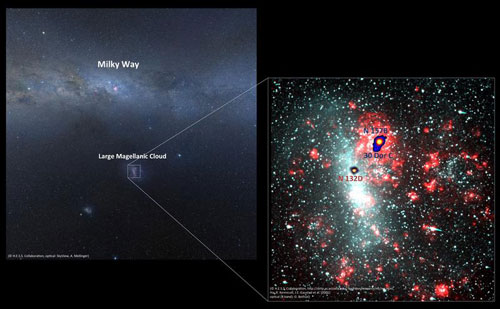
An exceptionally powerful trio in the Large Magellanic Cloud
Once again, the High Energy Stereoscopic System, H.E.S.S., has demonstrated its excellent capabilities. In the Large Magellanic Cloud, it discovered most luminous very high-energy gamma-ray sources.
January 22, 2015 Read more
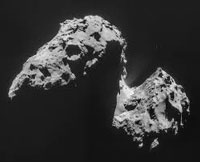
A first peek beneath the surface of a comet
Scientists report early measurements of comet 67P/Churyumov-Gerasimenko's subsurface temperature and production of gas from the surface of its nucleus.
January 22, 2015 Read more
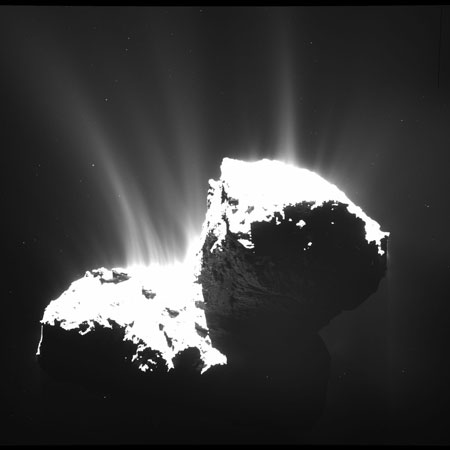
Watching the birth of a comet magnetosphere
The RPC-ICA instrument onboard the Rosetta spacecraft has been watching the early stages of how a magnetosphere forms around Comet 67P Churyumov-Gerasimenko as it moves closer to the Sun along its orbit and begins to interact with the solar wind.
January 22, 2015 Read more
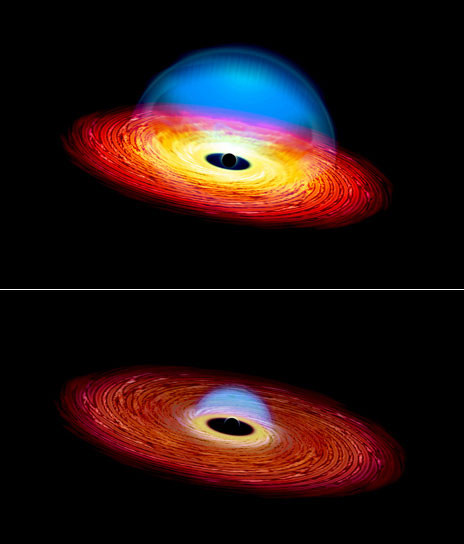
Black hole on a diet creates a 'changing look' quasar
Astronomers have identified the first 'changing look' quasar, a gleaming object in deep space that appears to have its own dimmer switch. The discovery may offer a glimpse into the life story of the universe's great beacons.
January 22, 2015 Read more
Stardust on ocean floor shows gold and uranium alchemy in stars much less frequent than expected
Half the heavy elements in nature are created during stellar explosions such as supernovae or star collisions. Analyzing deep-sea samples of stardust that fell to Earth over millions of years, researchers made a surprising discovery about how frequently far-away stars produce heavy elements like gold and uranium.
January 22, 2015 Read more