

Space Exploration News – Latest Headlines
 Subscribe to our Space Exploration News feed
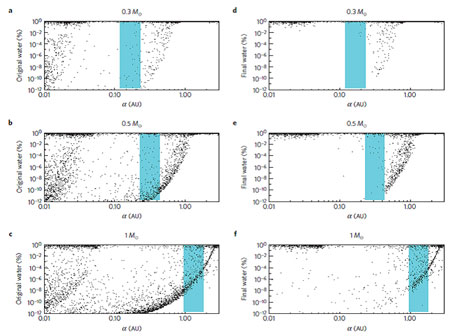
The mystery of cosmic oceans and dunes
Simulations by researchers at Tokyo Institute of Technology and Tsinghua University indicate that Earth-like planets are more likely to be found orbiting Sun-like stars rather than lower-mass stars that are currently targeted, in terms of water contents of planets.
February 17, 2015 Read more
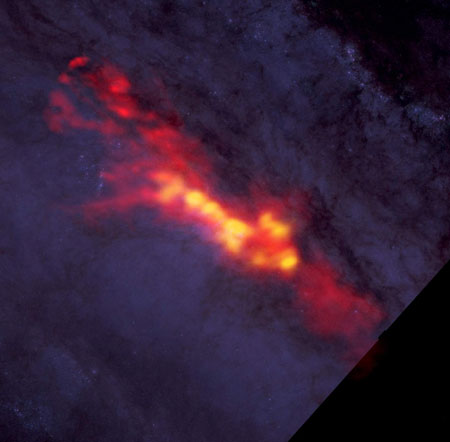
Why do starburst galaxies 'burst'?
Starburst galaxies transmute gas into new stars at a dizzying pace - up to 1,000 times faster than typical spiral galaxies like the Milky Way. To help understand why some galaxies 'burst' while others do not, an international team of astronomers used the Atacama Large Millimeter/submillimeter Array (ALMA) to dissect a cluster of star-forming clouds at the heart of NGC 253, one of the nearest starburst galaxies to the Milky Way.
February 16, 2015 Read more
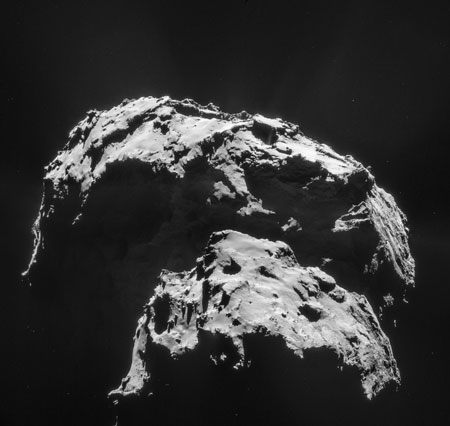
Why comets are like deep fried ice cream
Astronomers tinkering with ice and organics in the lab may have discovered why comets are encased in a hard, outer crust.
February 16, 2015 Read more
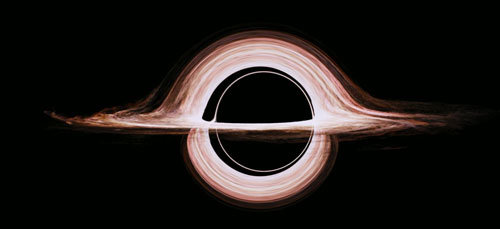
'Interstellar' technology throws light on spinning black holes
The team responsible for the Oscar-nominated visual effects at the centre of Christopher Nolan's epic, Interstellar, have turned science fiction into science fact by providing new insights into the powerful effects of black holes.
February 13, 2015 Read more
Life on other planets: Alternative chemistries of life
Ideas about directing evolution of life forms on Earth and finding life on other planets are rapidly morphing from science-fiction fantasy into mainstream science.
February 12, 2015 Read more
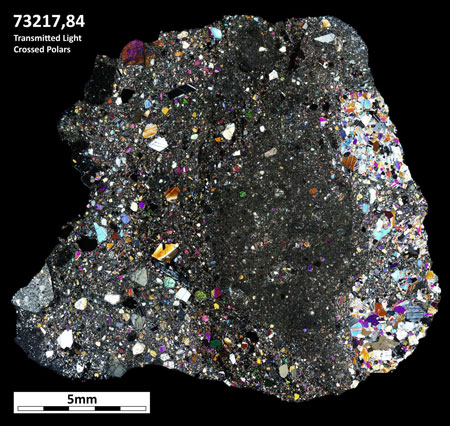
Application of laser microprobe technology to Apollo samples refines lunar impact history
It's been more than 40 years since astronauts returned the last Apollo samples from the moon, and since then those samples have undergone some of the most extensive and comprehensive analysis of any geological collection. Researchers have now refined the timeline of meteorite impacts on the moon through a pioneering application of laser microprobe technology to Apollo 17 samples.
February 12, 2015 Read more
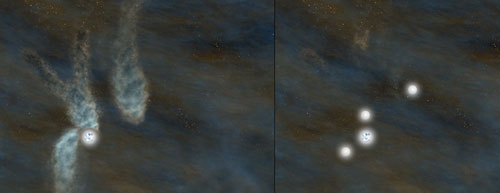
Birth of a star quartet
An international team of researchers has discovered something extraordinary in space: a new star system forming from parts of a filamentary gas cloud.
February 12, 2015 Read more
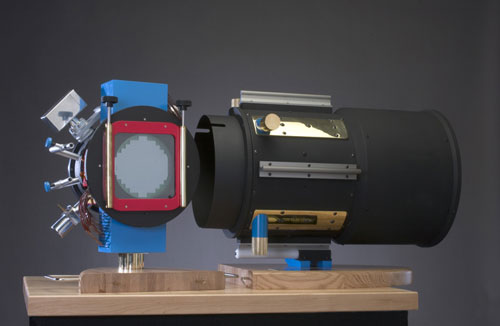
From space junk to asteroids, Dark Energy Camera unveils small objects in our solar system
The Dark Energy Camera, or DECam, peers deep into space from its mount on the 4-meter Victor Blanco Telescope high in the Chilean Andes.
February 12, 2015 Read more
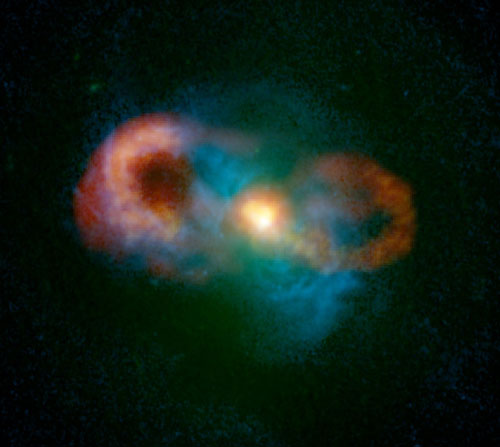
VLA finds unexpected 'storm' at galaxy's core
Supermassive black hole blasting gas, transforming galaxy.
February 11, 2015 Read more
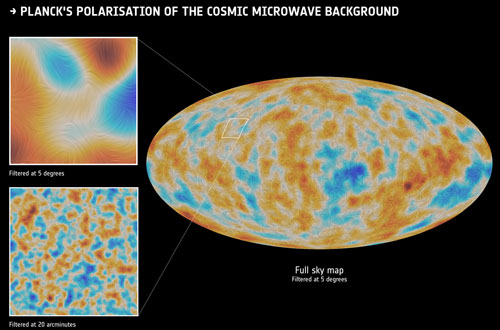
Planck reveals the dynamic side of the Universe
The Planck collaboration has today released data from four years of observation by the European Space Agency's Planck spacecraft. The aim of the Planck mission is to study the Cosmic Microwave Background, the light left over from the Big Bang.
February 11, 2015 Read more
Worms in space: Exploring health effects of microgravity
Can astronauts who spend time in space pass an epigenetic memory of microgravity to their future children? Researchers are hoping experiments with C. elegans can address how human biology reacts when exposed to changes in gravity.
February 10, 2015 Read more
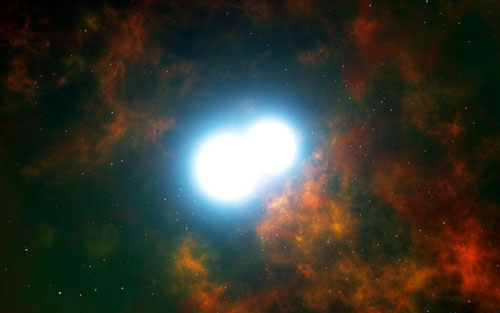
Stellar partnership doomed to end in catastrophe
First pair of merging stars destined to become supernova found.
February 9, 2015 Read more
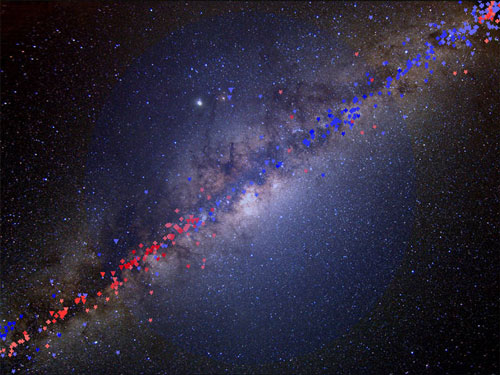
Dark matter at the heart of our Galaxy
The Universe is pervaded by a mysterious form of matter, dubbed dark matter, about five times more abundant than the ordinary matter we are familiar with. Its existence in galaxies was robustly established in the 1970s. Scientists now obtained for the first time a direct observational proof of the presence of dark matter in the innermost part our Galaxy, the Milky Way.
February 9, 2015 Read more
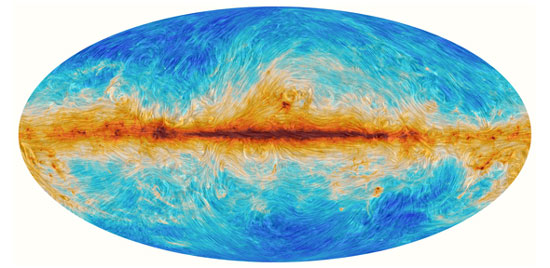
Planck reveals first stars were born late
New maps from the Planck satellite uncover the 'polarised' light from the early Universe across the entire sky, revealing that the first stars formed much later than previously thought.
February 8, 2015 Read more
Lifting the veil on a dark galaxy
A cluster of young, pulsating stars discovered in the far side of the Milky Way may mark the location of a previously unseen dark-matter dominated dwarf galaxy hidden behind clouds of dust.
February 8, 2015 Read more
Still doubts on gravitational waves
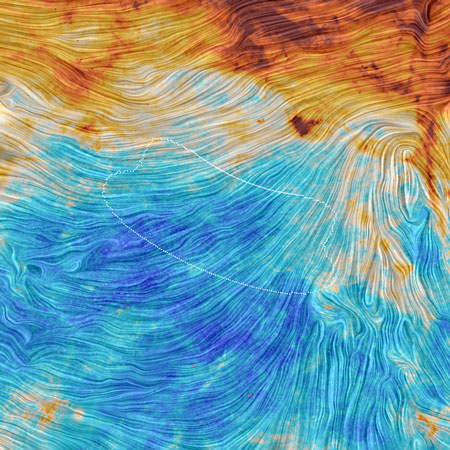
In March last year the BICEP2 team claimed to have observed, for the first time, the effects of gravitational waves in cosmic background radiation. In September Planck demonstrated that the signal observed might be the result of 'contaminants' due to the polarized radiation produced by our Galaxy. A new paper confirms the Planck observation: even following a more accurate analysis (and the adoption of new instruments) there is still evidence of contaminants.
February 2, 2015 Read more
How spaceflight ages the immune system prematurely
New research suggests that a ground-based model simulating some of the effects of spaceflight on mice induces changes in B lymphocyte production in bone marrow.
February 2, 2015 Read more
'Live fast, die young' galaxies lose the gas that keeps them alive
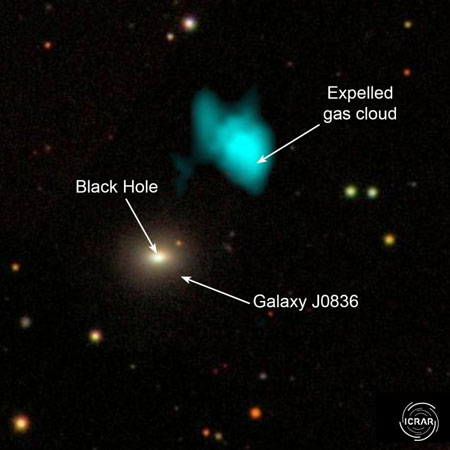
Galaxies can die early because the gas they need to make new stars is suddenly ejected, research published today suggests. Most galaxies age slowly as they run out of raw materials needed for growth over billions of years. But a pilot study looking at galaxies that die young has found some might shoot out this gas early on, causing them to redden and kick the bucket prematurely.
February 2, 2015 Read more