

Nanotechnology News – Latest Headlines
New process makes nanofibers in complex shapes and unlimited lengths
The continuous fabrication of complex, three-dimensional nanoscale structures and the ability to grow individual nanowires of unlimited length are now possible with a process developed by researchers at the University of Illinois.
January 30, 2008 Read more
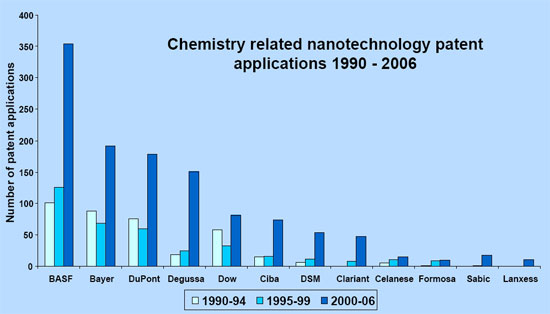
Nanotechnology creates new possibilities for plastics
Plastics are among the most notable business segments that benefit from the emergence of nanotechnology, which leads to new creations by controlling matter on atomic and molecular scale.
January 30, 2008 Read more
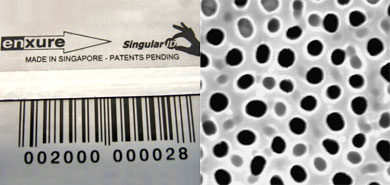
Tiny magnets to repel drug counterfeiters
A large pharmaceutical packaging company is hoping that nanotech security tags devised by a small Singaporean firm will help it combat counterfeit drugs. India-based drug supplier Bilcare says it is in talks with Indian pharmaceutical companies to commercialise the nanoscale magnetic fingerprinting technology by Singular ID, a spin-out they bought for SGD 19.58 million ($14 million) earlier this month.
January 30, 2008 Read more
Nanomedicine research for prostate cancer supported by $5 million gift
The Prostate Cancer Foundation, largely through the generosity of David H. Koch, has given $5 million to four institutions, including Weill Cornell Medical College, to support novel research in prostate cancer. The gift is one of the largest-ever individual donations for prostate cancer research.
January 30, 2008 Read more
Clarkson University's Minko featured in ACS nano podcast
An interview with Sergiy Minko, the Egon Matijevic Chaired Professor of Chemistry and Biomolecular Science at Clarkson University, is featured in the January ACS Nano podcast.
January 30, 2008 Read more
Call for papers on transhumanism and religion
The American Academy of Religion has created a 'Transhumanism and Religion' unit and issued a call for papers for their November 1-3 meeting in Chicago.
January 30, 2008 Read more
Prestigious European grants for top TU Delft researchers Scarano and Vandersypen
Dr Fulvio Scarano and Prof. Lieven Vandersypen of TU Delft are each to receive an ERC Starting Grant from the European Research Council. Their proposals, together with those of about 300 other researchers, were selected from over 9,000 applications. The ERC Starting Grant is a subsidy which is awarded for a period of five years to scientists who lead an independent team or programme and who have the potential to develop into world-class researchers.
January 30, 2008 Read more
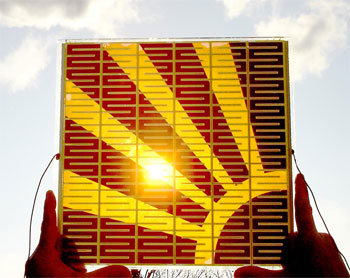
Screen-printed solar cells
Members of the Fraunhofer Institute for Solar Energy Systems ISE are traveling to Tokyo with bulky luggage these days. Their destination is Nanotech 2008, the world's largest trade fair for nanotechnology. Their solar module, which they will be presenting in the BMBF marketing campaign 'Nanotech Germany', is the size and shape of a door: two meters high and sixty centimeters wide.
January 30, 2008 Read more
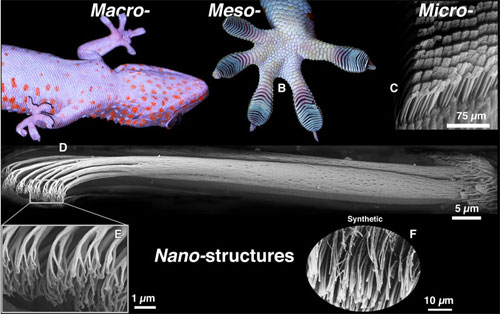
The pitter patter of little feet... climbing straight up a wall
New adhesive is first to mimic quick catch and rapid release traits of a gecko's foot.
January 29, 2008 Read more
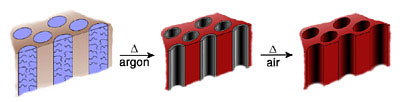
'One-pot' process can make more-efficient materials for fuel cells and solar cells
Cornell researchers have developed a 'one-pot' process to create porous films of crystalline metal oxides that could lead to more-efficient fuel cells and solar cells.
January 29, 2008 Read more
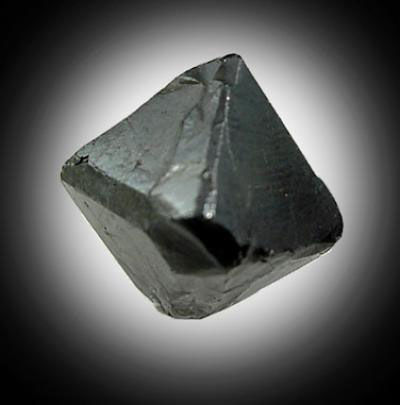
Magnetism loses under pressure
Researchers from the Carnegie Institution's Geophysical Laboratory, together with colleagues at the Advanced Photon Source of Argonne National Laboratory, have found that when magnetite is subjected to pressures between 120,000 and 160,000 times atmospheric pressure its magnetic strength declines by half. They discovered that the change is due to what is called electron spin pairing.
January 29, 2008 Read more
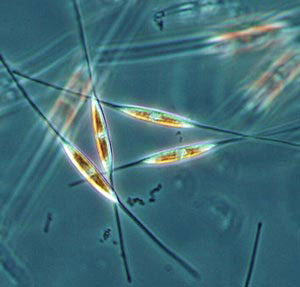
In diatom, scientists find genes that may level engineering hurdle
Denizens of oceans, lakes and even wet soil, diatoms are unicellular algae that encase themselves in intricately patterned, glass-like shells. Curiously, these tiny phytoplankton could be harboring the next big breakthrough in computer chips.
January 29, 2008 Read more
EPA launches nanotechnology monitoring project; Top government officials to speak at FDLI conference
Top officials at the agencies responsible for the regulation of nanotechnology products - including the Food and Drug Administration, Environmental Protection Agency, Occupational Safety and Health Administration and Department of Agriculture - will meet at a Food and Drug Law Institute conference to discuss their plans for managing and monitoring these products.
January 29, 2008 Read more
From here to there: nanotechnology roadmap
Foresight Nanotech Institute and Battelle unveil a Technology Roadmap for Productive Nanosystems.
January 29, 2008 Read more
With a jolt, 'nanonails' go from repellant to wettable
Sculpting a surface composed of tightly packed nanostructures that resemble tiny nails, University of Wisconsin-Madison engineers and their colleagues from Bell Laboratories have created a material that can repel almost any liquid.
January 29, 2008 Read more
Nanotechnology: The big news is small
EPA has awarded 21 grants totaling $7.34 million to universities to investigate potential adverse health and environmental effects of manufactured nanomaterials.
January 29, 2008 Read more
 Subscribe to our Nanotechnology News feed