

Nanotechnology News – Latest Headlines
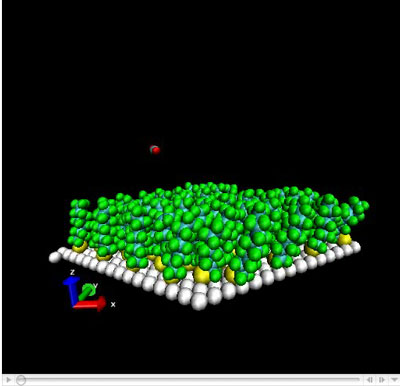
Skipping atomic-scale stones to study some chemistry basics
New experiments reported this week from JILA in Boulder, Colo., are giving a uniquely detailed look at what happens when gas molecule meets fluid.
August 6, 2008 Read more
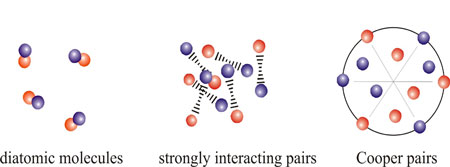
New technique reveals hidden properties of ultracold atomic gases
Physicists at JILA, a joint institute of the National Institute of Standards and Technology (NIST) and the University of Colorado at Boulder, have demonstrated a powerful new technique that reveals hidden properties of ultracold atomic gases.
August 6, 2008 Read more
Stretchable silicon camera next step to artificial retina
By combining stretchable optoelectronics and biologically inspired design, scientists have created a remarkable imaging device, with a layout based on the human eye.
August 6, 2008 Read more
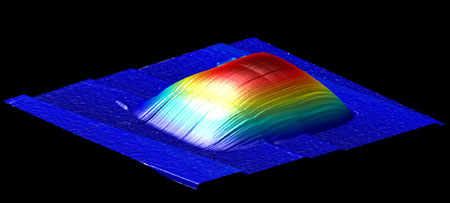
World's thinnest balloon made of graphene
Researchers in New York are reporting development of the world's thinnest balloon, made of a single layer of graphite just one atom thick. This so-called graphene sealed microchamber is impermeable to even the tiniest airborne molecules, including helium.
August 6, 2008 Read more
New class of electronics technology can conform to almost any shape
Instead of using a flat microchip as the light sensor for their new camera, a team of engineers has developed a sensor that is a flexible mesh of wire-connected pixels. The mesh is made from many of the same materials as a standard digital-camera sensor, but has the unique ability to conform to convoluted, irregular surfaces.
August 6, 2008 Read more
Innovative research brings quantum computers one step closer
Complex computer encryption codes could be solved and new drug design developed significantly faster thanks to new research carried out by the University of Surrey.
August 6, 2008 Read more
NanomMed 2009: 6th International Conference on Biomedical Applications of Nanotechnology
Experts from all over the world will gather for the 6th NanoMed conference from March 4-6, 2009 in Berlin to discuss the state of the art in biomedical applications of nanotechnology.
August 6, 2008 Read more
Now that's cool: Engineers out to thaw the mysteries of ice
'Ye canna change the laws of physics!' Scotty warned Captain Kirk on Star Trek. But engineers and physicists at the University of Maryland may rewrite one of them. The Third Law of Thermodynamics is on the minds of John Cumings and his research group as they examine the crystal lattice structure of ice and seek to define exactly what happens when it freezes.
August 6, 2008 Read more
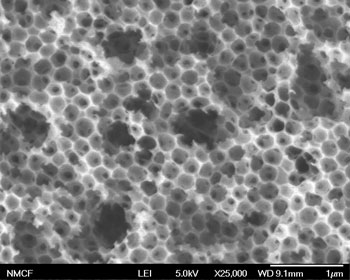
Nanotechnology fuel cell research may clear hydrogen hurdles
The biggest stumbling block preventing the widespread adoption of fuel cell technology has been a reliance on hydrogen as the fuel. Not only is hydrogen both difficult and dangerous to store and distribute, but 96 percent of hydrogen comes from oil and gas. New research from a University of Virginia team, recently funded by a new U.Va. Collaborative Sustainable Energy Seed Grant worth about $30,000, is taking two approaches to removing the need for hydrogen.
August 6, 2008 Read more
U.S. varsity team in India stresses potential of nanomedicine
A delegation from the University of Missouri that visited Chennai recently with its focus on nanomedicine, sought to explore ways to 'develop a scholarly, creative partnership that has a high impact on science and the potential to do something good for patients? unable to afford the treatment.'
August 5, 2008 Read more
Nanotechnology event: Nanoscale Materials Stewardship Seminar
Join the International Association of Nanotechnology, the United States Environmental Protection Agency (USEPA) and the California Department of Toxic Substances Control (CDTSC) on Wednesday, August 13, to provide input on new initiatives and regulations underway concerning nanotechnology.
August 5, 2008 Read more
Japanese-German dialogue on micro- and nanotechnology sets direction for the future
With over 300 participants from Japan, the Japanese-German Micro/Nano Business Forum at the Exhibition Micromachine/MEMS on July 30 in Tokyo was a huge success.
August 5, 2008 Read more
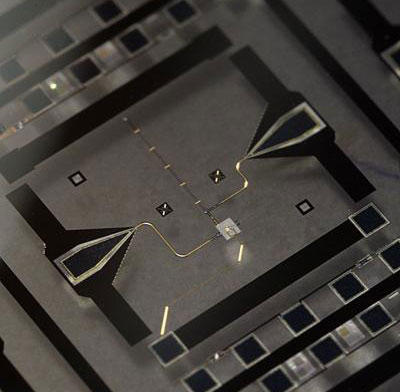
Researchers make milestone discovery in quantum mechanics
UCSB physicists Max Hofheinz, John Martinis, and Andrew Cleland showed how they used a superconducting electronic circuit known as a Josephson phase qubit, developed in Martinis's lab, to controllably pump microwave photons, one at a time, into a superconducting microwave resonator.
August 5, 2008 Read more
Nanodraht aus DNA
Losgeloest von ihrem biologischen Ursprung wurden kuenstliche DNA-Doppelhelices so modifiziert, dass das evolutionaer optimierte Biomolekuel auch als Geruest fuer die Anordnung von Metall-Ionen genutzt werden kann.
August 5, 2008 Read more
Japanisch-deutscher Dialog zur Mikro- und Nanotechnologie setzt Zeichen fuer die Zukunft
Mit mehr als 300 japanischen Teilnehmern war das japanisch-deutsche Mikro/Nano-Business-Forum auf der Exhibition Micromachine/MEMS am 30. Juli in Tokio ein voller Erfolg.
August 5, 2008 Read more
Intriguing structures of gold nanoparticles
Scientists from Germany, Canada and the Netherlands have studied tiny gold nanoparticles, so-called clusters, and found them to have fascinating arrangements of their constituent atoms.
August 5, 2008 Read more
 Subscribe to our Nanotechnology News feed