

Nanotechnology News – Latest Headlines
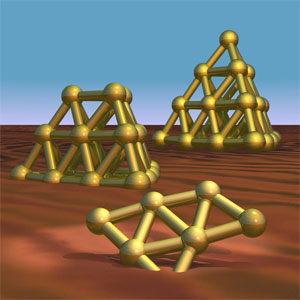
Nano sculptures in gold
Scientists in Berlin are using a new method to resolve the structure of uncharged gold nano particles.
August 1, 2008 Read more
New nanotechnology tagging system to help solve gun crime
Successful convictions in the fight against rising gun crime could be given a boost thanks to new DNA tagging technology developed by scientists at the University of Surrey.
August 1, 2008 Read more
China becomes a physics powerhouse
Judged by the astonishing increase in journal papers written by scientists in China, there can be little doubt that China is finding its place as one of the world's scientific power houses.
August 1, 2008 Read more
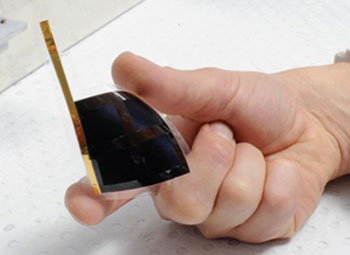
Revolutionary Goretex design fuels the next generation of hybrid cars
Monash University scientists have revolutionised the design of fuel cells used in the latest generation of hybrid cars which could make the vehicles more reliable and cheaper to build.
August 1, 2008 Read more
X-Ray diffraction of aerogel reveals nanoscale 3-D bulk lattice structure
A multi-institutional team of scientists has used beamline 9.0.1 at the Advanced Light Source to perform high-resolution x?]ray diffraction imaging of an aerogel for the first time, revealing its nanoscale three-dimensional bulk lattice structure down to features measured in nanometers.
July 31, 2008 Read more
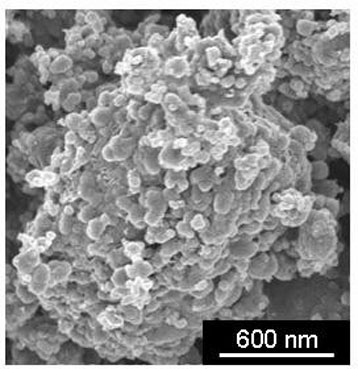
Promising nanomaterial lithium batteries for electric cars
Why does lithium iron phosphate, a candidate for use in future lithium batteries, conduct electricity despite being an insulating material? Chemists in France have shed light on this paradox.
July 31, 2008 Read more
Researchers analyze material with 'colossal ionic conductivity'
A new material characterized at the Department of Energy's Oak Ridge National Laboratory could open a pathway toward more efficient fuel cells.
July 31, 2008 Read more
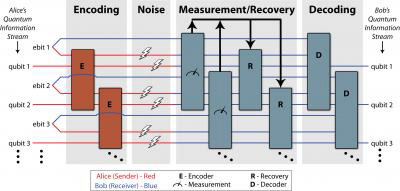
Viterbi Algorithm goes quantum
An old technique helps Bob correctly decode Alice's entangled message qubit.
July 31, 2008 Read more
QuantumSphere Announces Breakthrough in Clean Efficient Hydrogen Production by Electrolysis
Nano-enabled electrodes decrease cost, increase performance.
July 31, 2008 Read more
New nanomaterial that makes plastic stiffer, lighter and stronger
A Michigan State University researcher and his students have developed a nanomaterial that makes plastic stiffer, lighter and stronger and could result in more fuel-efficient airplanes and cars as well as more durable medical and sports equipment.
July 31, 2008 Read more
Graphene films have potential as next-generation transistors
Physicists at the University of Pennsylvania have characterized an aspect of graphene film behavior by measuring the way it conducts electricity on a substrate. This milestone advances the potential application of graphene, the ultra-thin, single-atom thick carbon sheets that conduct electricity faster and more efficiently than silicon, the current material of choice for transistor fabrication.
July 31, 2008 Read more
Scientists carve functional nanoribbons using super-heated, nano-sized particles of iron
Physicists at the University of Pennsylvania have demonstrated a new method by which few layer graphene can be etched along flawless, crystallographic axes by using thermally activated nanoparticles, a technique that results in atomically precise, macroscopic length ribbons of graphene.
July 31, 2008 Read more
NanoScale Materials Stewardship Seminar on August 13
Join the International Association of Nanotechnology at the NanoScale Materials Stewardship Seminar on August 13, to discuss new initiatives and collaborate with the U.S. Environmental Protection Agency (USEPA) and the California Environmental Protection Agency (CALEPA) to implement mutually beneficial standards for nanoparticles.
July 31, 2008 Read more
Scientists find way to harness nanomotors to engineer nanosystems for transport and assembly
A paper in this week's nature Nanotechnology outlines a roadmap for harnessing nanomotors for a broad range of applications, ranging from nanoscale sensing, and transport to assembly. It focuses on two broad classes of nanomotors that burn chemical energy to move along linear tracks: assembly nanomotors and transport nanomotors.
July 31, 2008 Read more
The amazing quantum world of ultra cold matter
Many of us have been fascinated by the concept of absolute zero, the temperature at which everything comes to a complete stop. But physics tells us otherwise: absolute zero cannot be reached but only approached, and the closer you get, the more interesting phenomena you find!
July 31, 2008 Read more
Nanojewels made easy
Coaxing colors from nanoscale particles broadens horizons for optical technologies.
July 30, 2008 Read more
 Subscribe to our Nanotechnology News feed