

Nanotechnology News – Latest Headlines
Gel-based glue fastens snails to wet surfaces, model for surgical adhesive
New findings could lead to developing surgical adhesives that would bind to wet surfaces and be less invasive than suturing mechanisms.
May 1, 2009 Read more
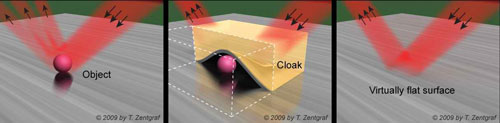
Never mind Harry Potter, researchers at Berkeley have made an invisibility cloak of their own
Blurring the lines between magic and science: Berkeley researchers create an 'invisibility cloak'.
May 1, 2009 Read more
SAFENANO to host Nanotechnology Risk Management Workshop at NanoMaterials '09
SAFENANO, the UK's premier resource on Nanotechnology Health and Safety, is pleased to announce it is to host a Pre-Conference workshop on Nanotechnology Risk Management at the forthcoming NanoMaterials '09 conference in Bonn, Germany.
May 1, 2009 Read more
Atomic physics study sets new limits on hypothetical new particles
In a forthcoming Physical Review Letters article, a group of physicists at the University of Nevada, Reno are reporting a refined analysis of experiments on violation of mirror symmetry in atoms that sets new constraints on a hypothesized particle, the extra Z-boson.
May 1, 2009 Read more
University of South Carolina receives $12.5 million for alternative energy research center
The University of South Carolina has been selected by the U.S. Department of Energy to house a research center that is expected to bring $12.5 million in federal funding, the largest award in the university's history, to a team of internationally recognized energy researchers in the College of Engineering and Computing.
May 1, 2009 Read more
New study of 24 nanoparticles clearly highlights the difference of sensitivity between cell types and cytotoxicity assays
A new study clearly highlights the difference of sensitivity between cell types and cytotoxicity assays that has to be carefully taken into account when assessing nanoparticles toxicity.
May 1, 2009 Read more
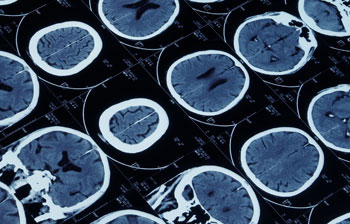
A safer nanocolloid contrast agent for magnetic resonance imaging
US and UK scientists have discovered a safer contrast agent for magnetic resonance imaging (MRI). The agent is an alternative to commonly used, but potentially harmful, gadolinium-based agents.
May 1, 2009 Read more
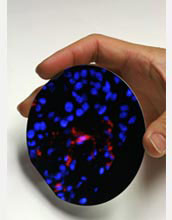
Nanoparticle cancer test in mice could pave the way for human uses
The first biodegradable fluorescent nanoparticle to safely image tumors and organs in live mice could be used for cancer detection and treatment in humans.
May 1, 2009 Read more
New Journal of Physical Chemistry Letters to debut in January
In response to the increasing demand for rapid dissemination of urgent research results in physical chemistry, the American Chemical Society (ACS) is pleased to announce the forthcoming publication of the Journal of Physical Chemistry Letters.
April 30, 2009 Read more
European consortium lights the way for photonics research
An umbrella group set up to give direction to Europe?s emerging photonics community has proposed a programme of strategic research and is calling for action to address a looming skills shortage.
April 30, 2009 Read more
New nanoparticle drug delivery technology shows promise against resistant staph infections
Scientists at Albert Einstein College of Medicine of Yeshiva University have combined their revolutionary new drug-delivery system with a powerful antimicrobial agent to treat potentially deadly drug-resistant staph infections in mice.
April 30, 2009 Read more
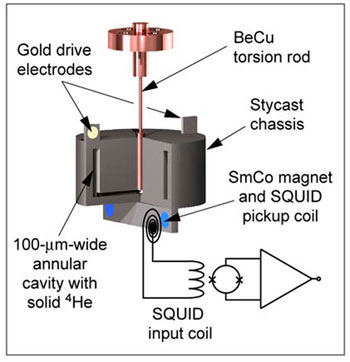
Supersolid or superglass?
Cornell researchers study a strange state of matter in helium.
April 30, 2009 Read more

New Center for Molecular Electrocatalysis at PNNL to study catalysis for solar energy, fuel cells
The Department of Energy's Pacific Northwest National Laboratory will be home to one of 46 new multi-million-dollar Energy Frontier Research Centers announced earlier this week.
April 30, 2009 Read more
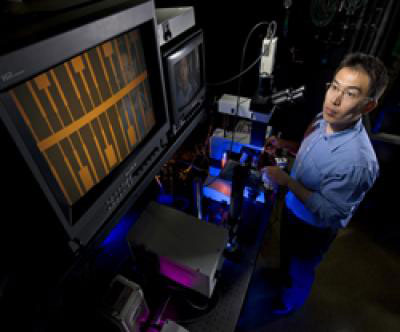
Novel carbon nanotube device can detect all colors of the rainbow
Researchers at Sandia National Laboratories have created the first carbon nanotube device that can detect the entire visible spectrum of light, a feat that could soon allow scientists to probe single molecule transformations, study how those molecules respond to light, observe how the molecules change shapes, and understand other fundamental interactions between molecules and nanotubes.
April 30, 2009 Read more
OECD publishes new report on in its series on the safety of manufactured nanomaterials
This report provides preliminary analyses and recommendations as well as brief summaries of background documents listed in the operational plan relevant to phase 1 of the project on exposure measurement and exposure mitigation.
April 30, 2009 Read more
European funding program FP7 fares well after two years and proves an asset in crisis recovery
According to a progress report, the Seventh Framework Programme (FP7) is on the right course to respond to the EU's socioeconomic needs, and is particularly relevant with regard to the challenges posed by the current financial crisis.
April 30, 2009 Read more
 Subscribe to our Nanotechnology News feed