

Space Exploration News – Latest Headlines
 Subscribe to our Space Exploration News feed
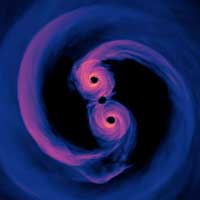
Quantum projects launched to solve universe's mysteries
Researchers will use cutting-edge quantum technologies to transform our understanding of the universe and answer key questions such as the nature of dark matter and black holes.
January 14, 2021 Read more
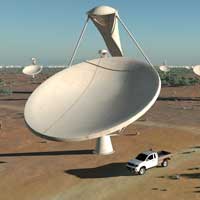
Can gravitational waves be detected by radio telescopes?
Two theoretical physicists are proposing a new approach to detect gravitational waves using a totally different type of observations: according to their calculations, parts of the waves should have converted to radio waves on their journey through the Universe, which might be measured by future radio telescopes.
January 14, 2021 Read more
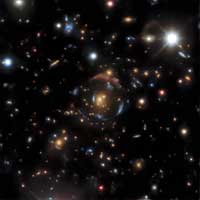
Doubling the number of known gravitational lenses
Astronomers hunting for gravitational lenses utilized machine learning to inspect the vast dataset known as the DESI Legacy Imaging Surveys, uncovering 1210 new lenses.
January 14, 2021 Read more
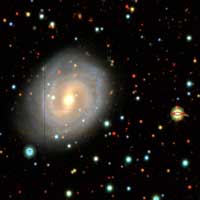
Building a giant 2D map of the universe to prepare for the largest 3D map
Nearly 200 researchers pitched in to gather, process, and stitch together images for half of the sky to prepare for the start of the Dark Energy Spectroscopic Instrument's observations.
January 14, 2021 Read more
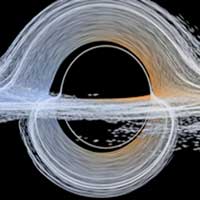
Could we harness energy from black holes?
A new study indicates energy can be extracted from black holes through reconnection of magnetic field lines.
January 13, 2021 Read more
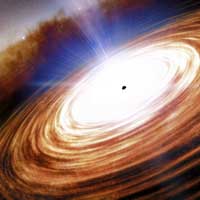
Astronomers discover most distant quasar
A team of astronomers has observed a luminous quasar 13.03 billion light-years from Earth - the most distant quasar discovered to date.
January 12, 2021 Read more
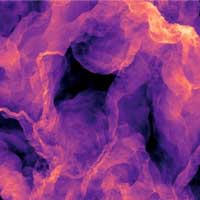
Unlocking the secrets of star formation
A new study by an international team of researchers has used computer power to map the so-called sonic scale, showing the key role turbulence plays in star formation.
January 11, 2021 Read more
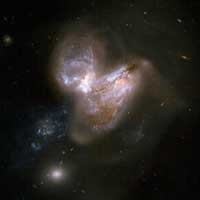
When galaxies collide: Hubble showcases six beautiful galaxy mergers
It is during rare merging events that galaxies undergo dramatic changes in their appearance and in their stellar content. These systems are excellent laboratories to trace the formation of star clusters under extreme physical conditions.
January 7, 2021 Read more
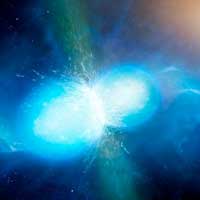
How large are neutron stars?
An interdisciplinary research team has identified new, narrower limits on the radii of neutron stars. The team determined the radius of a typical neutron star to be close to 11 kilometers.
December 30, 2020 Read more

Primordial black holes and the search for dark matter from the multiverse
Astrophysicists describe a novel scenario for PBH formation and showed that the black holes from the 'multiverse' scenario can be found using the Hyper Suprime-Cam of the 8.2m Subaru Telescope.
December 28, 2020 Read more
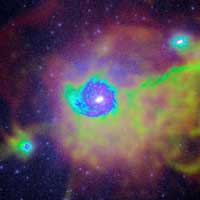
How nearby galaxies form their stars
The star-formation activity of typical, nearby galaxies is found to scale proportionally with the amount of gas present in these galaxies. This points to the net gas supply from cosmic distances as the main driver of galactic star formation.
December 22, 2020 Read more
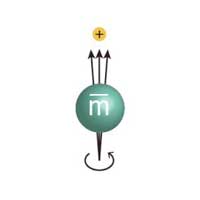
Looking for dark matter near neutron stars with radio telescopes
The targets of this search were two nearby neutron stars known to have strong magnetic fields, as well as the Milky Way's center, which is estimated to host half a billion neutron stars. Since no signal was seen, the team was able to impose the strongest limits to date on axion dark matter particles of a few micro electron-volt mass.
December 21, 2020 Read more

Key building block for organic molecules discovered in meteorites
Scientists have confirmed the presence in meteorites of a key organic molecule which may have been used to build other organic molecules, including some used by life. The discovery validates theories of the formation of organic compounds in extraterrestrial environments.
December 18, 2020 Read more
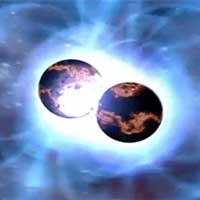
Colliding stars reveal fundamental properties of matter and space-time
Combining various observational data of neutron-star collisions with nuclear-physics calculations, astrophysicists made a breakthrough in constraining the size of a typical neutron star and in measuring the expansion rate of our Universe, determined by the Hubble constant.
December 18, 2020 Read more
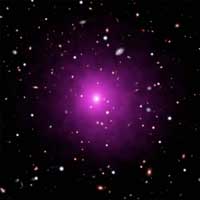
On the hunt for a missing giant black hole
Despite searching with the Chandra X-ray Observatory and Hubble Space Telescope, astronomers have no evidence that a distant black hole estimated to weigh between 3 billion and 100 billion times the mass of the sun is anywhere to be found. This missing black hole should be in the enormous galaxy in the center of the galaxy cluster Abell 2261, which is located about 2.7 billion light-years from Earth.
December 18, 2020 Read more

Smart fabric collects space dust on International Space Station
A smart fiber being tested on the International Space Station could be used to develop space dust telescopes and allow astronauts to feel through their pressurized suits.
December 17, 2020 Read more
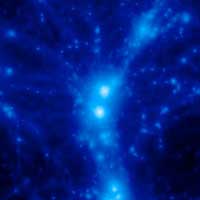
Longest intergalactic gas filament discovered
Astrophysicists have for the first time observed a gas filament with a length of 50 million light years. Its structure is strikingly similar to the predictions of computer simulations.
December 17, 2020 Read more
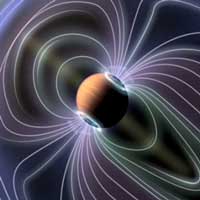
Astronomers detect possible radio emission from exoplanet
By monitoring the cosmos with a radio telescope array, an international team of scientists has detected radio bursts emanating from the constellation Booetes. The signal could be the first radio emission collected from a planet beyond our solar system.
December 16, 2020 Read more