

Space Exploration News – Latest Headlines
 Subscribe to our Space Exploration News feed
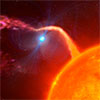
High-speed propeller star is fastest spinning white dwarf
Record-breaking spin rate for a confirmed white dwarf star is observed astronomers. Establishes the star as only the second magnetic propeller ever found, over seventy years since the first.
November 22, 2021 Read more

Alien organisms - hitchhikers of the galaxy?
Scientists warn, without good biosecurity measures 'alien organisms' on Earth may become a reality stranger than fiction.
November 17, 2021 Read more

Life on Mars search could be misled by false fossils, study says
Mars explorers searching for signs of ancient life could be fooled by fossil-like specimens created by chemical processes, research suggests.
November 17, 2021 Read more
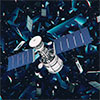
Russian anti-satellite weapon test: What happened and what are the risks?
On Nov. 15, 2021, U.S. officials announced that they had detected a dangerous new debris field in orbit near Earth. Later in the day, it was confirmed that Russia had destroyed one of its old satellites in a test of an anti-satellite weapon.
November 17, 2021 Read more
Astronomers team up to create new method to understand galaxy evolution
New research outlines a new method to establish the star formation history of a post-starburst galaxy using its cluster population. The approach uses the age and mass estimates of stellar clusters to determine the strength and speed of the starburst that stopped more stars from forming in the galaxy.
November 16, 2021 Read more
The worlds next door: Looking for habitable planets around Alpha Centauri
Could life survive around the nearest stars? This project aims to find out.
November 16, 2021 Read more
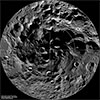
Carbon dioxide cold traps on the moon are confirmed for the first time
The traps likely contain solid carbon dioxide that could be used to sustain robot or human presence on the moon.
November 15, 2021 Read more

Have we made an object that could travel 1% the speed of light?
While 1% of anything doesn't sound like much, with light, that's still really fast - close to 7 million miles per hour! At 1% the speed of light, it would take a little over a second to get from Los Angeles to New York. This is more than 10,000 times faster than a commercial jet.
November 15, 2021 Read more
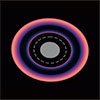
Simulations provide clue to missing planets mystery
New supercomputer simulations show that after creating a ring, a planet can move away and leave the ring behind. Not only does this bolster the planet theory for ring formation, the simulations show that a migrating planet can produce a variety of patterns matching those actually observed in disks.
November 12, 2021 Read more
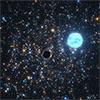
Black hole found hiding in star cluster outside our galaxy
Astronomers have discovered a small black hole outside the Milky Way by looking at how it influences the motion of a star in its close vicinity. This is the first time this detection method has been used to reveal the presence of a black hole outside of our galaxy.
November 11, 2021 Read more
Discovering exoplanets using artificial intelligence
A team of astronomers used artificial intelligence (AI) applied to image recognition. They taught a machine to predict the effect of interactions between planets, making it possible to discover exoplanets that were impossible to detect until now.
November 11, 2021 Read more
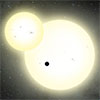
New method to detect Tatooine-like planets validated
A new technique has allowed scientists to quickly detect a transiting planet with two suns.
November 10, 2021 Read more
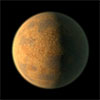
Tread lightly: 'Eggshell planets' possible around other stars
Strange 'eggshell planets' are among the rich variety of exoplanets possible, according to a study. These rocky worlds have an ultra-thin outer brittle layer and little to no topography. Such worlds are unlikely to have plate tectonics, raising questions as to their habitability.
November 10, 2021 Read more
Gamma ray discovery could advance understanding of UFOs' role in the evolution of galaxies
Using data gathered by the Large Area Telescope onboard NASA's Fermi Gamma-ray Space Telescope and a stacking technique combining signals too weak to be observed on their own, researchers detected gamma rays from ultra-fast outflows (UFOs) in several nearby galaxies for the first time, providing a basis for scientists to understand what happened in our own Milky Way galaxy.
November 10, 2021 Read more
Astronomers detect signs of water in a galaxy far, far away
New study marks most distant detection of required element for life as we know it in a regular star-forming galaxy.
November 3, 2021 Read more
Rocky exoplanets are even stranger than we thought
A new astrogeology study suggests that most nearby rocky exoplanets are quite unlike anything in our Solar System.
November 2, 2021 Read more
Galaxy murder mystery solved
Galaxies are being killed in one of the most extreme regions of the nearby Universe and astronomers think they know why. New findings provide the clearest evidence yet that the extreme environments surrounding galaxies can reach far within them and steal their molecular gas - the fuel needed to birth new stars and keep a galaxy alive.
November 2, 2021 Read more
Explore the universe with virtual reality
Have you ever wanted to explore outer-space? Now you can, without leaving Earth, thanks to powerful, open-source beta software VIRUP that builds - in real-time - a virtual universe based on the most detailed contemporary astrophysical and cosmological data.
November 1, 2021 Read more