

Space Exploration News – Latest Headlines
 Subscribe to our Space Exploration News feed
Stellar 'ashfall' could help distant planets grow
The world's first 3D simulation simultaneously considering dust motion and growth in a disk around a young star has shown that large dust from the central region can be entrained by and then ejected by gas outflows, and eventually fall back onto the outer regions of the disk where it may enable planetesimal formation.
December 14, 2021 Read more
Super-bright stellar explosion is likely a dying star giving birth to a black hole or neutron star (w/video)
The discovery, based on an unusual event dubbed 'the Cow', may offer astronomers a new way to spot infant compact objects.
December 13, 2021 Read more
Einstein wins again
The theory of general relativity passes a range of precise tests set by pair of extreme stars.
December 13, 2021 Read more
Astronomers find clue to solar system formation through little-known star
An international study focusing on an infamous star in Orion may help to shed light on how the solar system formed.
December 10, 2021 Read more
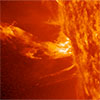
You can help scientists study the Sun
If you ever wanted to be an astronomer, now is your chance. A new citizen science project allows volunteers to play an important role in learning more about the Sun by using their personal computers.
December 9, 2021 Read more
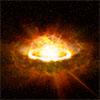
Researchers capture the fastest optical flash emitted from a newborn supernova
A team of astronomers has discovered the fastest optical flash of a Type Ia supernova.
December 9, 2021 Read more

Machine Learning decodes the tremors of the Universe
Researchers trained a neural network to estimate - in just a few seconds - the precise characteristics of merging black holes based on their gravitational-wave emissions. The network determines the masses and spins of the black holes, where in the sky, at what angle, and how far away from Earth the merger took place.
December 9, 2021 Read more
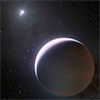
Astronomers observe planet orbiting b Centauri
The European Southern Observatory's Very Large Telescope has captured an image of a planet orbiting b Centauri, a two-star system that can be seen with the naked eye.
December 8, 2021 Read more
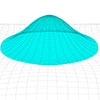
Gravitational waves could be key to answering why more matter was left over after Big Bang
A team of theoretical researchers have found it might be possible to detect Q-balls in gravitational waves, and their detection would answer why more matter than anti-matter to be left over after the Big Bang.
December 8, 2021 Read more
Star's self destruction is shown in 3D, revealing new details
A 1,000-year-old supernova has been captured in 3D images that reveal yet unseen details of the elements that are ejected when a star explodes. Analysis of data from the Multi-Unit Spectroscopic Explorer (MUSE) and X-shooter at the European Southern Observatory's (ESO) Very Large Telescope (VLT), offers new insights into how stars self-destruct.
December 8, 2021 Read more
Astronomers discover strangely massive black hole in Milky Way satellite galaxy
Astronomers have discovered an unusually massive black hole at the heart of one of the Milky Way's dwarf satellite galaxies, called Leo I. Almost as massive as the black hole in our own galaxy, the finding could redefine our understanding of how all galaxies evolve.
December 1, 2021 Read more
Astronomers observe a new type of binary star long predicted to exist
Astronomers have observed a new type of binary star that has long been theorized to exist. The discovery finally confirms how a rare type of star in the universe forms and evolves.
December 1, 2021 Read more
Record-breaking simulations of large-scale structure formation in the Universe
Scientists present computer simulations that capture the complex dynamics of elusive neutrinos left over from the Big Bang.
December 1, 2021 Read more
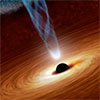
Mysterious clouds could offer new clues on dark matter
The hunt for gravitational waves, ripples in space and time caused by major cosmic cataclysms, could help solve one of the Universe's other burning mysteries - boson clouds and whether they are a leading contender for dark matter.
December 1, 2021 Read more
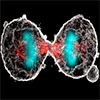
Cells' replication of DNA is more error-prone in microgravity
Researchers show for the first time that a DNA polymerase enzyme derived from bacteria makes 10-140% more errors while copying DNA in microgravity. Combined with the known greater rate of DNA damage from space radiation, this inaccuracy of DNA replication is likely to pose a threat to the health of future astronauts on long missions.
November 29, 2021 Read more
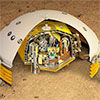
Mars seismic deployment lays groundwork for future planetary missions
About 1000 days after the Mars InSight mission deployed SEIS, the first seismometer on the red planet, researchers are analyzing new seismic data and reporting on instrument responses, using these data to plan for future planetary seismographs.
November 24, 2021 Read more
DARPA takes first steps towards biomanufacturing capabilities in space
B-SURE program aims to develop fundamental understanding of microbial capabilities for bioproduction in space.
November 24, 2021 Read more

Analysis of Mars's wind-induced vibrations sheds light on the planet's subsurface properties
Seismic data collected in Elysium Planitia, the second largest volcanic region on Mars, suggest the presence of a shallow sedimentary layer sandwiched between lava flows beneath the planet's surface.
November 23, 2021 Read more