

Robotics, AI and SmartTech News – Latest Headlines
 Subscribe to our Robotics, AI & SmartTech News feed

PAN-ROBOTS: Automating logistics for the factory of the future
Mass production and packaging in factories is already highly automated these days, but the same cannot be said for logistics. Movements of raw materials and finished products still depend heavily on manual labour. However, EU-funded research on Automatic Guided Vehicles means this is about to change over the next decade.
April 20, 2015 Read more
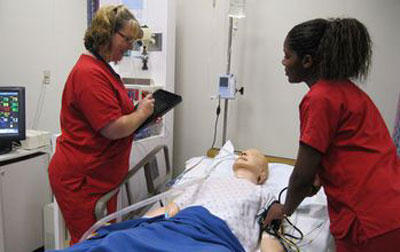
How robots can help build better doctors
Research seeks to make better 'human patient simulators'.
April 7, 2015 Read more

Octopus-inspired robot is the fastest underwater robot based on the given power (w/video)
Ability to morph (change shape), propel itself and turn quickly in water (i.e. super-manoeuvrability) efficiently and silently, lending itself to future possibilities in surveillance and inspection.
April 2, 2015 Read more
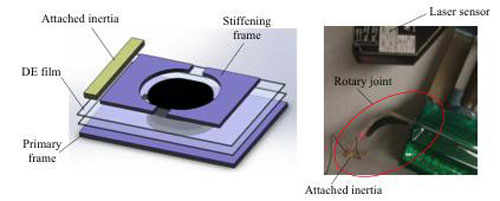
Soft, energy-efficient robotic wings
New discovery that can make a dielectric elastomer joint bend up and down demonstrates its potential in soft robotic applications as lightweight, energy-efficient flapping wings.
March 31, 2015 Read more
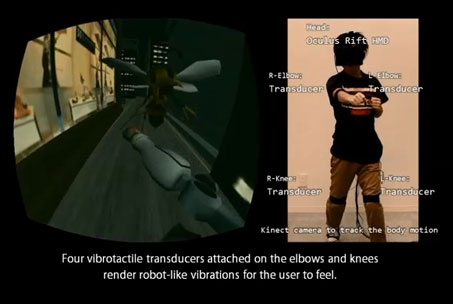
Human Interface: Virtual robotization for human limbs
A new virtual reality robotization gaming system called Jointonation, has taken gaming to a new level by allowing the player to discover what it feels like to become a robot. The robotic simulation uses a combination of visual, auditory and tactile sensations to 'transform' the player's arms and legs into metallic limbs.
March 25, 2015 Read more
Robobarista can figure out your new coffee machine (w/video)
In the near future we may have household robots to handle cooking, cleaning and other menial tasks. They will be teachable: Show the robot how to operate your coffee machine, and it will take over from there.
March 24, 2015 Read more
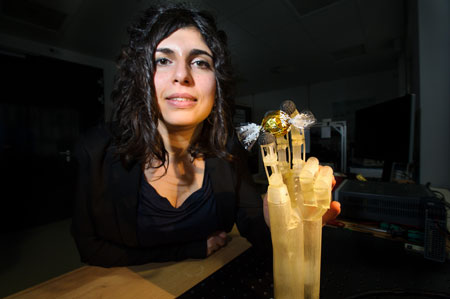
Artificial hand able to respond sensitively thanks to muscles made from smart metal wires
Engineers have taken a leaf out of nature's book by equipping an artificial hand with muscles made from shape-memory wire. The new technology enables the fabrication of flexible and lightweight robot hands for industrial applications and novel prosthetic devices.
March 24, 2015 Read more
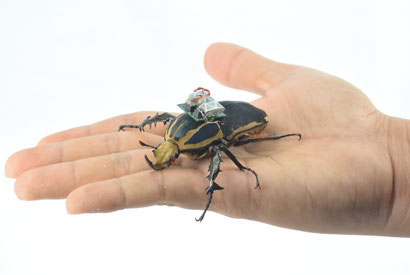
Cyborg beetle research allows free-flight study of insects (w/video)
Hard-wiring beetles for radio-controlled flight turns out to be a fitting way to learn more about their biology. Cyborg insect research is enabling new revelations about a muscle used by beetles for finely graded turns.
March 16, 2015 Read more
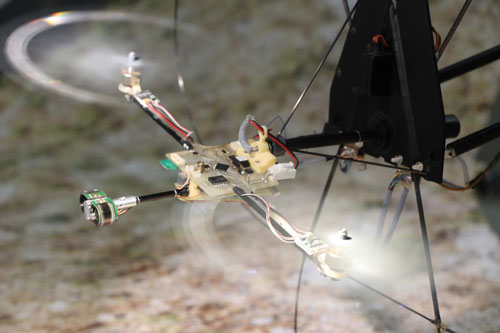
Bio-inspired eye stabilizes robot's flight without need for an accelerometer
Biorobotics researchers have developed the first aerial robot able to fly over uneven terrain that is stabilized visually without an accelerometer. Called BeeRotor, it adjusts its speed and avoids obstacles thanks to optic flow sensors inspired by insect vision.
March 10, 2015 Read more
Kids and robots learn to write together (w/video)
Who is the teacher: the student or the machine? By showing a robot how to write letters, children improve their writing skills and gain self-confidence. This system, called CoWriter, was developed by EPFL researchers.
March 4, 2015 Read more
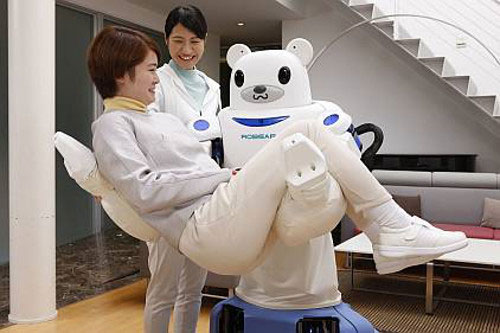
The strong robot with the gentle touch
Scientists have developed a new experimental nursing care robot, ROBEAR, which is capable of performing tasks such as lifting a patient from a bed into a wheelchair or providing assistance to a patient who is able to stand up but requires help to do so.
February 23, 2015 Read more
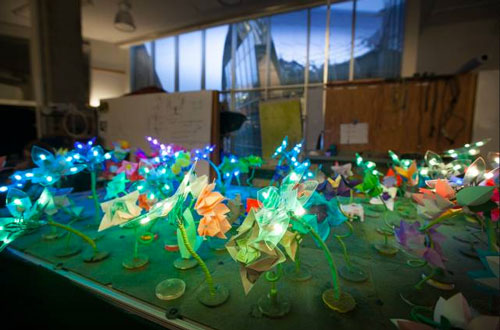
Can an LED-filled 'robot garden' make coding more accessible? (w/video)
CSAIL's 100-plus blooming, crawling, swimming bots teach basic programming concepts.
February 18, 2015 Read more
US$ 5 million robotics challenge launched in Abu Dhabi
Khalifa University to organize a USD 5 Million Prize challenging robotics competition.
February 16, 2015 Read more
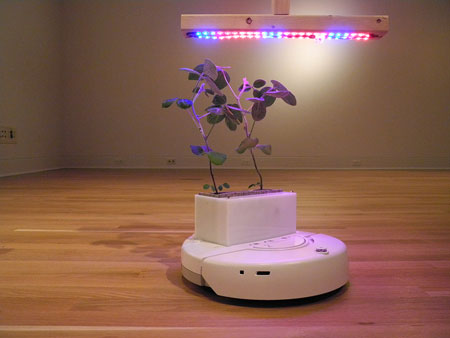
Soybots - a robotic platform allowing indoor plants to search for light
Soybots: Mobile Micro-Gardens is a responsive robotic-botanic hybrid artwork that utilizes light sensors to track sunlight intensity or to locate LED grow lights.
February 11, 2015 Read more
Prototype of a robotic system with emotion and memory (w/video)
Researchers at the University of Hertfordshire have developed a prototype of a social robot which supports independent living for the elderly, working in partnership with their relatives or carers.
February 5, 2015 Read more
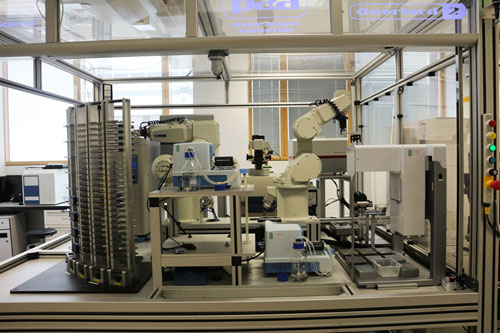
Robot scientist 'Eve' could boost search for new drugs
Eve, an artificially-intelligent 'robot scientist' could make drug discovery faster and much cheaper.
February 5, 2015 Read more
Researchers determine how the brain controls robotic grasping tools
Grasping an object involves a complex network of brain functions. First, visual cues are processed in specialized areas of the brain. Then, other areas of the brain use these signals to control the hands to reach for and manipulate the desired object. New findings suggest that the cerebellum, a region of the brain that has changed very little over time, may play a critical role. Findings could lead to advancements in assistive technologies benefiting the disabled.
February 3, 2015 Read more
Robots that mimic the properties of plant roots
Scientists in Italy are working on creating robots that mimic the properties of plant roots, including the capacity for growth. They believe the potential future applications are not just the stuff of science-fiction.
January 29, 2015 Read more