

Nanotechnology News – Latest Headlines
University of Kentucky awarded $2 Million EPA grant to study nanoparticle and human health
On August 20, 2008, the U.S. Environmental Protection Agency ( EPA ) will announce the award of a $2 million grant to the University of Kentucky to study nanoparticles.
August 18, 2008 Read more
Molecular Programming Project at Caltech receives $10m NSF funding
The National Science Foundation's Expeditions in Computing program has awarded $10 million to the Molecular Programming Project, a collaborative effort by researchers at the California Institute of Technology and the University of Washington to establish a fundamental approach to the design of complex molecular and chemical systems based on the principles of computer science.
August 18, 2008 Read more
Biochemist starts search for biomarker proteins in the secreted fluids of cancer cell lines
Thermo Fisher Scientific Inc. today announced a landmark collaboration between its Thermo Fisher Scientific Biomarker Research Initiatives in Mass Spectrometry (BRIMS) Center and the University Health Network (UHN) in Toronto to explore uncharted areas in biomarker research.
August 18, 2008 Read more
New speed record for magnetic memories
An experiment carried out at the Physikalisch-Technische Bundesanstalt (PTB) has realized spin torque switching of a nanomagnet as fast as the fundamental speed limit allows.
August 18, 2008 Read more
Nanoscale electrical fields will power future lab-on-chip systems
Tracking down cancer at a very early stage, studying cell growth, developing new medicines: future lab-on-a-chip systems will use nanoscale electrical fields to enable the detection and manipulation of cells and biomolecules.
August 18, 2008 Read more
IBM announces first working SRAM for the 22 nanometer node
IBM and its joint development partners - AMD, Freescale, STMicroelectronics, Toshiba and the College of Nanoscale Science and Engineering (CNSE) - today announced the first working static random access memory (SRAM) for the 22 nanometer (nm) technology node, the world's first reported working cell.
August 18, 2008 Read more
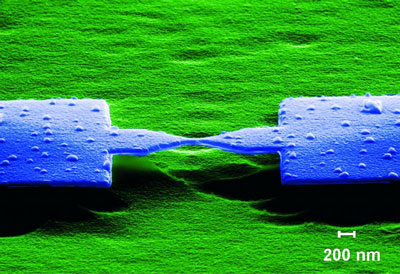
Nanotechnologie Konferenz nano.DE 2009
'Rohstoff' fuer Innovationen - unter diesem Motto werden erstmalig die bisher separat gefuehrten Konferenzen WING und nanoDE im naechsten Jahr zusammengelegt.
August 18, 2008 Read more
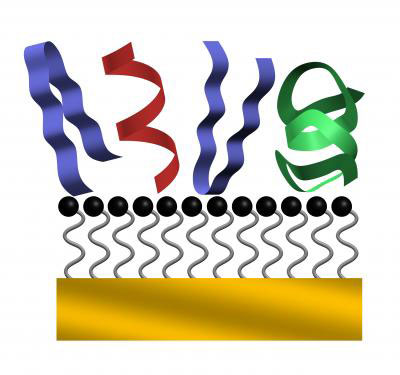
Tin film of protein coils promising for nanoelectronics and solar cells
Chemists have succeeded in making a layer of tiny protein coils attached to a surface, much like miniature bedsprings in a frame. This thin film made of stable and very pure helices can help researchers develop molecular electronics or solar cells, or to divine the biology of proteins.
August 18, 2008 Read more
The next big thing in nanotechnology? Litigation.
Nanotechnology holds great promise for revolutions in medicine, energy and agriculture. But as scientists work to make groundbreaking nanotechnology discoveries, lawyers are waiting.
August 18, 2008 Read more
Using tumeric and CAD to design artificial cancer-killing molecules
Seeking to improve on nature, scientists used a spice-based compound as a starting point and developed synthetic molecules that, in lab settings, are able to kill cancer cells and stop the cells from spreading.
August 17, 2008 Read more
Improved technique determines structure in membrane proteins
By combining custom-built spectrometers, novel probe designs and faster pulse sequences, a team led by Illinois chemistry professor Chad Rienstra has developed unique capabilities for probing protein chemistry and structure through the use of solid-state nuclear magnetic resonance spectroscopy.
August 17, 2008 Read more
Toward plastic spin transistors and organic LEDs
University of Utah physicists successfully controlled an electrical current using the 'spin' within electrons - a step toward building an organic 'spin transistor': a plastic semiconductor switch for future ultrafast computers. The study also suggests it will be more difficult than thought to make highly efficient light-emitting diodes (LEDs) using organic materials.
August 17, 2008 Read more
Hydrogel scaffolding for bone regeneration
Hyaluronic hydrogels developed by Carnegie Mellon University researchers may provide a suitable scaffolding to enable bone regeneration.
August 17, 2008 Read more
Scientists replicate a key process in photosynthesis
An international team of researchers led by Monash University has used chemicals found in plants to replicate a key process in photosynthesis paving the way to a new approach that uses sunlight to split water into hydrogen and oxygen.
August 17, 2008 Read more
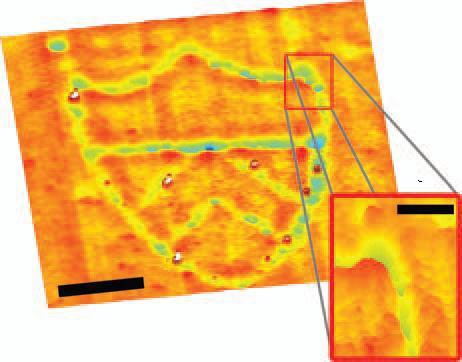
Military uses optical nanopatterning technology in space and aircraft applications
An AFOSR (Air Force Office of Scientific Research)-funded, Princeton-based professor has been researching a new approach to optical nanopatterning, the forming of nanometer scale patterns on a substrate. This technology will have an impact on a variety of current and future Air Force needs.
August 16, 2008 Read more
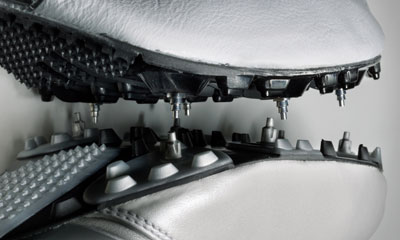
Adidas' revolutionary nanotechnology shoe for Beijing Olympics
Adidas Lone Star featuring first-ever asymmetrical carbon nanotube plates with progressive-compression spikes is 50 percent lighter.
August 16, 2008 Read more
 Subscribe to our Nanotechnology News feed