

Nanotechnology News – Latest Headlines
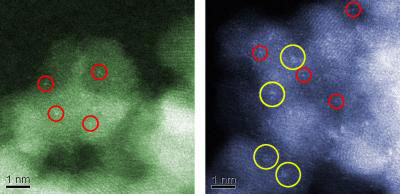
Active gold nanocrystals observed with scanning transmission electron microscopy
Using a pair of scanning transmission electron microscopy (STEM) instruments for which spherical aberration is corrected, researchers for the first time achieved state-of-the-art resolution of the active gold nanocrystals absorbed onto iron oxide surfaces. In fact, the resolution was sensitive enough to even visualize individual gold atoms.
September 5, 2008 Read more
European Commission urges to cut red tape for high-tech research
Urgent action is needed to cut red tape and create a more risk-tolerant environment for high-tech research in the ICT (Information and Communication Technology) sector, the European Commission has said.
September 5, 2008 Read more
Everything you always wanted to know about nanotechnology
CNRS Images has just released 'Nanosciences, Nanotechnologies', its second thematic DVD, to answer all our questions about the infinitesimally small.
September 5, 2008 Read more
New catalysis method will prompt researchers to create materials from new kinds of chemical reactions
Princeton scientists have discovered a way of stimulating organic molecules that they expect will prompt researchers to create materials from new kinds of chemical reactions.
September 5, 2008 Read more

Expanded Micro and Nanotechnology Laboratory at University of Illinois dedicated
On Thursday, September 4, the University of Illinois' hosted Capital Development Board Chairman Anthony Licata and other state officials on campus dedicated the recently expanded Micro and Nanotechnology Laboratory (MNTL).
September 5, 2008 Read more
Mehr Solarenergieforschung in Deutschland durch Spitzencluster Solarvalley
Das 'Solarvalley Mitteldeutschland' wurde vom Bundesforschungsministerium als ein Spitzencluster ausgewaehlt.
September 5, 2008 Read more
Nanotechnology researchers recognized for top-cited scientific articles
Six scientific articles by researchers in the Center for Nanoscale Science and Engineering (CNSE) and Department of Coatings and Polymeric Materials at North Dakota State University (NDSU), Fargo, appear among the most cited articles published in Volume 23 of Biofouling: The Journal of Bioadhesion and Biofilm.
September 4, 2008 Read more
Argonne develops precise molecular ruler for measuring distances within a protein
Scientists at the U.S. Department of Energy's (DOE) Argonne National Laboratory have won an $800,000 EUREKA award from the National Institutes of Health (NIH) to develop MADMAX, a precise molecular ruler for measuring distances within a protein.
September 4, 2008 Read more
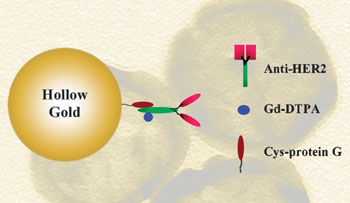
Nanoparticles hunt down cancer cells
Cancer cells can be detected then destroyed using a nanostructure designed by South Korean researchers.
September 4, 2008 Read more
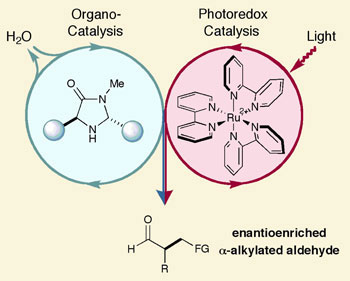
Two catalysts better than one
US researchers have cracked a long standing problem in chemical synthesis - the catalytic alpha-alkylation of aldehydes - by combining two catalysts in one pot.
September 4, 2008 Read more
How to effectively manage innovation like nanotechnology
How does one predict and direct something that is by nature unpredictable and, by necessity, often undirected? According to David Guston, who is co-director of ASU?s Consortium for Science, Policy and Outcomes and a professor of political science, it is by strengthening society?s ability to nurture and guide innovation within socially acceptable frameworks.
September 4, 2008 Read more
Sub-nanometer size gold cluster responsible for vital oxidation reaction
Scientists peel away the mystery behind gold's catalytic prowess.
September 4, 2008 Read more
Azaya licenses University of Texas nanotechnology to develop cancer treatment
A drug delivery system the size of a millionth of a centimeter could hold the key to more effective treatments of cancerous tumors. San Antonio researchers at the University of Texas Health Science Center and homegrown biotech firm Azaya Therapeutics Inc. have teamed up to test the new technology in humans and to bring it to the market.
September 4, 2008 Read more
FDA public meeting to assists implementing the FDA Nanotechnology Task Force Report
On September 8, FDA is holding a public meeting to gather comments and data to assist the agency in the development of agency guidance that would clarify what information industry needs to provide FDA about nanoproducts, and also when the use of nanoscale materials may change the regulatory status of products..
September 4, 2008 Read more
New $18.5 m projects seeks to develop biodegradable metal implant devices
The devices will be designed to adapt to physical changes in a patient's body and dissolve once they have healed, reducing the follow-up surgeries and potential complications of major orthopedic, craniofacial, and cardiovascular procedures and sparing millions of patients worldwide added pain and medical expenses.
September 4, 2008 Read more
Do 68 molecules hold the key to understanding disease?
Why is it that the origins of many serious diseases remain a mystery? In considering that question, a scientist at the University of California, San Diego School of Medicine has come up with a unified molecular view of the indivisible unit of life, the cell, which may provide an answer.
September 4, 2008 Read more
 Subscribe to our Nanotechnology News feed