

Photocatalyst: How It Works, Materials, and Nanotechnology Applications
What is a Photocatalyst?
A photocatalyst is a light-activated catalyst, usually a semiconductor, that absorbs photons and uses the resulting electrons and holes to drive chemical reactions without being consumed.
In many practical heterogeneous systems, the photocatalyst is a semiconductor: a photon with energy greater than the material's bandgap excites an electron from the valence band to the conduction band, leaving behind a positively charged hole. The resulting electron–hole pair migrates to the surface, where the electron drives a reduction reaction and the hole drives an oxidation reaction. Splitting water into hydrogen and oxygen, breaking down organic pollutants, reducing carbon dioxide to fuels, and killing bacteria on a self-cleaning surface are all variants of this same basic process.
The field traces back to a single 1972 paper by Akira Fujishima and Kenichi Honda, who demonstrated that a titanium dioxide electrode could split water under ultraviolet light. Their result, now called the Honda–Fujishima effect, opened heterogeneous photocatalysis as a research field. Titanium dioxide (TiO2) is still the most studied photocatalyst because it is inexpensive, non-toxic, and chemically stable, but its bandgap of about 3.0–3.2 eV restricts absorption to the ultraviolet, which is only about 4–5% of the solar spectrum reaching Earth's surface. Many high-performing modern photocatalysts are therefore engineered at the nanoscale or mesoscale to absorb more light, expose more active surface area, and suppress the loss of photogenerated charges before they can react.
Key takeaways:
- A photocatalyst is a semiconductor that absorbs light and uses photogenerated electrons and holes to drive chemical reactions.
- The reaction must be thermodynamically allowed at the photocatalyst's band edges.
- Nanostructuring increases surface area, shortens carrier diffusion paths, and can tune facets, interfaces, defects, and, in quantum dots, electronic structure.
- Common materials include TiO2, ZnO, g-C3N4, BiVO4, CdS, and MoS2.
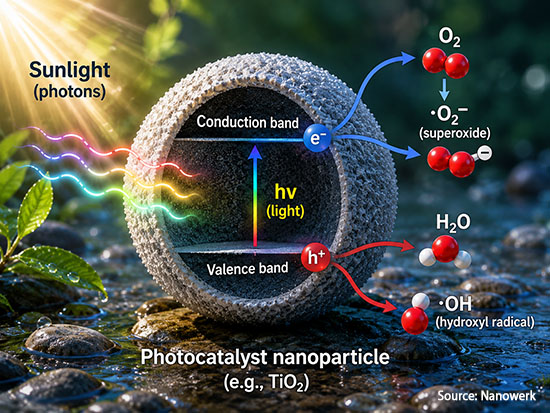
How a Photocatalyst Works
Heterogeneous photocatalysis on a semiconductor proceeds in three sequential steps: photon absorption and charge generation in the bulk, migration of the electron–hole pair to the surface, and surface redox chemistry with adsorbed species. The overall efficiency is the product of three corresponding quantum yields, so any one of the three can become the bottleneck. In a typical commercial titanium dioxide powder, only a small fraction of generated charges actually reach the surface and react before recombining, which is why much of the field is devoted to suppressing recombination.
Each step is constrained by different physics. Absorption is governed by the bandgap, which sets the longest wavelength the photocatalyst can use; a 3.0 eV bandgap corresponds to a cutoff near 410 nm, deep in the ultraviolet. Charge migration is governed by carrier diffusion length, rarely longer than tens to hundreds of nanometers in oxide semiconductors. Surface chemistry is governed by the band-edge positions: the conduction band must lie at a more negative potential than the reduction half-reaction, and the valence band more positive than the oxidation half-reaction, otherwise the reaction is thermodynamically forbidden no matter how bright the light.
Reactive oxygen species and indirect pathways
When a photocatalyst is dispersed in water or moist air, the holes and electrons often react first with adsorbed water, hydroxide, or oxygen rather than with the target molecule itself. In materials with sufficiently oxidizing valence bands, holes can oxidize surface-adsorbed water or hydroxide to form hydroxyl radicals (·OH), while electrons reduce dissolved oxygen to superoxide (O2·−) and downstream species such as hydrogen peroxide. These reactive oxygen species are powerful, often non-selective oxidants that can mineralize organic pollutants, damage microorganisms, and break down volatile organic compounds. Advanced oxidation processes used in water and air treatment often rely on this indirect pathway, although direct hole oxidation can also contribute.
Why Nanoscale Photocatalysts Outperform Bulk
Three factors make nanostructured photocatalysts substantially more active than bulk solids. First, the high surface-to-volume ratio exposes far more atoms to the reaction medium, giving more active sites per gram. Second, photogenerated electrons and holes only need to travel a few nanometers to reach the surface, comparable to or shorter than the carrier diffusion length, so a much larger fraction of charges escape bulk recombination. Third, nanostructuring allows tighter control over facets, interfaces, porosity, and defect density, all of which influence adsorption, charge separation, and surface reaction rates.
Quantum confinement is an additional benefit only in sufficiently small semiconductor nanocrystals, especially quantum dots. In those materials, shrinking the crystal can shift the bandgap and band-edge positions. In most oxide photocatalysts, however, nanostructuring improves activity mainly through surface area, shorter carrier paths, and interface engineering rather than through a large confinement-driven bandgap change.
Shape and crystal-facet engineering matter as much as size. Anatase TiO2 exposing the {001} facet is more reactive than the more thermodynamically stable {101} surface, and many photocatalysts work best as anisotropic nanoparticles, nanowires, two-dimensional sheets, or porous architectures. Selective deposition of cocatalysts on specific facets allows electrons and holes to be physically separated on different parts of the same particle, suppressing recombination further.
Related Terms: Photocatalyst, Photosensitizer, and Photoelectrocatalyst
A photocatalyst both absorbs light and participates in charge-transfer chemistry at or near its surface. A photosensitizer mainly absorbs light and transfers energy or electrons to another catalyst or semiconductor; dye-sensitized photocatalysts use this division of labor. A conventional catalyst accelerates a reaction without requiring light activation.
Photocatalysis is also distinct from photoelectrocatalysis. In photocatalysis, light absorption and surface reaction usually occur on catalyst particles or coatings without an external circuit. In photoelectrocatalysis, the semiconductor is an electrode connected to a circuit, and applied or built-in electrical bias can help separate charges and drive the reaction.
Common Photocatalyst Materials
No single material is best for every reaction. The right photocatalyst depends on the wavelength range that needs to be absorbed, the redox potentials required, the chemical environment, and the cost target. The table below summarizes the most widely studied classes; bandgap values are typical and depend on phase, defect chemistry, and morphology.
| Material class | Typical bandgap (eV) | Light absorbed | Strengths | Common uses |
|---|---|---|---|---|
| TiO2 (anatase, rutile) | 3.0–3.2 | Ultraviolet | Cheap, stable, non-toxic, well-positioned bands | Self-cleaning, water and air treatment, hydrogen evolution |
| ZnO | ~ 3.2 | Ultraviolet | High electron mobility, easy to nanostructure | Pollutant degradation, antibacterial coatings |
| Graphitic carbon nitride (g-C3N4) | ~ 2.7 | Visible (to ~ 460 nm) | Metal-free, chemically robust, low cost | H2 evolution, CO2 reduction |
| BiVO4 | ~ 2.4 | Visible (to ~ 520 nm) | Strong oxidant for water oxidation | O2 evolution photoanodes, Z-scheme systems |
| CdS, CdSe quantum dots | 2.2–2.4 (tunable) | Visible | Strong visible absorption, tunable by size | H2 evolution, sensitization |
| MoS2 and other 2D dichalcogenides | ~ 1.2–1.9, depending on layer number | Visible to near-IR | Edge-active sites, useful charge-transfer interfaces | Hydrogen evolution cocatalyst, heterostructures, sensitized systems |
| Bi-based oxides (Bi2WO6, Bi2MoO6, BiOX) | 2.0–3.0 | Visible | Layered structures with internal electric fields | Pollutant degradation, antibiotic remediation |
| Photocatalytic MOFs and COFs | 1.8–3.5 (tunable) | UV to visible | Tunable by linker; high surface area | CO2 reduction, organic transformations |
A practical photocatalyst is rarely the bare semiconductor in this list. Many reported high-performance systems are composites that combine a light absorber, a cocatalyst for the reduction half-reaction, often a cocatalyst for the oxidation half-reaction, and sometimes a second semiconductor that improves charge separation.
How Nanostructured Photocatalysts Are Made
Most laboratory photocatalysts are synthesized by wet-chemistry routes that allow control of size, shape, and crystallographic phase. Sol-gel synthesis and hydrothermal or solvothermal growth are the workhorses for oxide photocatalysts such as TiO2, ZnO, and BiVO4. Carbon nitride is commonly obtained by thermal polycondensation of melamine or urea, while quantum-dot photocatalysts are made by colloidal hot-injection chemistry.
Photocatalyst films are deposited by chemical vapor deposition, atomic layer deposition, sputtering, or spray pyrolysis to make self-cleaning thin films and textured photoanodes. Cocatalyst loading is usually done by photodeposition, in which the photocatalyst itself reduces or oxidizes a metal precursor under illumination, naturally placing the cocatalyst at sites where charges are most likely to be delivered.
Strategies to Enhance Photocatalytic Performance
A handful of design strategies recur across modern photocatalysts, all aimed at one of three goals: absorbing more of the solar spectrum, separating photogenerated electrons from holes before they recombine, or accelerating surface redox once charges arrive.
Bandgap engineering and doping
Bandgap engineering can extend absorption into the visible by changing the band structure or by introducing dopant- and defect-related states. Nitrogen, carbon, sulfur, and a range of metal dopants can introduce mid-gap states that allow visible-light absorption in TiO2. The 2011 demonstration of "black titania" by Chen and coworkers showed that hydrogenating anatase nanocrystals creates a disordered surface layer with oxygen vacancies and Ti3+-related states. This produces strong visible and near-infrared absorption and is often described as apparent bandgap narrowing, although much of the absorption is better understood as arising from defect and disorder states rather than a simple shift of the anatase band edges.
Heterojunctions and Z-scheme systems
Coupling two semiconductors with offset band positions creates a heterojunction that drives electrons in one direction and holes in the other, separating the charges before they can recombine. In a conventional Type-II heterojunction, electrons accumulate in the semiconductor with the lower conduction band and holes in the one with the higher valence band, which maximizes charge separation but reduces redox driving force. The Z-scheme architecture, inspired by natural photosynthesis, links two photocatalysts so that the more reducing electrons and the more oxidizing holes are retained, recombining the less useful carriers via a redox shuttle or solid conductor. Z-scheme systems are among the most important architectures for visible-light overall water splitting because they preserve strong redox potentials while improving charge separation.
Cocatalysts
A cocatalyst is a small amount of a second material, usually a few weight percent or less, loaded onto the photocatalyst surface to accelerate a specific half-reaction. Platinum and ruthenium nanoparticles are common cocatalysts for hydrogen evolution; cobalt phosphate, iridium oxide, and ruthenium oxide are common for oxygen evolution. Beyond lowering the kinetic barrier, cocatalysts trap one type of carrier and provide a spatially separated reaction site, improving both selectivity and durability. Recent demonstrations of overall water splitting with near-unity quantum efficiency have relied on selectively depositing reduction and oxidation cocatalysts on different crystal facets of the same particle.
Plasmonic enhancement
Plasmonic nanoparticles of gold, silver, or aluminum can be coupled to a wide-bandgap photocatalyst to harvest visible light through localized surface plasmon resonance. Hot electrons generated by plasmon decay can be injected into the conduction band of an adjacent semiconductor, and the strong near-field of the plasmon can also intensify absorption in a thin photocatalyst layer placed nearby.
Defect engineering
Oxygen vacancies, cation vacancies, and other point defects are no longer treated as flaws to be eliminated but as defect states that can be tuned. Defect engineering introduces sub-bandgap states that absorb visible light, modifies adsorption energies for reactants, and changes carrier lifetimes. Black titania and many high-activity oxynitride photocatalysts are engineered around the controlled introduction of these defects.
Applications
Solar hydrogen and CO2 reduction
In principle, particulate photocatalytic water splitting offers a route to solar hydrogen using only a powder, water, and sunlight, with no external bias. Particulate photocatalyst panels covering 100 m2 have been demonstrated outdoors using a doped strontium titanate photocatalyst; under ultraviolet light at wavelengths between 350 and 360 nm, modified Al-doped SrTiO3 photocatalysts have reached an external quantum efficiency of about 96 percent. Solar-to-hydrogen efficiencies under broadband sunlight remain in the low single-digit percent range. Photocatalytic CO2 reduction to CO, methane, methanol, or formate is harder still, since the reaction requires multiple electrons and protons and competes with hydrogen evolution.
Environmental remediation
Photocatalytic advanced oxidation is used to break down dyes, pharmaceuticals, pesticides, and other persistent organic contaminants in water, and to remove nitrogen oxides, formaldehyde, and other volatile organic compounds from air. UV-driven TiO2 systems have been commercialized for some water- and air-treatment uses, while many visible-light bismuth-based photocatalysts remain primarily at the laboratory or pilot-study stage. Photocatalytic cement, paving stones, and exterior paints incorporating metal oxide nanoparticles have been tested and deployed in some urban settings to reduce nitrogen oxides, although real-world performance depends strongly on light intensity, humidity, airflow, surface fouling, and maintenance. Environmental remediation and self-cleaning surfaces are among the most visible commercial uses of photocatalytic materials.
Self-cleaning, antibacterial, and antifogging surfaces
When sunlight hits a thin titanium dioxide nanocoating on glass or tile, photogenerated holes oxidize adsorbed organics and the same surface becomes superhydrophilic, so water sheets off and carries away loosened dirt. The combination of photocatalytic oxidation and photoinduced wettability is the basis of self-cleaning windows, antifogging mirrors, and antibacterial tiles. Silver- or copper-doped TiO2 coatings give round-the-clock antimicrobial activity by combining photocatalytic kill under light with metal-ion biocidal action in the dark.
Limitations and Challenges
Despite five decades of progress since the Honda–Fujishima paper, no photocatalyst yet meets the cost and efficiency targets for solar fuels at commercial scale. The unavoidable tension is that a small bandgap captures more sunlight but provides less driving force for redox chemistry, while a large bandgap drives the reactions easily but absorbs only ultraviolet. Charge recombination losses remain large in most materials, the most active visible-light absorbers such as cadmium sulfide and certain oxynitrides are vulnerable to photocorrosion under prolonged operation, and powder photocatalysts must remain stable for thousands of hours under temperature swings, pH changes, and intermittent illumination. In practice, photocatalyst design is a compromise between activity, stability, selectivity, scalability, and cost.
Future Perspectives
Three trends are shaping the next generation of photocatalysts. Single-atom and atomically dispersed catalysts push the use of expensive metals to the extreme limit, with isolated atoms anchored on a high-area support so that nearly every metal atom is exposed. Two-dimensional materials including 2D materials beyond graphene, transition-metal dichalcogenides, and MXenes provide ultrathin geometries with short carrier paths and tunable surface chemistry. Hybrid architectures that combine inorganic semiconductors with porous frameworks, molecular catalysts, or biological enzymes are extending photocatalysis into new reaction classes. As in situ spectroscopy and computational screening mature, photocatalyst design is shifting from empirical exploration toward targeted engineering of light absorption, charge dynamics, and surface chemistry as a coherent whole.
FAQ: Photocatalyst
What is a photocatalyst in simple terms?
A photocatalyst is a material, almost always a semiconductor, that absorbs light and uses that energy to drive a chemical reaction without being consumed itself. When the photocatalyst absorbs a photon with energy greater than its bandgap, it generates an electron in its conduction band and a hole in its valence band. These charge carriers then drive reduction and oxidation reactions at the surface. In engineered systems, titanium dioxide can participate in water splitting; in many practical coatings and treatment systems, it breaks down pollutants under ultraviolet light.
Why is titanium dioxide the most common photocatalyst?
Titanium dioxide is inexpensive, chemically and photochemically stable, relatively non-toxic, and has band edges that can drive many oxidation and reduction reactions under suitable conditions. The 1972 Honda–Fujishima experiment showed it could split water under ultraviolet light, and it has remained the benchmark photocatalyst ever since. Its main weakness is a wide bandgap of about 3.0 to 3.2 eV, which means only the small ultraviolet fraction of sunlight is absorbed.
Why are nanoscale photocatalysts more active than bulk materials?
Photocatalytic reactions happen at surfaces, so a high surface-to-volume ratio gives more active sites per gram of material. Nanostructuring also shortens the distance that photogenerated electrons and holes must travel before reaching the surface, which reduces bulk recombination losses. In very small semiconductor nanocrystals, especially quantum dots, quantum confinement can tune the bandgap; in most oxide photocatalysts, the main nanoscale benefits are higher surface area, shorter carrier paths, and better control of facets and interfaces.
What is the difference between a photocatalyst and a cocatalyst?
The photocatalyst absorbs light and generates the electron–hole pairs. A cocatalyst is a separate material, often a small amount of platinum, ruthenium oxide, cobalt oxide, or nickel-based species deposited on the photocatalyst surface, that lowers the kinetic barrier for the reduction or oxidation half-reaction. Cocatalysts also help separate charge carriers spatially, which suppresses recombination and is essential for efficient hydrogen and oxygen evolution.
Can photocatalysts work under visible light or only ultraviolet?
Pure titanium dioxide and zinc oxide absorb mainly ultraviolet light, which limits solar efficiency because ultraviolet is only about 4 to 5 percent of the solar spectrum. A wide range of strategies has been developed to extend absorption into the visible range, including nitrogen, carbon, or metal doping; coupling with narrow-bandgap semiconductors such as cadmium sulfide or bismuth vanadate; sensitization with dyes; and the introduction of oxygen vacancies, as in hydrogenated black titania. Carbon nitride and many oxynitrides absorb visible light directly.
What are photocatalysts used for in everyday products?
Beyond research on solar fuels, photocatalysts are used or tested in self-cleaning glass and tiles, antifogging coatings, antimicrobial surfaces in hygiene-sensitive settings, photocatalytic concrete and pavers designed to break down nitrogen oxide air pollution, deodorizing filters in air purifiers, and water-treatment systems for trace organic contaminants. Most of these products rely on titanium dioxide nanoparticle coatings, sometimes combined with silver or other functional additives.
Further Reading
Science, Increasing solar absorption for photocatalysis with black hydrogenated titanium dioxide nanocrystals
Nature Reviews Materials, Particulate photocatalysts for overall water splitting
Chemical Reviews, Particulate photocatalysts for light-driven water splitting: mechanisms, challenges, and design strategies
Chemical Society Reviews, Recent advances and perspectives for solar-driven water splitting using particulate photocatalysts
