

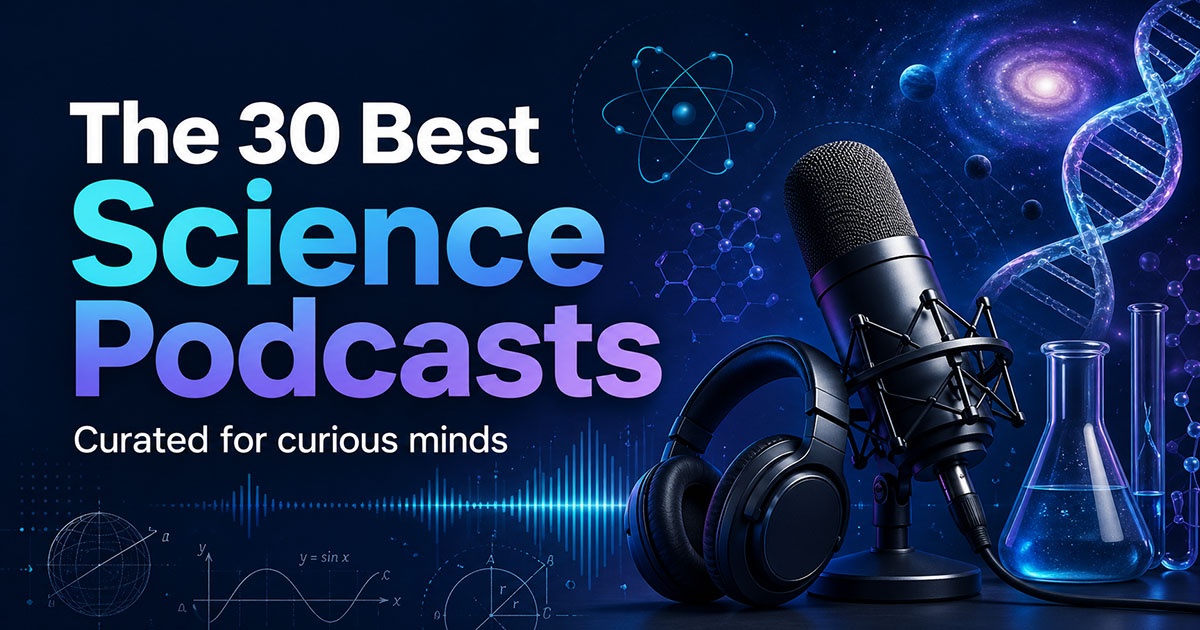
The 30 Best Science Podcasts
Why Listen to a Science Podcast?
Science podcasts are one of the easiest ways to keep up with a field that never sits still. New discoveries in astronomy, biology, medicine, climate science, artificial intelligence, psychology, physics, and mathematics appear every week, but most people do not have time to follow journals, conferences, and specialist news feeds directly.
A good science podcast turns that flood of information into something human: conversations with researchers, carefully reported stories, skeptical evidence checks, and clear explanations of why a discovery matters. Some shows are short daily briefings; others are long-form interviews with scientists, physicians, mathematicians, engineers, journalists, and authors. Together, they offer a flexible way to learn while commuting, exercising, cooking, or taking a walk.
For this list, we prioritized podcasts that are active, easy to find on live public links, and still useful for a broad science-curious audience. The final selection balances popularity, authority, editorial quality, topic diversity, and staying power. It includes major public-radio science shows, deep interview programs, space and astronomy podcasts, health and disease shows, skepticism, climate reporting, psychology, mathematics, and a few broad educational podcasts that regularly cover science.
The podcasts below are listed alphabetically.
List of the Best Science Podcasts
Here is an overview, sorted alphabetically (detailed descriptions are below the table):
| Name | Focus | Host(s) | |
|---|---|---|---|
 |
Big Picture Science | Big-picture science, technology, astronomy, SETI, and society | Seth Shostak and Molly Bentley |
 |
BrainStuff | Short science, technology, history, and everyday explainers | iHeartPodcasts / HowStuffWorks team |
 |
Curious Cases | BBC science mysteries and listener questions | Hannah Fry, Adam Rutherford, and team |
 |
Drilled | Climate science, fossil fuel accountability, and investigative journalism | Amy Westervelt and guests |
 |
Freakonomics Radio | Economics, data, incentives, behavior, and social science | Stephen J. Dubner and team |
 |
Hidden Brain | Psychology, behavior, decision-making, relationships, and social science | Shankar Vedantam |
 |
Huberman Lab | Neuroscience, health, sleep, performance, and science-based protocols | Andrew Huberman |
 |
Mindscape | Physics, philosophy, complexity, society, and ideas | Sean Carroll |
 |
Nature Podcast | Research highlights and science news from Nature | Nature editorial team |
 |
Ologies | Interviews with experts across scientific fields and odd specialties | Alie Ward |
 |
Planetary Radio | Space exploration, astronomy, planetary science, and missions | The Planetary Society team |
 |
Quirks & Quarks | Weekly science news and interviews from CBC | Bob McDonald and CBC team |
 |
Radiolab | Narrative science, philosophy, law, history, and human stories | Lulu Miller, Latif Nasser, and team |
 |
Science Friday | Weekly science news, interviews, and public-radio conversations | Ira Flatow and Science Friday team |
 |
Science Quickly | Fast science news and explainers from Scientific American | Scientific American team |
 |
Science Vs | Evidence checks on health, wellness, culture, and controversial claims | Wendy Zukerman |
 |
Short Wave | Daily science news, discoveries, health, environment, and culture | NPR science desk |
 |
StarTalk Radio | Space, astrophysics, science communication, and pop culture | Neil deGrasse Tyson and co-hosts |
 |
Stuff to Blow Your Mind | Science, culture, mythology, evolution, technology, and the weird | Robert Lamb, Joe McCormick, and team |
 |
Stuff You Should Know | General knowledge, science, history, technology, and culture | Josh Clark and Chuck Bryant |
 |
The Infinite Monkey Cage | BBC science comedy, panel discussion, physics, and big questions | Brian Cox and guests |
 |
The Joy of Why | Mathematics, physics, biology, cosmology, and deep scientific questions | Steven Strogatz and Janna Levin |
 |
The Naked Scientists | Science news, medicine, technology, and interviews | The Naked Scientists team |
 |
The Rest Is Science | Big science questions, reality, time, randomness, and everyday mysteries | Hannah Fry and Michael Stevens |
 |
The Science of Happiness | Psychology, well-being, gratitude, mindfulness, and behavior change | Greater Good Science Center team |
 |
The Skeptics' Guide to the Universe | Skepticism, critical thinking, science news, and pseudoscience | Steven Novella and the SGU panel |
 |
The Weirdest Thing I Learned This Week | Strange science facts, history, animals, medicine, and odd discoveries | Popular Science editors and guests |
 |
This Podcast Will Kill You | Disease, epidemiology, public health, biology, and medical mysteries | Erin Welsh and Erin Allmann Updyke |
 |
This Week in Space | Spaceflight, astronomy, space policy, missions, and industry news | Rod Pyle, Tariq Malik, and guests |
 |
Unexplainable | Mysteries at the edge of science and unanswered questions | Vox science team |
Reviews of the Best Science Podcasts (in alphabetical order)
Big Picture Science
Big Picture Science, produced by the SETI Institute, looks at science through the widest possible lens: astronomy, biology, physics, technology, culture, and the search for life beyond Earth.
Hosts Seth Shostak and Molly Bentley combine interviews, field reporting, and accessible explainers to connect new discoveries with the bigger questions they raise. The show is especially strong on space science and astrobiology, but it also regularly wanders into neuroscience, climate, skepticism, and the history of science.
Use this pick for readers who want a polished, public-radio style science show that can move from exoplanets to artificial intelligence to human perception without losing its sense of curiosity.
BrainStuff
BrainStuff is a compact, approachable explainer show from the HowStuffWorks/iHeart family. Episodes usually focus on one question or topic and unpack the science, history, or technology behind it in a short, listener-friendly format.
It is less of a breaking-news show and more of a knowledge snack: why certain animals behave the way they do, how technologies developed, what common phrases mean, or what researchers have learned about health and the environment.
Because it is broad, easy to sample, and well suited to casual listening, BrainStuff remains a useful addition to a general science podcast list.
Curious Cases
Formerly best known as The Curious Cases of Rutherford and Fry, the BBC's Curious Cases turns listener questions into lively science investigations.
The show is at its best when it starts with a deceptively simple mystery – why certain foods taste strange, how the body senses the world, whether animals can detect disasters, or what mathematics can tell us about everyday life – and then follows the evidence through interviews, experiments, and playful debate.
It is a strong fit for readers who want BBC-level production and accessible explanations without giving up scientific rigor.
Drilled
Drilled brings investigative reporting to the climate beat, with a particular focus on fossil fuel companies, climate disinformation, law, lobbying, and the people shaping public understanding of climate science.
It is not a general science explainer in the same style as Short Wave or Science Friday, but it belongs on a modern science list because climate is one of the central scientific and societal issues of the decade.
Choose this replacement if you want the page to include more serious science journalism and not just interview or curiosity-driven shows.
Freakonomics Radio
Freakonomics Radio is broader than natural science, but its strength is the scientific habit of asking testable questions about how people, markets, institutions, and incentives work.
The show frequently draws on economics, psychology, public health, data analysis, and policy research. Episodes can range from education and healthcare to technology, crime, sports, and the unintended consequences of well-meaning decisions.
For a general science podcast list, it works best as the social-science anchor: polished, popular, and built around evidence-driven storytelling.
Hidden Brain
Hidden Brain uses psychology and social science to explain why people think, feel, decide, and behave the way they do.
Hosted by Shankar Vedantam, the show combines storytelling with interviews from researchers and authors. Its topics are often personal – habits, emotions, relationships, identity, ambition, memory – but the frame is scientific rather than purely self-help.
It remains one of the most accessible and widely recognized science-adjacent podcasts for readers interested in the human mind.
Huberman Lab
Huberman Lab is one of the biggest health and neuroscience podcasts in the world, built around long-form explanations of how the brain and body work.
Andrew Huberman covers topics such as sleep, focus, stress, exercise, nutrition, learning, hormones, motivation, mental health, and sensory systems. Episodes can be dense, but they are structured for listeners who want practical takeaways rooted in physiology and neuroscience.
It is a strong replacement for older inactive shows because it is current, extremely popular, and squarely built around translating scientific research for a broad audience.
Mindscape
Sean Carroll's Mindscape is one of the best interview podcasts for listeners who like their science connected to big intellectual questions.
Carroll speaks with physicists, biologists, philosophers, historians, writers, technologists, and other thinkers about everything from quantum mechanics and cosmology to consciousness, democracy, creativity, complexity, and the nature of explanation.
The show rewards patient listeners: episodes are long, thoughtful, and often more conceptual than news-driven. That makes it a useful counterweight to shorter daily science shows.
Nature Podcast
The Nature Podcast is one of the most authoritative science news podcasts because it sits directly inside one of the world's leading scientific journals.
Each episode usually highlights new research, interviews scientists, and explains why particular papers or discoveries matter. Coverage spans biology, physics, climate, medicine, chemistry, technology, and research culture.
For readers who want to keep up with serious research without reading every journal article, this is one of the safest and most durable recommendations on the list.
Ologies
Ologies is a joyful tour through scientific fields, subfields, and deeply specific expert obsessions.
Alie Ward interviews scientists and specialists about their work, often introducing listeners to disciplines they did not know existed. The tone is funny, warm, and personal, but the interviews still deliver real science and field-specific detail.
It is one of the best choices for curious generalists and younger listeners because it makes expertise feel inviting rather than intimidating.
Planetary Radio
Planetary Radio is the flagship audio show from The Planetary Society, focused on space exploration, astronomy, planetary science, and the people behind missions.
The show regularly features scientists, engineers, mission leaders, advocates, and authors discussing spacecraft, telescopes, solar system exploration, exoplanets, and the future of space policy.
It is a natural keep for a science podcast list because space remains one of the strongest listener draws, and this show has long-running credibility in the field.
Quirks & Quarks
CBC's Quirks & Quarks is a long-running weekly science program that mixes research news, expert interviews, and listener-friendly explanations.
The show has the feel of a classic public-radio science magazine: wide-ranging, accessible, and consistently grounded in interviews with scientists.
It is a strong replacement candidate because it broadens the list beyond U.S. and U.K. outlets while staying squarely within mainstream science coverage.
Radiolab
Radiolab remains one of the defining narrative podcasts about science, curiosity, and the strange edges of human experience.
The show is not limited to laboratory science: it moves through biology, physics, law, history, ethics, medicine, and personal storytelling. Its signature strength is sound design, turning complex ideas into immersive audio stories.
Because of its influence, polish, and broad appeal, Radiolab still deserves a place on a best-science-podcasts list even as the broader podcast landscape has become much more crowded.
Science Friday
Science Friday is one of the most established science audio brands, with a format built around interviews, listener questions, and timely coverage of science and technology.
The show covers research, space, climate, health, engineering, environment, books, and science culture. Its strength is range: it can move from a breaking discovery to a deep conversation with a scientist or author in the same episode.
It is a foundational keep for the list because it remains active, recognizable, and useful for listeners who want a weekly science-news habit.
Science Quickly
Science Quickly is Scientific American's current short-form podcast feed and the right modern replacement for the older 60-Second Science and Science Talk branding.
The show delivers concise episodes on current research, health, technology, climate, astronomy, and the science behind the news. It is designed for listeners who want reliable science information without committing to hour-long episodes.
Keep the existing image filename from the older science-quickly artwork slot, but update the page title, copy, and link to the current Scientific American destination.
Science Vs
Science Vs investigates popular claims and controversies by checking them against the evidence.
Wendy Zukerman and the team take on topics such as health trends, drugs, diets, climate, technology, psychology, and viral claims, using interviews with researchers and a clear narrative structure.
It should stay on the list, but the old styling and link should be updated. The show name is normally written Science Vs, and the current public listening destination is Spotify.
Short Wave
NPR's Short Wave is one of the best daily science podcasts for a general audience.
The episodes are short, timely, and approachable, covering new research, health, climate, space, technology, nature, and the science behind everyday life. Its connection to NPR's science desk gives the show a steady pipeline of reporting and expert voices.
It is a high-priority keep because it fills the daily-news slot that many other shows on the list do not.
StarTalk Radio
StarTalk Radio blends astrophysics, space, comedy, celebrity guests, and science communication.
Neil deGrasse Tyson and co-hosts use pop culture and listener questions as entry points into cosmic subjects: black holes, planets, relativity, spaceflight, time, science fiction, and the history of discovery.
It remains a recognizable, popular choice for readers who first come to science through space and astronomy.
Stuff to Blow Your Mind
Stuff to Blow Your Mind explores science through the strange, speculative, and surprising.
The show moves across biology, neuroscience, ancient history, monsters, technology, evolution, philosophy, and the human imagination. It is especially good for listeners who like science but also enjoy folklore, weird history, and big speculative questions.
It is broader and more playful than a straight news show, which helps diversify the list.
Stuff You Should Know
Stuff You Should Know is not exclusively a science podcast, but it remains one of the most popular educational podcasts in the world.
Josh Clark and Chuck Bryant explain topics across science, history, technology, culture, medicine, and everyday life in a conversational style that has made the show unusually durable.
For a broad public-facing list, it earns its place because many listeners discover science through exactly this kind of accessible general-knowledge format.
The Infinite Monkey Cage
The Infinite Monkey Cage is a BBC science-comedy panel show built around big questions, expert guests, and an accessible sense of fun.
Historically hosted by Brian Cox and Robin Ince, the show mixes scientists, comedians, and public figures to discuss topics such as the universe, evolution, technology, mathematics, and the limits of knowledge.
Because the hosting lineup has changed, update the copy cautiously, but keep the show: the archive is deep, the BBC page is live, and it remains one of the best-known science podcasts for listeners who like humor with their physics.
The Joy of Why
The Joy of Why from Quanta Magazine is a thoughtful interview show about curiosity and the pursuit of knowledge.
Mathematician Steven Strogatz and cosmologist Janna Levin interview researchers about major questions in mathematics, physics, biology, computer science, cosmology, and complexity.
It is an excellent replacement for less active shows because it brings prestige, depth, and a strong science-and-math identity while remaining approachable to non-specialists.
The Naked Scientists
The Naked Scientists is a long-running science podcast and radio project associated with Cambridge-based science communicators.
The show covers science, technology, medicine, and research news with interviews, explainers, and listener questions. It has the feel of a dependable science magazine with a large archive.
It remains a useful keep because it offers breadth and an international voice that complements NPR, BBC, CBC, and U.S. independent shows.
The Rest Is Science
The Rest Is Science is a new high-profile science show hosted by mathematician Hannah Fry and science creator Michael Stevens of Vsauce.
The premise is simple and effective: take ideas people assume they understand – time, randomness, gravity, reality, perception – and show how much stranger they become when examined carefully.
It is a strong 2026-style replacement because it has recognizable hosts, broad appeal, and a clear curiosity-driven format that fits the same audience as this page.
The Science of Happiness
Produced by UC Berkeley's Greater Good Science Center, The Science of Happiness explores evidence-based approaches to well-being.
The show combines psychology research with practical exercises and personal stories about gratitude, mindfulness, compassion, awe, resilience, social connection, and meaning.
It is a good fit for a science podcast list because it sits at the intersection of psychology, neuroscience, and daily life, with a clear public-service mission.
The Skeptics' Guide to the Universe
The Skeptics' Guide to the Universe is one of the longest-running science and skepticism podcasts.
The panel discusses science news, critical thinking, pseudoscience, medical claims, conspiracy theories, logical fallacies, and the psychology of belief. It is conversational and sometimes opinionated, but its central mission is scientific literacy.
It remains a valuable counterweight on the list because not all science podcasting is about discovery; some of it is about learning how to evaluate claims.
The Weirdest Thing I Learned This Week
The Weirdest Thing I Learned This Week is a science-and-history hangout built around surprising facts.
Editors and guests each bring odd discoveries, strange experiments, bizarre animal behavior, medical curiosities, and historical weirdness to the table. The format is light, fast, and highly shareable.
It works well in the list because it offers fun and novelty without requiring listeners to follow a news cycle or a technical discipline.
This Podcast Will Kill You
This Podcast Will Kill You is one of the strongest science podcasts for disease, epidemiology, and medical history.
Hosts Erin Welsh and Erin Allmann Updyke explain infectious diseases, chronic illnesses, poisons, public health issues, and medical mysteries with a mix of biology, history, and storytelling.
It is an excellent replacement because it has a clear scientific niche, a large audience, and active episodes into 2026.
This Week in Space
This Week in Space is a current-events space show focused on missions, spaceflight, astronomy, exploration, policy, and the growing commercial space industry.
It is more news-oriented than Planetary Radio, making it a good complement for readers who want to follow launches, space companies, NASA plans, lunar exploration, Mars, telescopes, and space culture.
Add it if you want the updated list to reflect the renewed public interest in spaceflight and the faster cadence of the commercial space sector.
Unexplainable
Vox's Unexplainable focuses on the questions science has not fully answered yet.
Rather than simply explaining settled facts, the show often starts with mysteries: unresolved phenomena, strange research frontiers, surprising gaps in knowledge, and the limits of current evidence.
That angle makes it a strong keep for a modern science list because it communicates science as an active process, not just a collection of answers.