

Space Exploration News – Latest Headlines
 Subscribe to our Space Exploration News feed
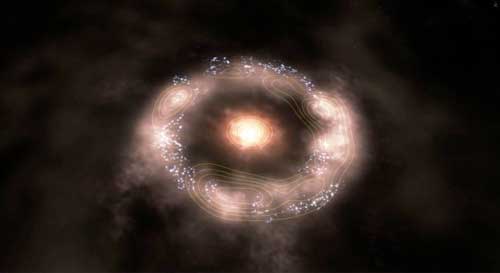
Why is massive star formation quenched in galaxy centers? (w/video)
A new study points to the role of the magnetic field as responsible for decelerating the formation of massive stars in the center of galaxies.
November 28, 2017 Read more
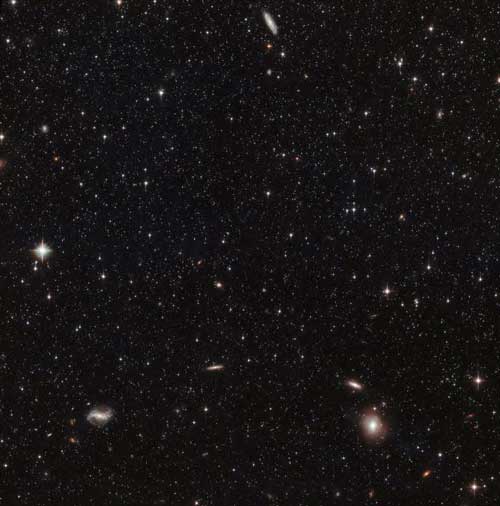
Hubble and Gaia team up to measure 3-D stellar motion with record-breaking precision
A team of astronomers used data from both the NASA/ESA Hubble Space Telescope and ESA's Gaia satellite to directly measure the 3D motions of individual stars in a nearby galaxy. The achieved accuracy is better than anything previously measured for a galaxy beyond the Milky Way.
November 27, 2017 Read more

You don't need to build a rocket to prove the Earth isn't flat - here's the simple science
Could 2,000 years of belief be wrong? Are we in fact living on a disc rather than a globe? One believer from the Flat Earth Society is determined to find out. 'Mad' Mike Hughes is all set to build his own rocket to see for himself that the Earth is flat.
November 27, 2017 Read more
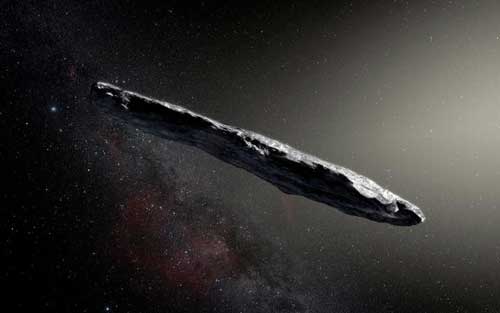
Observations show first interstellar asteroid is like nothing seen before
For the first time ever astronomers have studied an asteroid that has entered the Solar System from interstellar space. It appears to be a dark, reddish, highly-elongated rocky or high-metal-content object.
November 20, 2017 Read more
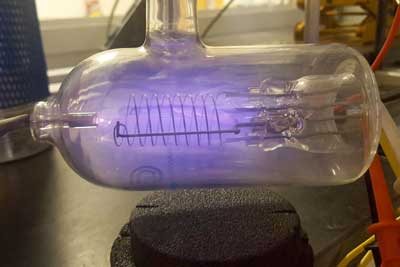
Heavy nitrogen molecules reveal planetary-scale tug-of-war
Nature whispers its stories in a faint molecular language, and scientists can finally tell one of those stories this week, thanks to a one-of-a-kind instrument that allowed them to hear what the atmosphere is saying with rare nitrogen molecules.
November 18, 2017 Read more
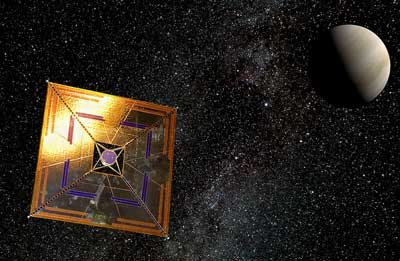
Interstellar space probes: Where's the brakes?
With a miniaturised space probe capable of being accelerated to a quarter of the speed of light, we could reach Alpha Centauri, our nearest star, in 20 to 50 years. However, without a mechanism to slow it down, the space probe could only collect data from the star and its planets as it zoomed past.
November 17, 2017 Read more
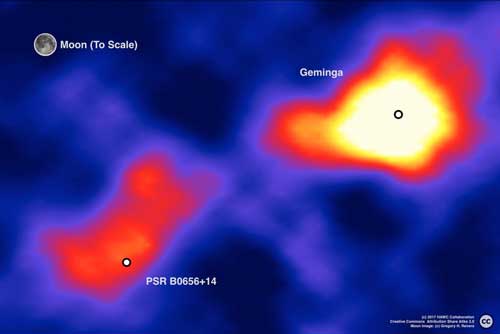
Nearby pulsars shed light on the antimatter puzzle
There are too many high-energy positrons in the cosmic rays reaching the Earth. These positrons could be being produced by pulsars in our vicinity. The most recent measurements have practically excluded this possibility, strengthening the competing and much more exotic hypothesis concerning the origin of the excess positrons.
November 17, 2017 Read more
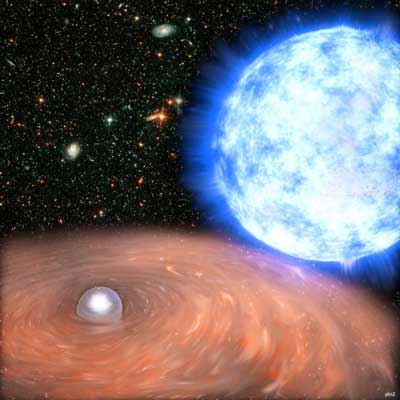
Contracting white dwarf observed for the first time
Astrophysicists have found the first observational evidence for a contracting white dwarf. Constant high spin-up rate of a star of this type, located in an enigmatic binary system, can be easily explained if the white dwarf is contracting.
November 14, 2017 Read more
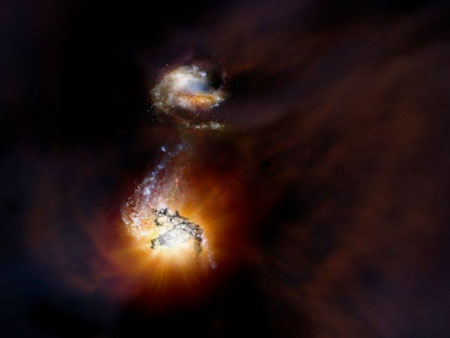
Duo of titanic galaxies captured in extreme starbursting merger
Pair of exceptionally rare hyper-luminous galaxies discovered with ALMA.
November 13, 2017 Read more
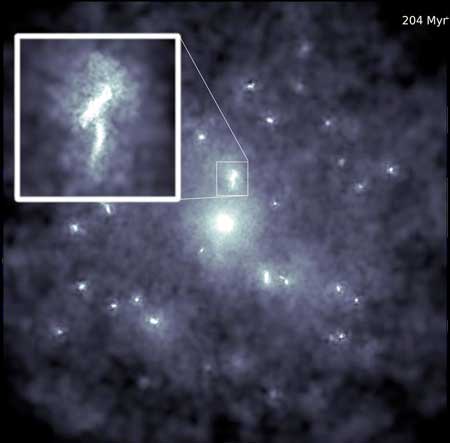
A 'cosmic snake' reveals the structure of remote galaxies
The formation of stars in distant galaxies is still largely unexplored. For the first time, astronomers have now been able to closely observe a star system six billion light-years away.
November 13, 2017 Read more
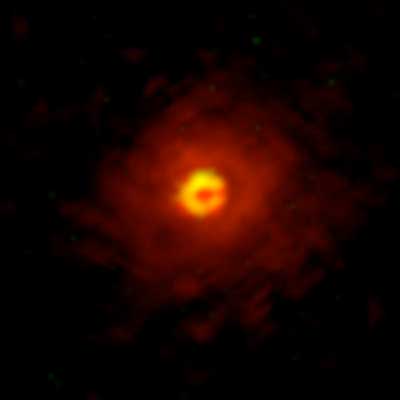
Winds blowing off a dying star
Stars like our Sun eject large amounts of gas and dust into space, containing various elements and compounds. Asymptotic giant branch -- AGB -- phase stars, near their end of life, are particularly significant sources of such substances in our galaxy.
November 10, 2017 Read more
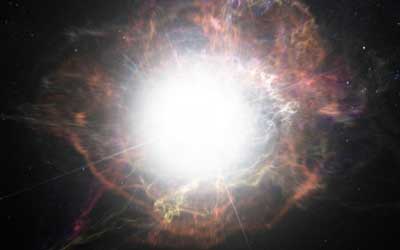
Star exploded, survived, and exploded again more than 50 years later
An international team of astronomers discovered a star that exploded multiple times over a period of 50 years.
November 8, 2017 Read more

Researchers model Coulomb crystals to understand star evolution
These calculations can be used to understand the thermal evolution of neutron stars and white dwarfs.
November 7, 2017 Read more

Using powerful new telescope astronomers observe one of the oldest objects in the universe
Astronomy team image one of the first massive galaxies to form, 12.8 billion years ago.
November 6, 2017 Read more

Forest of molecular signals in star forming galaxy
Astronomers observed the galaxy NGC 253 and for the first time, they resolved the locations of star formation in this galaxy down to the scale of a molecular cloud, which is a star formation site with a size of about 30 light-years.
November 6, 2017 Read more

ALMA discovers cold dust around nearest star
The ALMA Observatory has detected dust around Proxima Centauri. The data also hint at the presence of an outer dust belt and may indicate the presence of a planetary system. These structures are similar to the belts in the solar system and are expected to be made from rock and ice.
November 3, 2017 Read more

The inner secrets of planets and stars (w/video)
After a five-year, 1.74 billion-mile journey, NASA's Juno spacecraft entered Jupiter's orbit in July 2016, to begin its mission to collect data on the structure, atmosphere, and magnetic and gravitational fields of the mysterious planet.
November 1, 2017 Read more

New research looks at how 'cosmic web' of filaments alters star formation in galaxies
The National Science Foundation has granted $280,000 to an international collaboration that is investigating galaxies that extend along this 'cosmic web' of filaments.
November 1, 2017 Read more