

Nanotechnology News – Latest Headlines
New aerogels could clean contaminated water, purify hydrogen for fuel cells
Scientists have identified a new technique for cleansing contaminated water and potentially purifying hydrogen for use in fuel cells, thanks to the discovery of a innovative type of porous material.
July 30, 2007 Read more
The story of a nanotechnology start-up
A TV interview with the founder of Midatech, a nanoparticle manufacturer.
July 30, 2007 Read more
Graphene sniffs out dangerous molecules
Researchers have used the world's thinnest material to create sensors that can detect just a single molecule of a toxic gas.
July 30, 2007 Read more
New joint venture for nanotechnology water and process treatments
New company will create products with nano-features for industrial markets.
July 30, 2007 Read more
New technique to 'see' and protect transplants successful in diabetic animal model
Researchers have found a way to overcome a major stumbling block to developing successful insulin-cell transplants for people with type I diabetes, encapsulating them in spheres with nanoscale pores.
July 29, 2007 Read more
Nanotechnology in construction engineering research grants
The German Federal Ministry for Education and Research (BMBF) has issued a call for research projects that deal with nanotechnology applications in the construction industry.
July 28, 2007 Read more
How to deal with nanotechnology waste
A new report presents the most comprehensive analysis to-date of two key Environmental Protection Agency laws that regulate the end-of-life management of nanotechnology.
July 27, 2007 Read more
FDA nanotechnology task force report available for download
The U.S. Food and Drug Administration yesterday released a report that recommends the agency consider developing guidance and taking other steps to address the benefits and risks of drugs and medical devices using nanotechnology.
July 26, 2007 Read more
Hidden order found in a quantum spin liquid
A newly detected, hidden "string order" that extends over a length of 30 nanometers in a material that is otherwise apparently disordered, could have implications for the design of materials at the nanoscale, including those used for a developing concept known as quantum computing.
July 26, 2007 Read more
New technique may speed development of molecular electronics
To produce materials for modern electronics, small amounts of impurities are introduced into silicon - a process called doping. Scientists recently succeeded in being the first to implement doping in the field of molecular electronics.
July 26, 2007 Read more
California NanoSystems Institute industry collaboration on nanobiotechnology research
The California NanoSystems Institute at UCLA today announced a partnership with the integrated global biopharmaceutical company Abraxis BioScience Inc. to collaborate on nanobiotechnology research for the advancement of new technologies in medicine.
July 26, 2007 Read more
Nanoscale clay creates fire resistant hard wearing latex emulsion paints
Researchers have found a way of replacing the soap used to stabilize latex emulsion paints with nanoscale clay armour that can create a much more hard wearing and fire resistant paint.
July 26, 2007 Read more
The future of medicine: Insert chip, cure disease?
Imagine a chip, strategically placed in the brain, that could prevent epileptic seizures or allow someone who has lost a limb to control an artificial arm just by thinking about it.
July 25, 2007 Read more
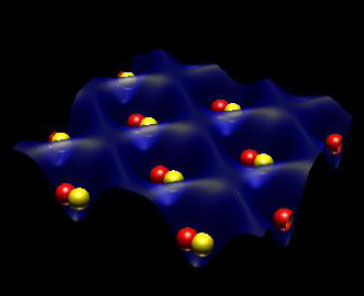
Thousands of atoms swap 'spins' with partners in quantum square dance
Advance is step toward quantum computing with neutral atoms.
July 25, 2007 Read more
Graphene oxide paper could spawn a new class of materials
Researchers have fabricated a new type of paper that they hope will create a revolution of its own - and while it won't replace your notepad, this remarkably stiff and strong yet lightweight material should find use in a wide variety of applications.
July 25, 2007 Read more
FDA sees no need for additional nanotechnology labelling
Food, drugs, medical devices and cosmetics that contain minuscule engineered particles don't necessarily need special labeling to alert consumers, a federal task force recommends.
July 25, 2007 Read more
 Subscribe to our Nanotechnology News feed