

Nanotechnology News – Latest Headlines
Forschungsstrategie Nanotechnologie erarbeitet
Die Bundesanstalt f. Arbeitsschutz und Arbeitsmedizin (BAuA), das Bundesinstitut f. Risikobewertung (BfR) und das Umweltbundesamt (UBA) haben eine gemeinsame Forschungsstrategie 'Nanotechnologie: Gesundheits- und Umweltrisiken von Nanopartikeln' erarbeitet.
February 29, 2008 Read more
Biomagnetics developed for use in new breast cancer tests
A team from University College London has developed a new medical device which will make the early detection of breast cancer more cost effective and easier to administer. The team plans to use magnetic nanoparticles and an extremely sensitive magnetometer called the 'HistoMag' to detect cancerous cells in samples of breast tissue.
February 29, 2008 Read more
Diatom research reveals possible climate solutions
The research of tiny microscopic cells is changing the way people look at the environment and nanotechnology.
February 29, 2008 Read more
Prof posits metananocircuits as electronics' next frontier
A University of Pennsylvania professor is exploring an approach to nanotechnology that will allow circuit theory to operate in an entirely new regime - one where 'current' is no longer defined as the movement of electrons and holes, but instead as an electromagnetic wave.
February 29, 2008 Read more
Bionic implants raise ethical questions
Australian researchers trying to regrow damaged spinal cords with tiny bionic implants are seeing for the first time what's happening at the nanoscale.
February 29, 2008 Read more
China's top 10 events in basic research in 2007
Under the joint auspices of the Ministry of Sciences & Technology (MOST) and China Association for Science & Technology, more than 1,600 Chinese scholars including CAS and CAE members, chief scientists of the National Basic Research Program (dubbed 973 Program) and directors of national key labs, have voted for China's top 10 events basic research in 2007.
February 29, 2008 Read more
$2 billion Indiana military technical center taps world-class university firepower
Have more than a casual interest to work on fuel cells, fiber lasers, hyper-spectral imagers, threat device detection or SIGINT, ELINT, MASINT and HUMINT technology? These and other needs were on deck at what was described as an 'unprecedented gathering' on Feb. 20: the first-annual NSWC Crane University Summit.
February 29, 2008 Read more
Breakthroughs in nanotechnology on edge of 'knowledge frontier'
University of Missouri scientist Kattesh Katti recently discovered how to make gold nanoparticles using gold salts, soybeans and water. Katti's research has garnered attention worldwide and the environmentally-friendly discovery could have major applications in several disciplines.
February 28, 2008 Read more
Single particles of light are now for sale
The world's first commercial source of individual photons (particles of light) using diamond based quantum technology has been developed by Quantum Communications Victoria (QCV) within the School of Physics at The University of Melbourne, Australia.
February 28, 2008 Read more
New method for creating tough metallic glass composites
Scientists at the California Institute of Technology have developed a new strategy for creating 'liquid metal' that makes it able to bend significantly without breaking, while retaining a strength twice that of titanium. It is among the toughest, or least brittle, known materials, and could be used anywhere that strong metal alloys are traditionally found, but may prove most useful in the aerospace industry, where lower density means fuel savings.
February 28, 2008 Read more
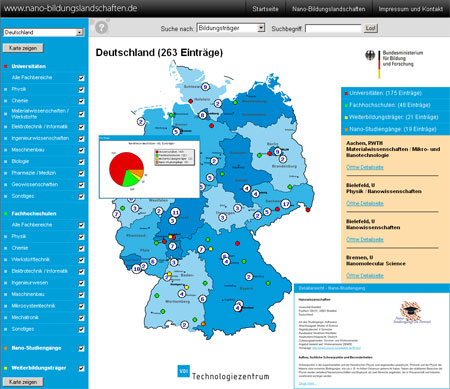
Nanotechnologie in Deutschland studieren - Angebote interaktiv und kartografisch abrufbar
Beste Karrierechancen eroeffnet eine berufliche Ausrichtung auf Nanotechnologie. Mittels kartografisch und interaktiv abrufbarer Nano-Bildungsangebote spricht das Bundesministerium fuer Bildung und Forschung gezielt Jugendliche an und zeigt Einstiegsmoeglichkeiten in dieses chancenreiche Innovationsfeld.
February 28, 2008 Read more
Nanotechnology: An insurer's perspective
February's Feature Article over at the Safenano website comes from David Baxter, Lead Researcher on Emerging Risks for Lloyd's of London. In this article, David introduces the concept of insuring new technologies, and discusses the issues presented to the insurance industry by nanotechnology.
February 28, 2008 Read more
Nanotechnology at the OECD
The OECD has prepared an overview of its work on nanotechnologies for Forum VI of the Intergovernmental Forum on Chemical Safety (IFCS). This event will be held in Dakar, Senegal, September 15-19, 2008.
February 28, 2008 Read more
COMSTECH to hold workshop on nanomedicine, bioethics education
The Organization of Islamic Conference Standing Committee on Scientific and Technological Cooperation (COMSTECH) is organizing a week-long international workshop on nanomedicine from March 13-20.
February 28, 2008 Read more
Magnetic atoms of gold, silver and copper have been obtained
An international team led by Physics and Chemistry teams from the Faculty of Science and Technology at the University of the Basque Country has achieved, by means of a controlled chemical process, that atoms of gold, silver and copper - intrinsically non-magnetic - become magnetic.
February 28, 2008 Read more
Finland is preparing for cleantech era
Energy & Enviro Finland describes some examples of Finnish research efforts and success stories on clean energy and environmental technology development. Many of the projects are creating know-how and technologies which can be utilized in combating climate change - globally.
February 28, 2008 Read more
 Subscribe to our Nanotechnology News feed