
| Posted: Jun 21, 2006 | |
Achieving higher spacial resolution with apertureless optical near-field probes |
|
| (Nanowerk Spotlight) Cantilever based back-illuminated full body glass tips with thin metal layers can be used as apertureless optical near-field probes with single molecule sensitivity and optical resolutions down to 15 nm exceeding by far the classical diffraction limit of Abbé. | |
| In the early 1870s, the German physicist Ernst Karl Abbé formulated a rigorous criterion for being able to resolve two objects in a light microscope. According to his equation, the best resolution achievable with visible light is about 200 nanometers. | |
| With the first theoretical work on a new technique called "scanning near-field optical microscopy" (SNOM) appearing in the 1980's Abbé's classical diffraction limit was overcome, and optical resolution of < 50 nm can be achieved. SNOM strives for the highest optical resolution and simultaneously provides optical and topographical information. | |
| Researchers at the BioPhysics & Applied Nanosciences department (Prof. Dr. D. Anselmetti) at Bielefeld University, and the Fraunhofer Institute for Physical Measurement Techniques, both in Germany, recently published a paper that reports that high resolution single molecule fluorescence SNOM imaging is possible at an optical resolution of 15 nm with optimized, apertureless and back illuminated metal coated full body glass tips. The paper, titled "Optimized apertureless optical near-field probes with 15 nm optical resolution" was published in the June 5, 2006 online edition of Nanotechnology. | |
| "Efficient and successful SNOM fluorescence imaging of single dye molecules combines high optical intensities, high signal-to noise ratio and high spatial resolution" says Dr. Robert Ros, one of the authors of the paper explains to Nanowerk. "In conventional fiber-optic SNOM, where light confinement is realized with a nanometer-sized aperture in a metal coated fiber tip, these issues are very difficult to combine, since a small aperture (<50 nm) is normally characterized by an extremely low light throughput." | |
| The approach for high resolution fluorescence imaging investigated by the German researchers uses optical cantilever probes with an integrated and completely metal coated full body glass tip, which are illuminated from the back side. | |
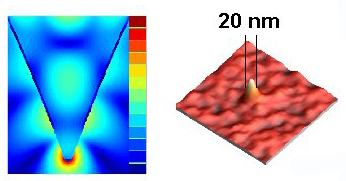 | |
| Apertureless SNOM setup and single dye molecule imaged at 20 nm optical resolution. (Source: Bielefeld University) | |
| "It has already been shown that such probes can be used for fluorescence near-field imaging" says Ros. "What we succeeded achieving was higher spatial resolution by optimizing illumination conditions and metal layer thickness. We demonstrated that very thin and optimized metal layers allow a good background suppression - in the case of aluminum a layer thickness of only 10-15nm is already sufficient." | |
| In their work, the researchers determined the optimal coating thicknesses to be about 10–15 nm for aluminum and 15–25 nm for silver. "In addition, we found a subtle dependence of the observed single molecule fluorescence pattern on the illumination conditions, which indicate the involvement of plasmon-coupled electric field tip enhancement as predicted in theoretical considerations" says Ros. | |
| Interesting for potential industrial applications is that, due to the fact that these novel optical probes do not rely on the fabrication of a reproducible and very critical nanometer-sizes aperture, these near-field probes can be fabricated rather simply in a batch fabrication process. | |
 By
Michael
Berger
– Michael is author of three books by the Royal Society of Chemistry:
Nano-Society: Pushing the Boundaries of Technology,
Nanotechnology: The Future is Tiny, and
Nanoengineering: The Skills and Tools Making Technology Invisible
Copyright ©
Nanowerk LLC
By
Michael
Berger
– Michael is author of three books by the Royal Society of Chemistry:
Nano-Society: Pushing the Boundaries of Technology,
Nanotechnology: The Future is Tiny, and
Nanoengineering: The Skills and Tools Making Technology Invisible
Copyright ©
Nanowerk LLC
|
Become a Spotlight guest author! Join our large and growing group of guest contributors. Have you just published a scientific paper or have other exciting developments to share with the nanotechnology community? Here is how to publish on nanowerk.com.