
| Posted: Jun 19, 2006 | |
Electrochromic devices based on tungsten oxide |
|
| (Nanowerk Spotlight) Switchable materials exhibit reversible optical change in the visible region when they are subjected to UV-visible light, heat or charge injection-extraction respectively. These abilities are known as photochromism, thermochromism and electrochromism. Electrochromic (EC) materials allow easy user control and have the widest range of application. They can be used not only for "smart windows" in buildings and cars, but also in information displays, eyewear, and in many other applications. | |
| An electrochromic display is one of the most attractive candidates for paper-like displays, so called electronic paper, which will be the next generation display, owing to attributes such as thin and flexible materials, low-power consumption, and fast switching times. | |
 |
|
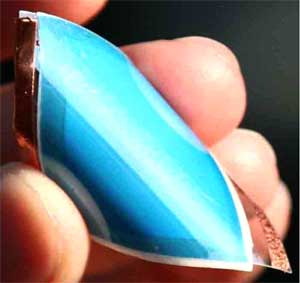
| Transition metal oxide nanowire based flexible electrochromic devices. (Image: National Tsing Hua University) | |
| In the past, electrochromic devices (ECD) were made of film and they had the drawback of a long transition time. Several researchers, like Gratzel, who used TiO2 nanoparticles and absorbed organic monomers to improve the transition time, and Kim et al., who developed array structured PEDOT nanotubes to provide an attractive solution to slow switching rates and extent of coloration, have attempted to employ nanotechnology to improve this drawback. | |
| Inorganic materials usually have better lifetime and UV stability than organic materials. This prompted us to develop a transition metal oxide nanowire (TMONWs) based ECD. | |
| We developed a simple methodto fabricate such TMONWs based ECDs. Among the various transition metal oxides exhibiting electrochromism, tungsten oxide is found to be the most efficient candidate. | |
| The electrochromic performance of tungsten oxide, reversible coloration under double injection of ions and electrons, depends strongly on its nature and structure. Our group published a paper, titled "WO3-x nanowires based electrochromic devices" in the May 5, 2006 online edition of Solar Energy Materials & Solar Cells. The WO3-x nanowires are grown directly from tungsten oxide powders in a tube furnace. They have diameters ranging from 30 nm to 70 nm and lengths up to several micrometers. The WO3-x nanowire based device has short bleach-coloration transition time and can be grown in a large scale directly onto an ITO coated glass that gives it potential for many electrochromic applications. | |
| By Dr. Chia-Ching Liao, Department of Engineering and System Science, National Tsing Hua University, Hsinchu, Taiwan |
Become a Spotlight guest author! Join our large and growing group of guest contributors. Have you just published a scientific paper or have other exciting developments to share with the nanotechnology community? Here is how to publish on nanowerk.com.