
| Posted: Jun 16, 2006 | |
Vibrational in situ analysis of individual molecules |
|
| (Nanowerk Spotlight) Single molecule Raman spectroscopy of molecules on metal surfaces was achieved by means of optical field-enhancement from a scanning probe tip. This was made possible by the optical antenna configuration formed by optical coupling between metallic tip and the substrate. | |
| Dr. Markus B. Raschke and his group at the Max Born Institute for Nonlinear Optics and Short Pulse Spectroscopy in Berlin, Germany, are researching the optical antenna properties of metallic nanostructures. Their capabilities to concentrate and locally enhance optical fields is explored and applied for scanning probe optical near-field microscopy with ultrahigh spatial resolution down to the several nanometer range and single molecule sensitivity. Their recent work, titled "Scanning-probe Raman spectroscopy with single-molecule sensitivity" was published in the May 23, 2006 issue of Physical Review B. For a related paper on a combined theoretical-experimental study on that subject, see "Resonant-plasmon field enhancement from asymmetrically illuminated conical metallic-probe tips", published in the April 3, 2006 issue of The Virtual Journal for Biomedical Optics | |
| So far, the detection of individual molecules is largely based on their fluorescence properties. Relying on the molecular electronic transition, this limits the chemical specificity that can be obtained. In contrast, the vibrational Raman signature can provide rich structural information and the discovery of single-molecule sensitivity in surface enhanced Raman scattering (SERS) seemed particularly promising. | |
| "Previously" Raschke explains his group's findings to Nanowerk, "single molecule vibrational spectroscopy was restricted to SERS, taking advantage of the large local field enhancement at rough metal surfaces or colloidal aggregates at often poorly defined 'hot spots'. In our study, no special substrates are required with the molecules adsorbed on a planar surface. In addition, being a scanning probe method, the molecules can be addressed selectively with a spatial resolution of 10 nm or better." | |
| By combining optical vibrational spectroscopy with high resolution scanning probe methods the German researchers were able to determine the chemical identity of matter on a length scale previously inaccessible. This provides access to optical probing, e.g., of biomolecular or polymer surfaces with ultrahigh spatial resolution. | |
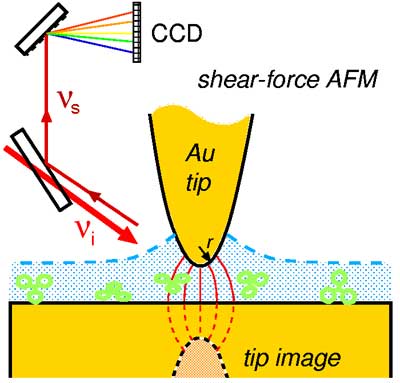 |
Probing the tip-scattered and -enhanced Raman response applying a side-on confocal epi-illumination and detection geometry. The plasmon resonance of the tip is selected to provide strongly localized and enhanced pump νi and Stokes Raman fields νs at the tip apex. (Source: Max Born Institute) |
| The plasmonic coupling between the scanning probe tip and a metallic sample can be tuned to provide sufficient field enhancement to allow for probing a single molecule Raman response. With the nanometer spatial localization and a Raman enhancement up to 1010 this combines high resolution scanning probe microscopy with ultrasensitive in situ analysis of individual molecular structures on planar and arbitrary metal surfaces. | |
| "Our experiments open new possibilities for vibrational nanospectroscopy of individual chemical and biological structures" says Raschke, "however, for routine applications of this technique we still need to further develop our instruments." | |
 By
Michael
Berger
– Michael is author of three books by the Royal Society of Chemistry:
Nano-Society: Pushing the Boundaries of Technology,
Nanotechnology: The Future is Tiny, and
Nanoengineering: The Skills and Tools Making Technology Invisible
Copyright ©
Nanowerk LLC
By
Michael
Berger
– Michael is author of three books by the Royal Society of Chemistry:
Nano-Society: Pushing the Boundaries of Technology,
Nanotechnology: The Future is Tiny, and
Nanoengineering: The Skills and Tools Making Technology Invisible
Copyright ©
Nanowerk LLC
|
|
Become a Spotlight guest author! Join our large and growing group of guest contributors. Have you just published a scientific paper or have other exciting developments to share with the nanotechnology community? Here is how to publish on nanowerk.com.