
| Posted: May 31, 2006 | |
Single molecule Kondo switch |
|
| (Nanowerk Spotlight) A recent study shows that just by changing a molecule's structure — without altering its chemical composition – can lead to a variation in the spin-electron interaction strength, and consequently the associated Kondo temperatures. | |
| In a combination of two recent hot pursuit research areas, single molecule switching and molecular spintronics, researchers at the Nanoscale & Quantum Phenomena Institute at Ohio University showed that the two different Kondo temperatures can be changed via a single molecule switching mechanism. The results were reported in a recent paper, titled "Manipulating Kondo Temperature via Single Molecule Switching" published in the March 14, 2006 online edition of Nano Letters. | |
| Professor Saw-Wai Hla explained his group's findings to Nanowerk: "This is the first time that a single molecule conformation switching has been shown to change two Kondo temperatures, from 130°K to 170°K." | |
 |
|
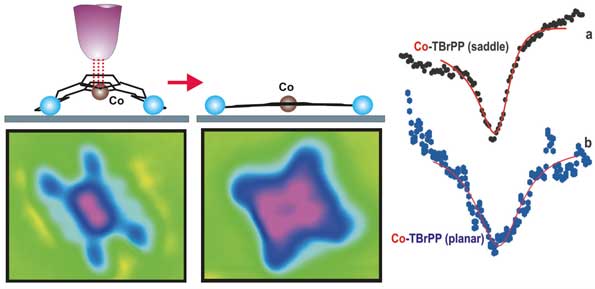
| Molecular conformations. (left) STM images of saddle conformation (width 11 Â, length 18 Â) and (right) planar conformation (length 15.5 Â) of TBrPP-Co on Cu(111) with the corresponding models of saddle and planar conformation above. The curves on the right show the Kondo signatures. (a) A conductance spectrum of the saddle TBrPP-Co molecules showing a dip (Kondo resonance) around surface Fermi level (0 V). The solid line represents the Fano line-shape fit to the data. (b) The width of the Kondo resonance increases in the dI/dV spectra of planar TBrPP-Co molecules, which corresponds to an increase in Kondo temperature. (Source: Prof. Hla, Ohio University) | |
| Hla describes how with the technological advances in nanoscale fabrication, the Kondo effect has seen a revival of interest in recent years and has been observed in a wide variety of systems, ranging from semiconductor quantum dots to single atoms to carbon nanotubes. | |
| "Among them, molecules exhibiting magnetic properties are of special interest to investigate the spin-electron interaction because of their potential in spintronic applications" says Hla. | |
| "Our work opens an entirely new research route in molecular spintronics, where we are currently exploring how the environment of an organic molecule can change spin behavior of caged magnetic atoms"says Hla. | |
| For their experiments, the researchers anchored TBrPP-Co molecules on a Cu(111) surface via their four bromine atoms positioning at the 3-fold hollow sites of the copper surface and form two molecular conformations: the saddle and the planar. Metallotetraphenylporphyrin molecules are known to have several conformations including the saddle and planar both in gas phase and in solutions. | |
| The distortion (saddling) of the molecule can be removed by applying a burst of voltage pulses from an STM tip, which supplies the necessary energy to switch the molecule from the saddle to the planar conformation. The molecule remains intact after switching. | |
| "We measured the Kondo signatures before and after the switching events" says Hla. "The resultant Kondo temperature of saddle TBrPP-Co at 4.6 K is 130°K +/-15°K. The width of Kondo resonance increases for the planar TBrPP-Co, and the corresponding Kondo temperature is determined as 170°K +/- 10°K." | |
| A possible application for this research is for the Kondo switches to be used as molecular memory devices. Molecules can self-assemble on surfaces. | |
| "I could imagine that one would write the data by switching the molecular conformations inside 2-D arrays of molecules, and eventually retrieve the data from their Kondo temperatures" Hla explains. "We are one of only a few research groups having expertise in single atom/molecule manipulations. Naturally, we would like to apply our STM manipulation techniques to investigate spintronic behaviors of magnetic molecules on metal surfaces at an atomic level." | |
 By
Michael
Berger
– Michael is author of three books by the Royal Society of Chemistry:
Nano-Society: Pushing the Boundaries of Technology,
Nanotechnology: The Future is Tiny, and
Nanoengineering: The Skills and Tools Making Technology Invisible
Copyright ©
Nanowerk LLC
By
Michael
Berger
– Michael is author of three books by the Royal Society of Chemistry:
Nano-Society: Pushing the Boundaries of Technology,
Nanotechnology: The Future is Tiny, and
Nanoengineering: The Skills and Tools Making Technology Invisible
Copyright ©
Nanowerk LLC
|
Become a Spotlight guest author! Join our large and growing group of guest contributors. Have you just published a scientific paper or have other exciting developments to share with the nanotechnology community? Here is how to publish on nanowerk.com.