Using gold nanoparticles to find cancerous toxicant in agricultural products
Researchers used gold nanoparticles in the production of a detection kit to find cancerous toxicant in agricultural products.
Jan 5th, 2015
Read more
Researchers used gold nanoparticles in the production of a detection kit to find cancerous toxicant in agricultural products.
Jan 5th, 2015
Read more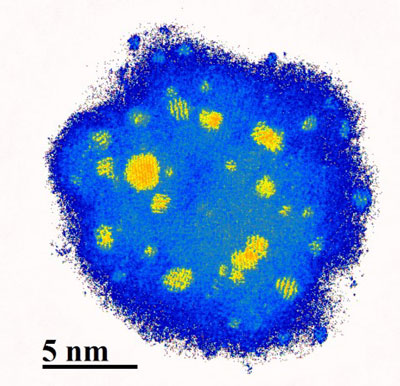 The Nanoparticles by Design Unit at the Okinawa Institute of Science and Technology Graduate University is constantly finding new ways to endow the tiniest of particles with more specific properties.
Jan 5th, 2015
Read more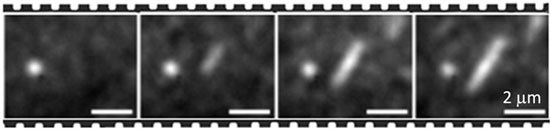 Ebola virus, Alzheimer's amyloid fibrils, tissue collagen scaffolds and cellular cytoskeleton are all filamentous structures that spontaneously assemble from individual proteins.
Jan 5th, 2015
Read more One of the goals of Cimav specialists is to develop biomedical implants needed in Mexico, as the ones existing in the domestic market are usually manufactured abroad.
Jan 5th, 2015
Read moreResearchers created a tri-component, synthetic graft for reconstructing torn anterior cruciate ligaments.
Dec 30th, 2014
Read more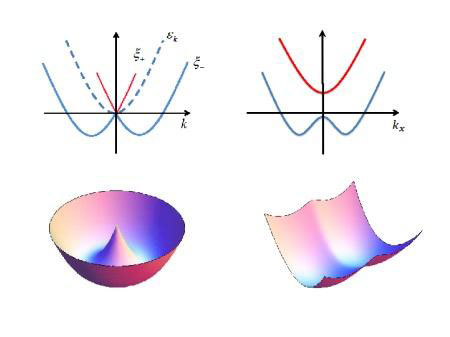 Scientists have reviewed the recent theoretical studies on various novel pairing superfluid phases in spin-orbit coupled ultracold Fermi gases. They showed that spin-orbit coupling modifies the single-particle spectra, which gives rise to exotic few-body correlations and interesting pairing states.
Dec 30th, 2014
Read moreIn a world-first achievement, scientists have developed a new hydrogel whose properties are dominated by electrostatic repulsion, rather than attractive interactions.
Dec 30th, 2014
Read more As part of its extensive education and outreach activities, Europe's Graphene Flagship will soon stage a second Graphene Study week. This will take place from 23-28 March 2015 in Kaprun, Austria.
Dec 30th, 2014
Read more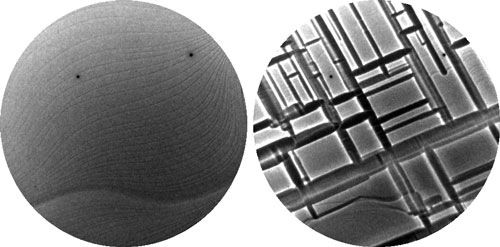 A new study reveals that certain features of metal surfaces can stop the process of oxidation in its tracks. The findings could be relevant to understanding and perhaps controlling oxidation in a wide range of materials.
Dec 29th, 2014
Read moreScientists have developed an extremely sensitive yet simple motion detector that can be built easily by adapting already-existent technology. The system has proven accurate with detecting bacteria, yeast, and even cancer cells, and is considered for the rapid testing of drugs and even the detection of extraterrestrial life.
Dec 29th, 2014
Read moreIn a pioneering study, researchers were able to discover half-light, half-matter particles in atomically thin semiconductors consisting of two-dimensional layer of molybdenum and sulfur atoms arranged similar to graphene.
Dec 29th, 2014
Read more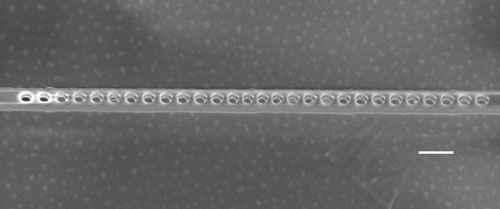 Precisely placing imperfections called 'nitrogen vacancy centers' within nano-sized diamond structures can boost their fluorescence, a key step toward using the defects in future quantum computers.
Dec 29th, 2014
Read more Gelatin is used in the pharmaceutical industry to encapsulate active agents. It protects against oxidation and overly quick release. Nanopores in the material have a significant influence on this, yet they are difficult to investigate. In experiments on gummy bears, researchers have now transferred a methodology to determine the free volume of gelatin preparations.
Dec 29th, 2014
Read more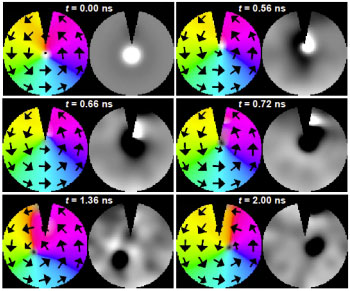 Magnetic vortices in thin films can encode information in the perpendicular magnetization pointing up or down relative to the vortex core. These binary states could be useful for non-volatile data storage devices such as RAM memories, but the switching between them must be fast and energy-efficient.
Dec 24th, 2014
Read more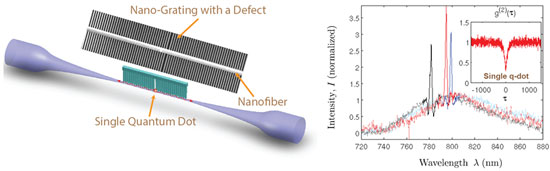 Integrating quantum light sources e.g. single quantum dot / single atom, into specially designed nanofibers holds the potential to revolutionize distributed quantum networks for secure, ultra-high speed communication.
Dec 24th, 2014
Read more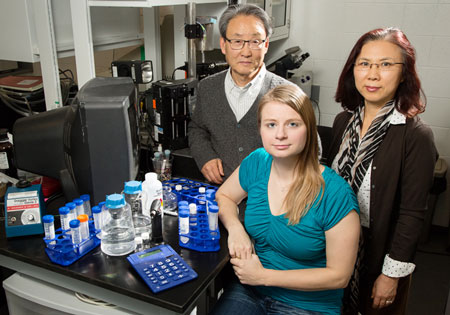 Stroke victims could have more time to seek treatment that could reduce harmful effects on the brain, thanks to tiny blobs of gelatin that could deliver the medication to the brain noninvasively.
Dec 24th, 2014
Read more Subscribe to our Nanotechnology News feed