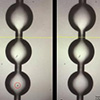
 Researchers have developed an acoustic trapping chip that can provide three-dimensional (3D) trapping of cells in a continuously flowing medium with a circular resonance structure.
Oct 13th, 2023
Read more
 An international team has uncovered details about the formation of DNA's building blocks, paving the way for potential medical and therapeutic applications.
Oct 12th, 2023
Read more
 Imagine a life form that doesn't resemble any of the organisms found on the tree of life. One that has its own unique control system, and that a doctor would want to send into your body. It sounds like a science fiction movie, but according to nanoscientists, it can - and should - happen in the future.
Oct 5th, 2023
Read more
 Imagine a device smaller than a toddler's shoebox that can simulate any human disease in multiple organs or test new drugs without ever entering - or harming - the body.
Oct 3rd, 2023
Read more
 Researchers have combined painless microneedles with nanoscale sensors to create a wearable sensor patch capable of continuously monitoring the levels of one of these antibiotics.
Oct 3rd, 2023
Read more
 Researchers have pushed forward the boundaries of biomedical engineering one hundredfold with a new method for DNA detection with unprecedented sensitivity.
Oct 3rd, 2023
Read more
 By focusing on causal relationships in genome regulation, a new AI method could help scientists identify new immunotherapy techniques or regenerative therapies.
Oct 2nd, 2023
Read more
 Rresearchers have genetically engineered two synthetic bacteria they say can help turn plastic waste into more useful chemicals. The two bacteria strains can process the common plastic polyethylene terephthalate and create terephthalic acid and ethylene glycol. These two products can then be used in the production of materials used in insulators, foams, coatings, adhesives and nylon.
Sep 26th, 2023
Read more
 Researchers have developed the first method to uncover the tasks that microRNAs perform in single cells. This is a huge improvement over existing state-of-the-art methods that require millions of cells and will for the first time allow researchers to study microRNAs in complex tissues such as brains.
Sep 21st, 2023
Read more
 Researchers have developed a method to transport proteins through a nanopore, which allows sequencing of proteins in a simple, handheld device.
Sep 20th, 2023
Read more
 The complete, day 14 synthetic models may open new avenues of research into infertility, drug testing and growth of tissues for transplant - as well as help scientists peer into the dramatic first weeks of embryonic development.
Sep 15th, 2023
Read more
 The research can help unlock answers around how cells assemble themselves during embryonic development and what happens when this fundamental process goes awry.
Sep 14th, 2023
Read more
 Researchers propose the development of low-cost universal platforms for early cancer screening.
Sep 8th, 2023
Read more
 Researchers applied a new technology to generate the full inventory of mutations in the bacterial species Escherichia coli where the antibiotic rifampicin attaches to and disables an essential bacterial enzyme known as RNA polymerase (RNAP).
Aug 30th, 2023
Read more
 Scientists have developed a specially formulated bioink, which contains microparticles engineered for sustained delivery of insulin-like growth factor-1 (IGF-1). This delivery enhances the formation of mature skeletal muscle tissue from muscle precursor cells.
Aug 29th, 2023
Read more
 A new study highlights the potential of artificial DNA structures that, when fitted with antibodies, instruct the immune system to specifically target cancerous cells.
Aug 18th, 2023
Read more
 Scientists have developed a dynamic DNA-crosslinked matrix (DyNAtrix) by combining classical synthetic polymers with programmable DNA crosslinkers.
Aug 15th, 2023
Read more
 Advanced biosensor leverages gene swapping to identify colon cancer.
Aug 12th, 2023
Read more

 Subscribe to our Biotechnology News feed